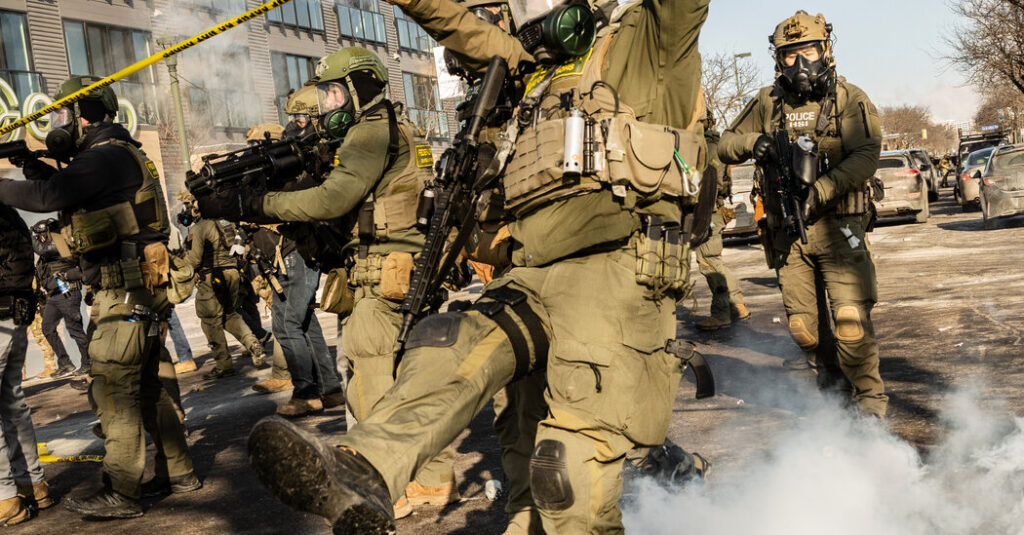
The big news in the United States over the weekend was the fatal shooting of a 37-year-old American citizen in Minneapolis by federal agents. Alex Pretti was the second civilian to be killed this month during an aggressive immigration crackdown. Videos show he was restrained when he was shot. Trump administration officials have rushed to smear him as a terrorist labeled him a terrorist; videos show he was restrained before he was shot. We have the latest coverage of the developing story below.
Separately, I spoke with A.G. Sulzberger, publisher of The New York Times, about threats to press freedom from the Trump administration.
Another deadly shooting in Minneapolis
For the second time this month, federal agents shot and killed a civilian in Minneapolis, and then blocked access to the scene. Here’s the latest.
The victim, a 37-year-old man named Alex Pretti, was filming on his phone and trying to help a fellow protester on Saturday morning when several agents wrestled him to the ground and restrained him. Then they shot him multiple times. You can watch what happened here. (A warning that it’s disturbing.)
The Trump administration claimed that Pretti, a nurse at the city’s veterans hospital, had approached the federal agents with a handgun and the intent to “massacre” them. But eyewitness video footage quickly emerged indicating that Pretti never drew his concealed pistol, and had already been disarmed when he was killed.
His death prompted large protests across the U.S., and led to a remarkable clash: Federal authorities have blocked state and local investigators from the crime scene. A judge issued a late-night order barring federal officials from destroying evidence, as the Trump administration repeated baseless accusations against the victim.
Pretti was a U.S. citizen with no known criminal record who held a legal permit to carry a firearm. Neighbors and colleagues at the hospital described him as passionate and kindhearted. The Minneapolis chief of police, Brian O’Hara, said Pretti had appeared to be “exercising his First Amendment rights to record law enforcement activity, and also exercising his Second Amendment rights to lawfully be armed in a public space in the city.”
More from Minneapolis:
-
This timeline shows how the shooting unfolded in a matter of seconds.
-
My colleague Charles Homans has spent the past 10 days in his native city covering what he calls “the great American unraveling.”
A world hostile to reporting
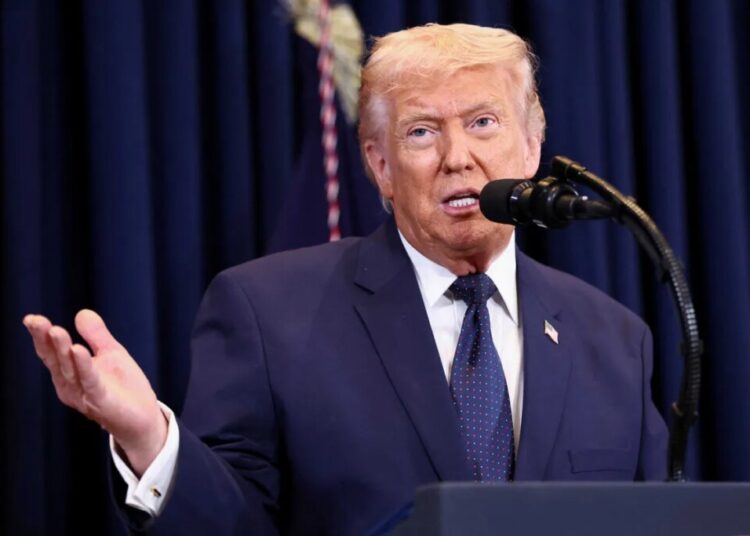
Events like the shooting in Minneapolis, in which eyewitness video and independent reporting contradict the government’s account, only highlight the importance of press freedom.
Earlier this month, the F.B.I. searched the home of a Washington Post reporter and seized her phone, laptops and other devices. We’re used to reading about governments going after journalists in places like China, Russia or Turkey. This took place in the U.S.
The job of journalists is to hold the powerful to account on behalf of the public. That job is becoming harder. The economics of journalism have been tough for a couple of decades. But the most immediate threat comes from attacks on press freedom by the U.S. government and the president himself. The New York Times has been the target of multiple lawsuits from President Trump over the past five years.
I spoke to the man who has been leading The Times through this new era: our publisher, A.G. Sulzberger.
A.G., U.S. press freedom is under attack from the Trump administration. Talk me through its playbook.
The First Amendment of the American Constitution offers the press some of the most robust protections in the world. The architects of the Constitution understood that a healthy democracy depends on an informed public, and an informed public depends on a free press.
In defiance of that ideal, which has long enjoyed bipartisan support, President Trump has borrowed many of the anti-press tactics used by authoritarian-minded leaders abroad. He has spent years attacking journalists and news organizations. He has sued a number of U.S. news organizations, including The New York Times, and has extracted large financial settlements from some.
His administration has aggressively used other levers of power — from access to the Pentagon to regulatory and investigative oversight — to punish news organizations for writing things they don’t like, or reward those willing to parrot administration talking points. Sadly, there is growing evidence that, in response to this pressure, certain news organizations have, at times, self-censored for fear of retaliation.
How do these attacks compare with past administrations coming after The New York Times?
Trump has been far more aggressive in working to undermine the rights and legitimacy of the press than his recent predecessors.
But every president has complaints about the people covering their administrations. Kennedy tried to get The Times to reassign our reporter in Vietnam because he was revealing how badly the war was going. Bush warned us that if we exposed his campaign of illegal wiretapping on Americans we’d have blood on our hands. Biden was so incensed with our coverage, including our reporting on questions about his age and fitness, that he became the first president in close to a century not to do a single interview with The Times.
The lesson from all of those examples is clear: We must continue reporting the facts and bringing what we find to the public, regardless of what pressure we might face.
Times reporters already do journalism in many countries where press freedoms have been gutted or were never established. Does that help us now?
The world as a whole has gotten much less hospitable to independent reporting. There are a growing number of places where journalists face arrest or violence for writing pieces that challenge the government. Russia, China and Iran are the most obvious examples. Israel has killed a huge number of Palestinian journalists in Gaza and banned foreign journalists from operating freely there for more than two years now.
Our view is that the story of those places needs to continue to be told, no matter the obstacles. So that means our reporters must work harder to find new ways to keep reporting in the face of limited access, increased surveillance and more fearful sources. And The Times must spend more on legal and security support than ever, nearly 10 times as much as a decade ago. Are those approaches for operating in more hostile environments proving useful in the United States now? Yes.
The media is very unpopular. Trump is using that. What have we done badly? What could we do better to win back trust?
First, it’s worth remembering that the vast majority of Americans still believe that a free press is important. That said, it is true that journalists will inevitably make mistakes or miss things. But our core commitment is that when we make mistakes we acknowledge them, correct them and learn from them. When we miss things, we go back to the story and dig deeper.
We spend an inordinate amount of time at The Times asking what we could have done differently or better. That instinct toward reflection, transparency and self-correction is to me the most important ingredient in trust. Another is bringing readers a clearer view of how our work happens and why we make certain choices — which we’re trying to do more often with reporter videos and round tables, Times Insider pieces and Q&As like this one.
When you’re under attack, is there a danger that you become part of the polarization? That you are seen as some kind of opposition or resistance? How do you think about navigating this?
We are not anyone’s opposition or resistance — just as we’re not anyone’s supporter or cheerleader. We’re independent. As journalists we have to focus on presenting the fullest, fairest picture of what’s happening and why it matters, and that means tuning out both jeers and cheers.
A lot of press organizations have paid Trump huge settlements in weak lawsuits. The New York Times hasn’t. Are there lessons in standing up to Trump?
President Trump has filed three lawsuits against us in my tenure, and the only check that has been sent as a result was from the president to The Times: He was ordered to repay our lawyers’ fees.
Your rights will only hold if you exercise them. And retreating in the face of pressure just emboldens future attacks and abuses.
OTHER NEWS
-
China ousted its top general, escalating a purge of the military elite that one analyst described as “the total annihilation of the high command.”
-
Peace talks among Russian, Ukrainian and U.S. officials ended on a rare positive note.
-
Trump threatened Canada with steep tariffs if it “makes a deal with China,” deepening his feud with Prime Minister Mark Carney.
-
Iranians are getting brief windows of connectivity in an internet blackout, offering a better view of the government crackdown.
-
The Syrian government extended a cease-fire, hours after a truce with a Kurdish-led militia in the country’s northeast expired.
-
Dozens of political prisoners in Venezuela have been freed, but some families are still searching for relatives who are detained and missing.
SPORTS
Tennis: Aryna Sabalenka broke Novak Djokovic’s Grand Slam tiebreaker record at the Australian Open.
ROBOT THING OF THE DAY
The detachable hand
— Swiss researchers created a hand-like robot that’s more versatile than the human version: It can detach from the rest of the robot, crawl to grasp several objects at once and then reattach itself. The result is something like Thing from “The Addams Family” — but without the skin or snark.
MORNING READ
The rock climber Alex Honnold climbed the 101-story skyscraper, Taipei 101, in Taiwan yesterday, without a rope. But scaling a building is different from climbing a mountain.
We spoke with skyscraper climbers to better understand their sport. For one thing, there’s often the threat of arrest, since the largely underground sport is usually illegal. (Honnold got permission.) Read more.
AROUND THE WORLD
The ‘Australia effect’
Young travelers on working holiday visas in Australia are documenting their glow-ups on social media, giving credit to the sunny climate and laid-back vibes.
The Working Holiday Maker Program in Australia, which dates to 1975, allows stays of up to three years if visitors are willing to work in agriculture, health care or other high-need areas. A photographer from the Czech Republic said she traded fashion-conscious clothes and full makeup for a bucket hat and minimal makeup: “I’ve simplified my wardrobe.” Read more.
RECOMMENDATIONS
Watch: Kyle Buchanan, our awards columnist, gives us the surprises and snubs of the 2026 Oscar nominations.
Hydrate: How should you treat dry lips? We’ve got some tips.
Read: These eight historical novels are about people who push back against expectations.
RECIPE
Mild Jamaican curry powder and Scotch bonnet pepper add heat and flavor to this comforting, one-pot chicken and potato curry. Jamaican curry tends to be heavier on turmeric and lighter on spice, so it’s not as hot as some Indian or Thai varieties. Have it on its own, or over rice.
WHERE IS THIS?
Where is this ski resort?
TIME TO PLAY
Here are today’s Spelling Bee, Mini Crossword, Wordle and Sudoku. Find all our games here.
You’re done for today. See you tomorrow! — Katrin
We welcome your feedback. Send us your suggestions at [email protected].
Katrin Bennhold is the host of The World, the flagship global newsletter of The New York Times.
The post Another Fatal Shooting in Minneapolis appeared first on New York Times.