Máximo Mendoza, 78, walks into a Miami supermarket every week and fills a cart until it can hold no more — flour, sugar, eggs and butter stacked high, the wheels groaning as he pushes it toward the register.
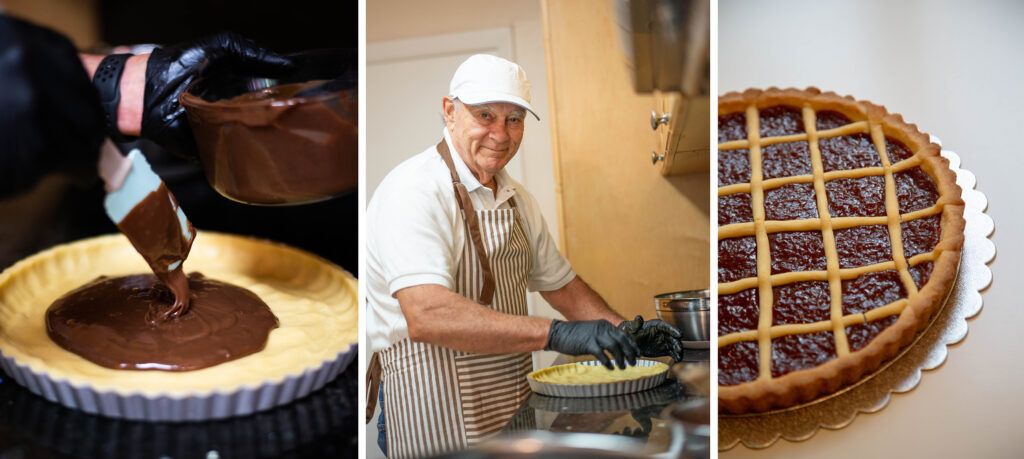
A few days later, those ingredients will reappear as pies: chocolate and guava. Full- and individual-size. Rolled, filled and baked by hand in the kitchen of Mendoza’s Coral Gables, Florida, home, where pie pans crowd every surface.
What began as a small operation at farmers markets has grown into a full-fledged business, driven in part by Mendoza’s decision to infuse his company branding with his immigration experience — sharing with customers how he had lost everything in Venezuela and started over in the United States.
Shortly after the business rebranded as Max & Crust in late November, Mendoza — known to customers as Grandpa Max — saw demand for his pies surge. Last month, he said, he received more orders than ever and made more than 240 pies — starting before dawn, finishing long after midnight and filling his home with the smell of butter and sugar.
“It’s practically industrial quantities,” Mendoza said.
The pie business is a far cry from what Mendoza, a civil engineer by training with a long career in Venezuela, imagined he’d be doing in his 70s. For most of his life, he did not cook at all. In fact, he said with a laugh, “I used to burn water.”
What brought him to the United States was not a lifelong dream of pastry-making but something quieter and more familiar to many immigrants: a life upended more than once by forces beyond his control, and the determination to keep starting over every time.
“You can’t keep thinking about what you had before,” said Mendoza, who immigrated in 2018, during the height of Venezuela’s economic collapse. “If you have to start again, you start again. If you stay stuck in what you lost, you’ll die thinking.”
As a young man, he dreamed of becoming a veterinarian. But guerrilla violence repeatedly shut down the university he attended in the mountain-hemmed city of Maracay, stretching one year of classes into two. Eventually, he said, he realized his father could not keep paying tuition for a school that was often closed. Mendoza returned to his family’s home in Caracas, began working and enrolled in engineering school at night.
It became a long and stable career. Mendoza built a company and worked on major engineering projects in Caracas, including Parque Central, one of the city’s most recognizable commercial and cultural developments. He also held contracts with Enrique Delfino, one of Venezuela’s best-known architects, and worked extensively on city and state projects.
That stability unraveled after Venezuela elected Hugo Chávez, the founder of the country’s socialist regime, as president in 1998. Mendoza, who opposed Chávez, said the state contracts his firm depended on soon disappeared.
“They took everything from me,” Mendoza said. “I had my company, and they took it. The contracts with the state were gone.”
He pivoted again, this time to agriculture, managing a farm that produced and packaged sweet corn for distributors. Eventually, that, too, was taken by the government.
In 2018, as Venezuela’s economy spiraled and political protests grew, Mendoza traveled to the United States to attend his granddaughter’s First Communion. He said his daughter, a U.S. citizen who had lived in the country for years, pulled him aside.
“Papá, you’re not going back,” he recalled her telling him.
Mendoza and his wife stayed in Florida and applied for green cards through their daughter. They had arrived in Miami with a suitcase and some savings. When that money ran out, his wife found work at a boutique. Together, they did delivery jobs.
Mendoza said he looked for work wherever he could. He applied for a job at a hospital and to load trucks at a hardware store. No one hired him.
Then his daughter, Ana, had an idea.
“Why don’t you make the pies?” she asked.
The recipe was hers — one she created more than 30 years ago, when she was in high school in Venezuela and wanted a little extra money. She had tasted similar pies and decided to try to make a better version. She sold them to friends, refining the dough and fillings over time. When she moved to the U.S., she baked the pies only when someone asked or to occasionally sell them at farmers markets.
She taught her father everything, he said.
“I had to learn from zero,” Mendoza said. “From zero.”
Mendoza began selling his pies in March at a small market in Key Biscayne. The volume was modest at first, but he kept baking, week after week, determined to build something sustainable.
In November, the business underwent a rebrand and became Max & Crust, a name chosen to feature Mendoza.
“For me, it was key that Max be the face of the brand,” said María Julia Stolk, who led the rebrand. “People connect with stories — not just products, but emotions. And he’s just so full of life. I think he’s an example and an inspiration, and that’s why it was important for him to show who he is and tell his story.”
Sales have surged since the change, Stolk said. Orders now come through Instagram and WhatsApp, in Spanish and English. Mendoza’s clientele has grown beyond mostly Venezuelans to people from across the Miami area, many of whom discover the pies online and order directly.
Part of that growth, Mendoza said, comes from sharing his story. As a federal immigration crackdown instills fear and uncertainty in many immigrants, Mendoza speaks openly about starting over — about losing everything and building something new, late in life, with his hands — and hoping others relate.
“It’s never too late to start,” he said. “Even when something very bad happens, there’s always a future. You just have to go look for it.”
What keeps him going, he said, are the messages from customers — notes thanking him, telling him the pies reminded them of home or that they brought one to a family gathering.
“Those messages make you want to keep going,” Mendoza said. “To improve. To grow.”
For now, Mendoza continues baking from his home kitchen. He hopes to soon ship his pies, which are available for pickup and delivery in Miami, to other states — and, eventually, to move into an industrial kitchen, if only to reclaim some space in his house.
Until then, his home kitchen remains full. And each pie carries what Mendoza calls “un pedacito de casa” — a small piece of home — baked slowly, patiently, by someone who has learned, again and again, how to begin.
The post An engineer-turned-baker shared his immigration story. Pie sales surged. appeared first on Washington Post.