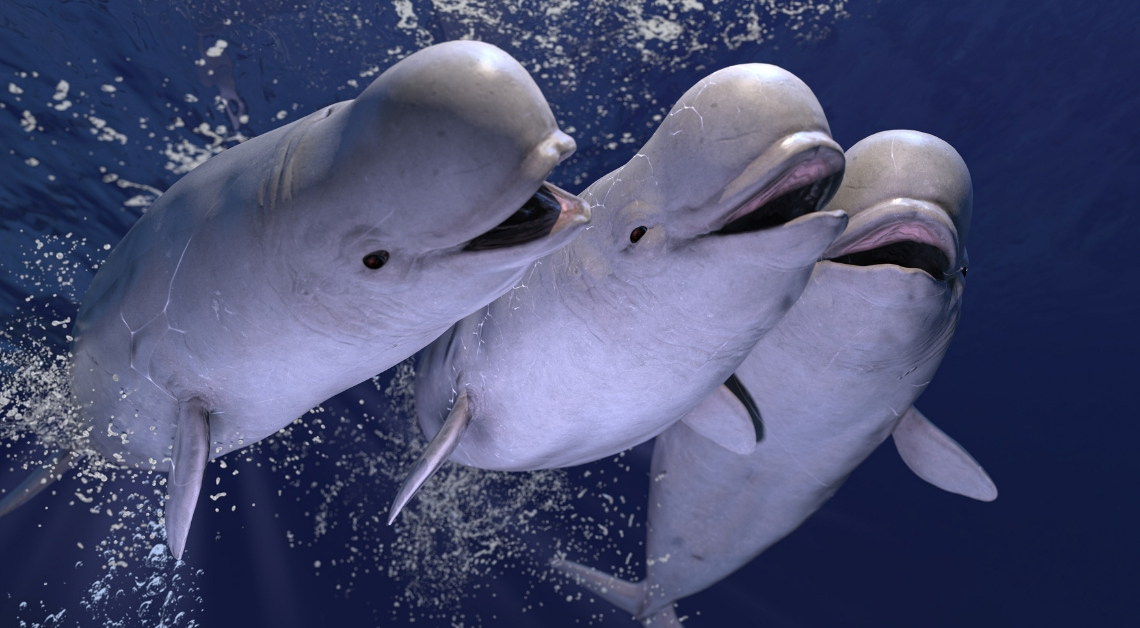
A recent study published in Frontiers in Marine Science says that an isolated beluga whale society in Bristol Bay, Alaska, is breaking the binary of its mating systems, eschewing the usual choice between lifelong monogamy and freewheeling sexual Baconalia. And it seems to be doing pretty well for itself.
Researchers studying this small, long-isolated group of about 2,000 belugas expected to find low genetic diversity. There are so few of them, and they collectively had such infrequent contact with outside groups, that there was no doubt in anyone’s mind that there was going to be strong evidence of inbreeding.
Instead, they found a surprisingly high level of genetic diversity. The authors of the study say that this small group of isolated whales pulled off this incredible feat by finding a middle ground between being exclusively monogamous and being big-time polygamists.
It also seemed to help out quite a bit that they are a whale society without dominant males, whose extreme horniness could have easily become a detriment to their existence.
Alaska’s Beluga Whales Have Complicated Sex Lives—and It Helps Them Survive
Using DNA from tissue samples collected from 623 whales over 13 years, scientists found no evidence that a few dominant males were fathering most of the calves. While male belugas do mate with multiple females, the advantage is modest at best. No male in the study had more than four offspring in the sampled population.
Females weren’t sticking with a single partner either. Calves from the same mother typically had different fathers across breeding seasons.
None of this seems like a fluke. Belugas can live up to 90 years, giving both sexes long reproductive lifespans and plenty of opportunities to spread their seed without ever feeling the desperate need to dominate the sexual landscape.
What should have been an unstable, chaotic genetic catastrophe turned out to be a remarkably stable system that maintains genetic health despite its isolation. Researchers found evidence that this pattern has existed for generations, with belugas somehow keeping inbreeding low without reliance on migration or population growth. All they needed was some male belugas who weren’t a bunch of sexually conquest thing freaks and some lax views on monogamy, and as far as beluga whales can have “views.”
The team points out that this doesn’t mean all beluga whale populations behave the same way. They’re thriving because these whales don’t subscribe to the idea that one male’s genetic linage most rule them all. It seems they think everyone should get a fair shot at carrying on their lineage. And it seems to be working out for them so far.
The post Alaska’s Beluga Whales Have Wild Sex Lives—and It Keeps Them Alive appeared first on VICE.