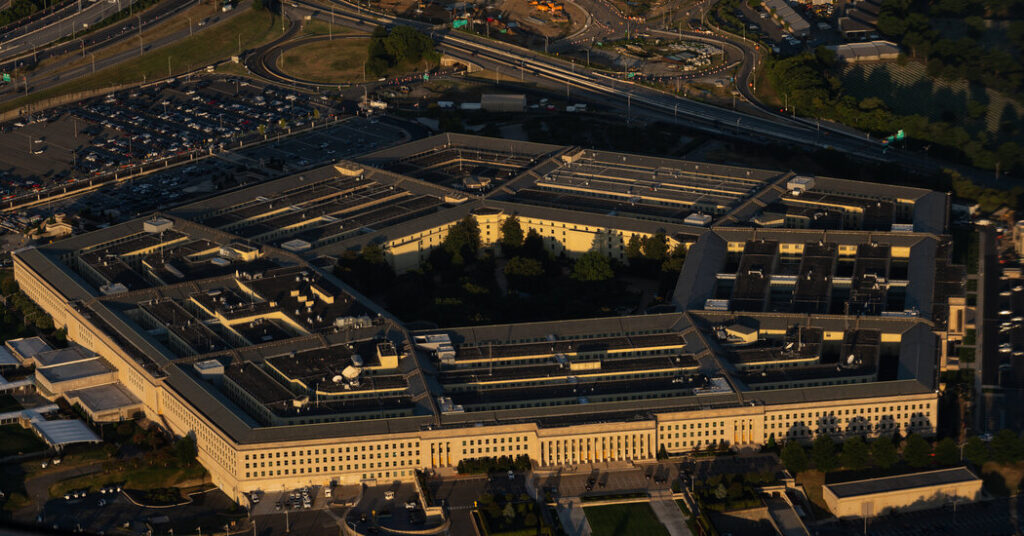
The media world and many readers took notice when The New York Times sued the Pentagon over First Amendment rights.
In the suit, filed in early December in the U.S. District Court in Washington, The Times accused the Pentagon of infringing on the constitutional rights of journalists by imposing new restrictions on reporting about the military.
The rules require reporters to sign a 21-page form agreeing to publish only information approved by military leadership in exchange for access to the Pentagon building and the press pool that accompanies the secretary of defense and other officials. The Times and every major news organization surrendered their Pentagon passes rather than sign the agreement when it took effect in October.
Some readers defended the Pentagon, arguing that the rules were meant to protect national security. Access, they pointed out, is restricted in other government settings. Many view the policy as an inconvenience, rather than an infringement on rights. But major events, like the U.S. capture of President Nicolás Maduro of Venezuela, show just how much the public relies on information from the Pentagon to understand military action.
In response to the suit, Sean Parnell, the chief spokesman for the Pentagon, told The Times, “We are aware of the New York Times lawsuit and look forward to addressing these arguments in court.”
The case is on a fast track, with oral arguments scheduled for March 6.
We put some of the most common reader questions to several Times leaders: A.G. Sulzberger, the publisher of The Times; Joseph Kahn, the executive editor; David McCraw, the lead newsroom lawyer; Richard W. Stevenson, who oversees the Washington bureau; Adrienne Carter, the Europe editor; and Eric Schmitt, a reporter who covers national security.
These questions, written by editors on The Times’s Trust and Standards teams, are intended to reflect a range of comments we received from readers in response to the lawsuit.
Of all the fights for The Times to take on against the Trump administration, why this one? You’ve written and spoken about President Trump’s anti-press playbook and his crackdown on journalists. But the Defense Department says its new press policy is about access and security at the Pentagon, not the First Amendment. Why should people care about this fight?
A.G. SULZBERGER: Americans should care about this lawsuit because they care about the state of our nation’s military, because they care about the soldiers that risk their lives to protect us, and because they care about knowing what their government is doing and how it’s using taxpayer dollars.
The Pentagon is insisting that journalists who are issued press passes agree to report only officially approved information or risk having their access rescinded. That demand flies in the face not just of the First Amendment, but also a long American tradition of presidents of both parties respecting the role of the press in scrutinizing the world’s most powerful military. That’s why no serious journalistic outlet signed the agreement. The longtime employer of Defense Secretary Pete Hegseth, Fox News, said it crossed a line. So did The Wall Street Journal, The Washington Post, ABC, NBC, CBS, CNN and Newsmax. The Times is just taking the next step, asking a court to confirm what we know to be true: This policy violates the letter and spirit of the law.
Here’s an example of the type of reporting this policy would seek to punish: Top defense officials looked the other way for years as weapons training drove an epidemic of devastating brain injuries among service members. It took the dogged reporting of my colleague Dave Philipps to bring this issue to light, which spurred important reforms. I could point to countless other examples of ways our journalism has exposed misconduct or saved taxpayer money. The real reason behind the Pentagon’s new policy is to protect the administration from the scrutiny and accountability that service members and the broader public deserve.
To be clear, losing access won’t discourage us from reporting on the military. In fact, it will only make us work harder. But, unchallenged, this move would set a bad precedent that could be embraced by other parts of the government. Even more than that, it is a disservice to the American people, who have no interest in having government propaganda replace independent journalism.
How do procedural changes to Pentagon press access rise to the level of a First Amendment issue? Isn’t The Times ultimately free to publish what it wishes?
DAVID McCRAW: A press pass is a government benefit. The government could decide that nobody gets a pass. That would be bad for democracy, but legal. But once the government decides to issue passes, two important things are true: The government cannot condition the receipt of a pass on a reporter’s agreement to surrender a constitutional right, and a reporter is entitled to due process if the government decides to take the pass away.
The new Pentagon press policy violates both of those principles. If journalists want to keep their passes, they are required to publish only information approved by Pentagon leadership. If they seek information from military employees — no matter where in the world the journalist happens to be, no matter where the employees are, no matter whether the information is supposed to be secret or not — the Pentagon can pull their press passes and kick them out of the press pool. (And the Pentagon fails to say exactly what standard will be used to decide when a press pass can be revoked.) It is clear what is happening: The Pentagon is using the press pass system to control what the public gets to know about the military.
It is true that the new policy does not reach reporters who cover the military, but who do not have press passes. But why should the government be allowed to control those reporters who do have passes, who are experts on the military and likely to have the kind of experience that can make coverage of the Pentagon more insightful and meaningful? Those are the very journalists the public needs to have in the building asking hard questions of military leadership without the threat of reprisal. Journalists have been allowed into the Pentagon for decades without any government official imposing a policy limiting what they can write or broadcast. That is how it is supposed to work in a democracy. The public is entitled to independent news coverage from journalists who are free to hold people in power accountable. The new policy works very hard to keep that from happening.
President Trump regularly attacks The Times and other news organizations, threatening punitive action for coverage he doesn’t like and mocking journalists for asking questions, even suggesting they should be jailed. He has sued The Times for libel and filed lawsuits against other news media outlets, sometimes winning settlements. Was The Times worried that suing the administration would antagonize the president?
Trump Administration: Live Updates
Updated
- Federal judge extends deportation protections for Burmese migrants.
- Renée Fleming won’t perform at Kennedy Center concerts.
- The U.S. says its first boat strike since Maduro’s capture killed 2 in the eastern Pacific.
A.G. SULZBERGER: At The Times, we talk a lot about our responsibility to report the news without fear or favor.
That means asking questions powerful people would rather not answer, and publishing information powerful people would rather keep secret. So we have plenty of practice upsetting presidents of both parties. And we have plenty of experience standing up to their efforts to badger, charm, threaten or otherwise pressure us into dropping or softening stories they don’t like.
So no, we’re not worried. We believe the law is behind us. We believe the public deserves the fullest and fairest version of the facts. And we will not be intimidated or dissuaded from doing our jobs. That’s true whether the pressure comes from President Trump, or from anyone else.
One more note: In the United States, press freedom, free expression and due process enjoy some of the strongest legal protections in the world. But these rights, however robust on paper, have value only if we exercise them. To do otherwise for fear of reprisal is no different than giving up our rights altogether.
Many readers, particularly those on the political left, support this action by The Times and view it as an act of resistance to the Trump administration. Is that how leaders of The Times see the suit?
JOE KAHN: Our lawsuit is not an act of political resistance. It is a necessary step to ensure that this administration, or any administration, cannot deter journalists from reporting on the government they fund. The Pentagon’s policy aims to restrict journalists from reporting on military matters and seeking information from members of the military. We believe that violates the First Amendment and impedes the public’s right to know about its armed forces.
Many Trump supporters perceive The Times and other mainstream press outlets as fishing for stories to undermine or embarrass the administration, and Pentagon leadership claims the press pool has been rebalanced to represent a wider cross-section of the media. What are your thoughts on that?
JOE KAHN: For generations, through Democratic and Republican administrations, two world wars, and dozens of military engagements abroad, The Times has done essential reporting on the military that provides the public with facts and analysis critical to understanding its armed forces. That reporting has helped people reach their own conclusions about the successes and failures of their military. The information we provide is useful to a wide range of readers who have diverse political views.
We welcome good reporting on the Pentagon by other news media. The rules any government agency sets for the news media should be transparent, nonpartisan and consistent with Constitutional rights.
RICHARD W. STEVENSON: The Times is dedicated to the mission of independent journalism, meaning reporting that follows the facts where they lead and presents them to readers without regard for any political or ideological agenda. If the facts reflect well on a particular administration, so be it. If they are embarrassing to an administration, so be it. The Trump administration is pushing the nation in new directions, and we report aggressively but fairly on those developments and their consequences. Where justified, we seek to hold those in power accountable. We are neither cheerleaders nor enemies, and we do not believe the public is served by excluding from the Pentagon press corps those news organizations that share our vision for the role of journalism in a democracy.
What does Pentagon access mean for international coverage?
ADRIENNE CARTER: The United States military and its operations are spread across the world, and the activities of the armed forces shape nations, economies and communities. U.S. warships were positioned near Venezuela’s coast well before the Maduro mission. U.S. soldiers were recently killed in Syria. U.S. weapons are used by Ukraine in its fight against Russia. U.S. bases and outposts are in South Korea, Qatar, Germany, Australia and dozens of other countries. Reporting from the Pentagon is vital to our understanding of the world.
Broadly speaking, it sounds easy to stand up for the First Amendment and press freedom. But that can be more difficult than it might appear. Why?
DAVID McCRAW: It may sound easy, but standing up for press freedom can be challenging. The law is not as settled as people might think, and every administration, no matter how much it talks about openness, inevitably fights to keep information secret at precisely the moments when the public most needs to know what is going on. That is why, in my two decades at The Times, we have brought litigation aimed at rolling back government secrecy in every administration — Bush, Obama, Trump, Biden and Trump again. That will never change.
The Times has made the case that it can cover the Pentagon aggressively, whether or not it has access to the building’s offices and hallways. Has something about that stance changed?
DAVID McCRAW: As far as our military coverage, our journalists have been stellar at reporting out the most important stories the public needs to know, both before the credentials dispute and since. That will continue, no matter how this case turns out. But a press pass is intended to provide even more access to information and newsmakers, to be one more tool that journalists can use in their coverage. It allows the press to get information that cannot be obtained by other means. Journalists need to be present at the White House, City Hall, the Statehouse, the Pentagon and every other government location where news is being made. We cannot let what happened at the Pentagon become a precedent that is then used to block journalists from other important news sites.
Why should reporters be allowed to roam the Pentagon in the first place? Congress conducts closed-door hearings on sensitive matters, as just occurred with the Caribbean boat strikes. Aren’t restrictions justified on national security grounds?
RICHARD W. STEVENSON: National security is a legitimate issue, which is why The Times has always abided by security restrictions and limitations on access inside the Pentagon, and those in place in other government buildings as well. But while we respect the need for rules and follow them, we also believe that a physical presence is important, because it provides reporters with a chance to meet people who are involved in and knowledgeable about issues that can have a profound impact on the nation and the world. It also allows us to gather information quickly when news breaks. At the end of the day, excluding reporters, or imposing unreasonable restrictions on them, limits the public’s right to know about actions and policies and is a step toward government control of information that is vital to the functioning of a democracy. That said, nothing in our lawsuit challenges the right of Pentagon officials to limit where reporters can go.
What was a day like for New York Times reporters based at the Pentagon before the credentials dispute?
ERIC SCHMITT: Until the most recent restrictions, a typical reporting day at the Pentagon for me involved meeting civilian or military contacts for coffee in the food court, receiving background briefings from senior officials about new weapons systems or counterterrorism strategies, and schmoozing with spokespeople for the armed services, the military Joint Staff and the secretary of defense, from whom I gleaned an array of tips that often led to stories. In addition, I’d often bump into top officials in the hallways and grill them on the latest military crisis, policy debate or personnel controversy. Former Defense Secretary Jim Mattis used to pick up his own dry cleaning at the Pentagon laundry, and we would chat (on deep background) on the walk back to his office. Hallway conversations provided critical reporting for our scoop that senior Russian military leaders had recently held conversations to discuss when and how Moscow might use a tactical nuclear weapon in Ukraine. Access to the building was important to the reporting we did in breaking the news in August that President Trump had secretly signed a directive to the Pentagon to begin using military force against certain Latin American drug cartels that his administration had deemed terrorist organizations. In ways large and small, my day-to-day reporting inside the Pentagon, and that of my Times colleagues, immensely enriched our report.
Mike Abrams is the deputy editor for Trust, working to help readers understand The Times and its journalistic values.
The post Why The New York Times Sued the Pentagon appeared first on New York Times.