As if the Europeans needed another wake-up call about the contempt in which President Trump holds them, his mocking antipathy at the World Economic Forum in Davos, Switzerland, was a good reminder.
But Davos presented another lesson to Europe. Standing together on the principle of territorial integrity and sovereignty, while warning of severe economic countermeasures, the Europeans achieved an apparent retreat from Mr. Trump over Greenland.
Sovereignty and the inviolability of borders are fundamental tenets of the European project, built out of the ruins of World War II, when the aggressive imperialism of big powers led to millions of deaths. The lesson was clear: Defending borders collectively is the only way small states are protected from the predations of larger ones.
Now Europe finds itself again confronted by big powers with expansionist goals. Russia continues its effort to conquer Ukraine, whose sovereignty it had recognized in numerous treaties. And the United States has been demanding that Denmark, an E.U. and NATO ally, hand over Greenland.
But preserving territorial integrity and sovereignty is the red line, expressed both in the European Union, a collective of 27 nations, and in NATO, a military alliance of 32 nations. It can seem quixotic in the current world to be defending international law, the U.N. Charter and the Helsinki Accords, which all insist on the inviolability of borders, but in a sense, that is Europe’s fate.
“That borders can be challenged by force, and the threat of force threatens the core tenets of European security and aspirations since the end of World War II,” said Ian Lesser, the head of the Brussels office of the German Marshall Fund.
“The war in Ukraine brought it to the fore,” he continued, “but the idea that the United States, the principal guarantor of European security, should be challenging the concept of sovereignty and territorial integrity is a serious concern.”
Mark Leonard, the director of the European Council on Foreign Relations, argued that the continent has been rediscovering the importance of sovereignty in the face of challenges from the “great powers” of China, Russia and the United States.
“Most of European history since World War II has been about taming sovereignty and pooling it” in multilateral institutions, he said. But the new world is “fundamentally changing the nature of the E.U.,” he said.
Europeans realize that they cannot defend the old, rules-based order on a global level, “but they can be sure it survives in Europe,” he said. “Thus the importance of Ukraine and Greenland.”
Mr. Leonard said he hoped that “Europeans will take the lesson of the last few days, that when they stand up for sovereignty and territorial integrity and these rules they can defend them.”
Prime Minister Mark Carney of Canada won praise for a speech in Davos in which he said that the old international order was dead. “Middle powers” like Canada and Europe, he said, must form new alliances as the great powers abandon postwar international norms and treaties and rely instead on “economic integration as weapons, tariffs as leverage, financial infrastructure as coercion, supply chains as vulnerabilities to be exploited.”
There is a rupture in the old order, Mr. Carney said: “When the rules no longer protect you, you must protect yourself.”
Europe has been absorbing that lesson.
Europeans have resisted Mr. Trump’s demands that Ukraine hand over to Russia territory that Moscow has not conquered. And the Europeans have insisted that even if a peace deal left Russian troops occupying 20 percent of Ukraine, the occupation would never be recognized as permanent, not even in Crimea.
The Europeans have come up with more money and military aid for Ukraine than the United States, and they have largely picked up the slack after Mr. Trump cut off funding for Ukraine. They recently agreed to another 90 billion euros ($106 billion) in economic and military aid to Kyiv.
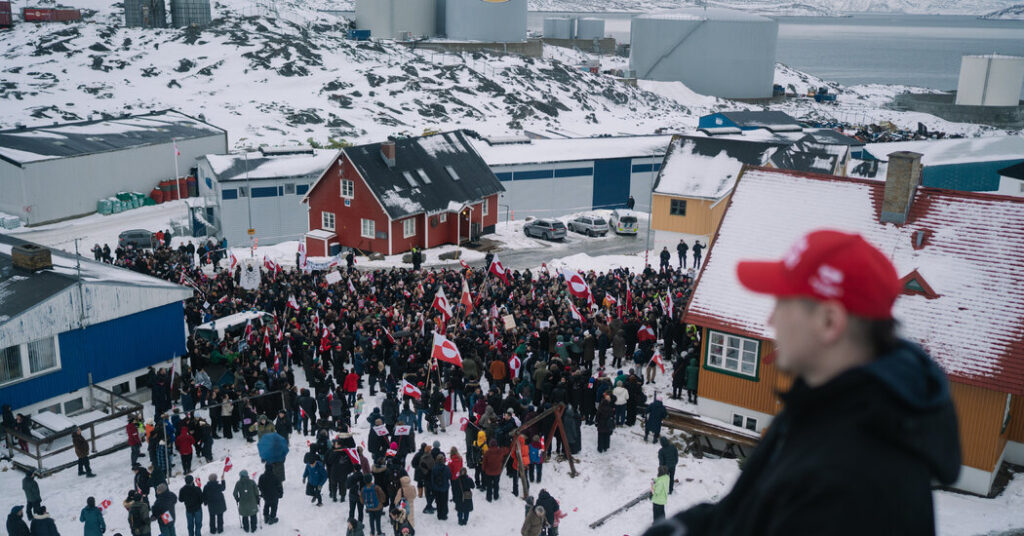
And it has been the Europeans who have expressed solidarity with Denmark and Greenland against Mr. Trump’s demands to annex the island on the same principle of territorial integrity, and who seem to have caused him to back down.
President Emmanuel Macron of France spoke for many Europeans at Davos when he said, “Europe has very strong tools now, and we have to use them.”
Prime Minister Bart De Wever of Belgium was harsher. “So many red lines are being crossed,” he said at the forum. “Being a happy vassal in one thing, being a miserable slave is something else.”
The second Trump presidency has taught Europe that its initial policy of flattering Mr. Trump has been a failure, and that standing up for core principles is vital, said a senior European official, speaking anonymously given the sensitivity of the U.S.-European relationship. In essence, he agreed, Europe has learned that a little flattery is fine, so long as you have a gun in your pocket.
That was the case with Denmark and Greenland. For many weeks, European leaders and officials hoped that Mr. Trump would back down over his intention to take Greenland “the easy way” or “the hard way.” Instead he threatened even more punitive tariffs.
So the European Union scheduled an emergency summit meeting for right after Davos.
In the face of Mr. Trump’s threats, the Europeans suspended a pending U.S.-E.U. trade agreement on tariffs that had been criticized as too weak. Instead, they prepared a retaliation of €93 billion ($109 billion) in countertariffs on American goods — the gun in the pocket.
The prospect of those countertariffs upset the markets, said Mr. Leonard of the European Council on Foreign Relations. The effect appeared to have an impact on Mr. Trump and his aides, he said, by showing “that the Europeans were serious and through the markets they pushed Trump to pull back.”
Mr. Trump, in discussion with Mark Rutte, the NATO secretary general, then appeared to back down, saying there was an unspecified framework for “a deal” on Greenland and removing his own threatened tariffs.
The president declared victory, but the real winner in this case were the Europeans, both the European Union and NATO, grasping on to this core principle of no border changes without the consent of the countries involved.
After the E.U. summit meeting early Friday morning, Ursula von der Leyen, the president of the European Commission, the bloc’s executive arm, said the latest tariff threats offered a tactical lesson for dealing with the United States. “Firmness, outreach, preparedness and unity” had been effective, she said.
“So going forward we should maintain this very approach.”
Smaller European nations, like the Baltic and Nordic states, are deeply worried about the great powers’ attack on sovereignty, said Jana Puglierin, head of the German office of the European Council on Foreign Relations.
“This is the end of their business model,” she said. “It’s the very foundation of the European Union and the postwar order, where one country gets one vote, no matter how small.”
Russia, China and the United States are trying to change the entire international order, she said, and Europe is in the middle. All of those countries “are trying to split us,” she said, “because it is easier to deal with us when we are divided.”
The fundamental question is whether the European Union and NATO can still function in this new, more rapacious world, she said. These institutions “are based on the invulnerability of sovereignty and the principle of consensus, and the challenge now is to the very existence of the organizations that have brought peace and prosperity to Europe.”
Steven Erlanger is the chief diplomatic correspondent in Europe and is based in Berlin. He has reported from over 120 countries, including Thailand, France, Israel, Germany and the former Soviet Union.
The post What Europe Learned From the Greenland Crisis appeared first on New York Times.