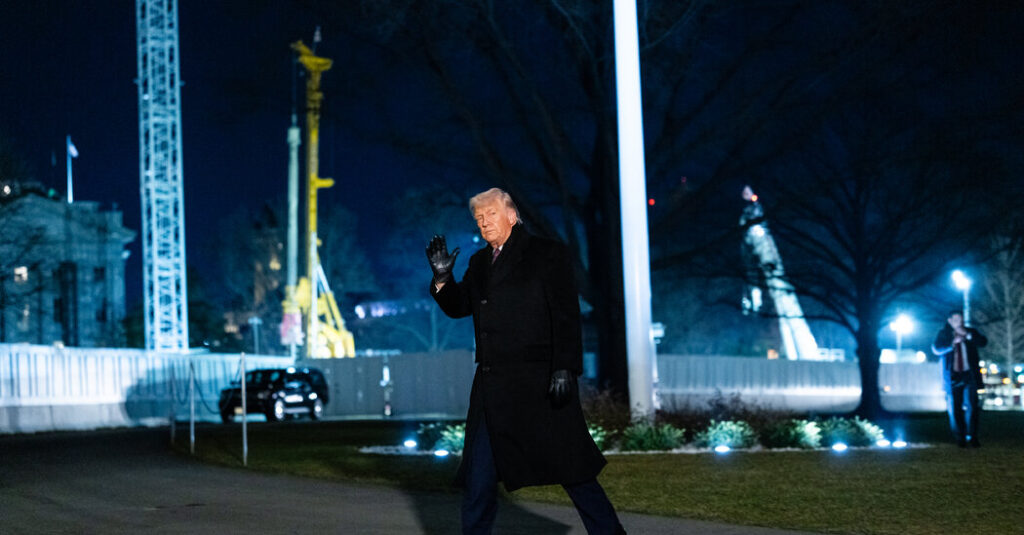
President Trump on Saturday threatened Canada with steep tariffs if it “makes a deal with China” and insulted Prime Minister Mark Carney, his latest swing at the country since Mr. Carney pushed back against his policies in a highly publicized speech in Davos, Switzerland, this week.
“If Canada makes a deal with China, it will immediately be hit with a 100% Tariff against all Canadian goods and products coming into the U.S.A.,” Mr. Trump said in a post on Truth Social. He referred to Mr. Carney as “Governor Carney,” a reference to Mr. Trump’s repeated insistence that Canada should become the 51st U.S. state.
There is no indication that Canada and China are in discussions about a broad trade agreement. Mr. Trump may have been reacting to Mr. Carney’s state visit to China last week, during which he agreed to lower tariffs on some Chinese electric vehicles in exchange for China doing the same for some Canadian agricultural products. The closely-watched visit was billed as a crucial reset in the two countries’ relationship, but the trade agreement itself was modest.
Mr. Trump appeared to praise Mr. Carney after that deal was reached. (“Good for him,” he said.)
But he soured on the prime minister after Mr. Carney’s Davos speech, in which Mr. Carney declared that the U.S.-led world order had been ruptured and called on “middle powers” like Canada to band together to survive a new and perilous era.
Without mentioning Mr. Trump or the United States by name, Mr. Carney pointedly called out the use of tariffs as coercion. “More recently, great powers have begun using economic integration as weapons, tariffs as leverage, financial infrastructure as coercion, supply chains as vulnerabilities to be exploited,” Mr. Carney said.
The speech did not go down well with Mr. Trump, who responded in his own address the next day at Davos, saying that Canada “lives because of the United States.” Mr. Trump also rescinded an invitation to Mr. Carney to join his “Board of Peace.”
Mr. Carney’s office did not immediately respond to a request for comment about Mr. Trump’s post on Saturday.
While Mr. Trump routinely fails to make good on his tariff threats, calling Mr. Carney “governor” could be a bad sign for the two countries’ relationship. After returning to the White House last year, Mr. Trump routinely applied the title to Mr. Carney’s predecessor, Justin Trudeau, as part of his rhetoric about the United States annexing Canada.
The relationship between Mr. Trump and Mr. Carney had been much more respectful, at least until the Davos gathering. The leaders met several times last year, twice in the White House, and Mr. Trump expressed admiration for Mr. Carney’s electoral victory last spring.
Still, their warm words have not materialized into an improved trade relationship. Though the United States has a three-way trade agreement with Canada and Mexico, the Trump administration has imposed tariffs on certain exports from both countries, which in Canada’s case have hurt its steel, aluminum, automobile and lumber industries. A review of the three-way trade deal is due this year, and its renewal is far from certain.
Mr. Trump has maintained that the United States does not need anything from Canada, even as it gets most of its imported oil from its northern neighbor and their economies continue to be closely integrated.
The latest flashpoint bodes ill for Canada’s efforts to stabilize its relationship with the Trump administration, just as Mr. Carney looks for new allies and trading partners to lessen his country’s overwhelming dependence on the United States.
In his Davos speech, Mr. Carney indicated that he had given up hopes of a return to the way things had been before Mr. Trump’s second term. “The old order is not coming back. We should not mourn it,” he said. “Nostalgia is not a strategy.”
Matina Stevis-Gridneff is the Canada bureau chief for The Times, leading coverage of the country.
The post Trump Threatens Canada With Tariffs as Post-Davos Fallout Continues appeared first on New York Times.