Leah Goodridge was sitting at home in New York late last year, laptop open, planning a train trip to Washington at a reasonable hour as she had many times before.
She clicked, waited and leaned in.
The Amtrak fare appeared on her screen: $572 round trip.
She checked again, thinking she had missed something. Then she checked flights. Flying, somehow, would cost less.
Ms. Goodridge does not drive. She relies on trains. She believes them to be superior, for cities and the climate. But lately, she has noticed that belief being tested.
“It felt backward,” she said in an interview. She said she associated flying with luxury, but also an earlier arrival to her destination. “I thought, ‘why would I pay Amtrak $200 more to get there hours later?’”
Across the country, riders like Ms. Goodridge, who is also a member of the New York City Planning Commission, are feeling squeezed when booking an Amtrak ticket without a long lead time.
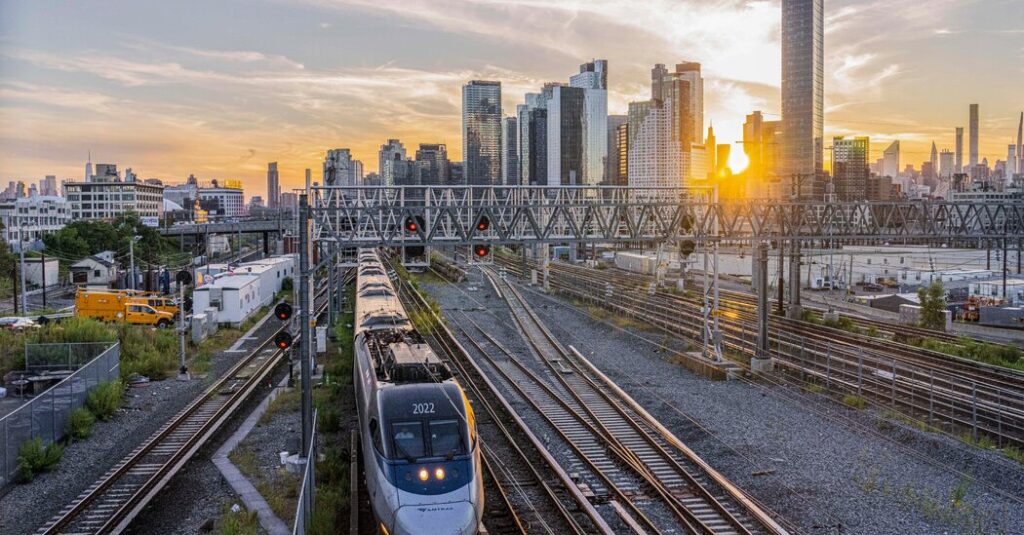
In a response to the post-pandemic return to travel, Amtrak over the last few years has expanded its use of dynamic pricing, a system that rewards early planners and charges a premium for flexibility and last-minute travel.
“If people stop taking the train,” Ms. Goodridge said, “they don’t just disappear.”
Buy early, though — let’s say at least two to three weeks in advance — and ticket prices are often more forgiving.
You may find an 8 a.m. $35 fare to Wilmington, Del., from Washington — a route once routine for a certain former senator who became president. Or $112 for the Acela, Amtrak’s premium service in the Northeast Corridor, for a comfortable glide to Boston from New York. But the enticing fares might not last long.
The rail service adjusted its approach as ridership began to pick up as pandemic-era restrictions loosened. As business travelers stayed home, leisure travelers appeared in their place, curious and price-sensitive. To draw them in, Amtrak began offering more flexible fares that rose and fell depending on demand, timing and, sometimes, a mysterious algorithm.
Eliot Hamlisch, one of Amtrak’s executive vice presidents and its chief commercial officer, said in a statement that the array of prices and fare types had attracted travelers, fueling both ridership and growth.
Other companies, including Wendy’s and Instacart, have experimented with forms of dynamic pricing, only to walk those efforts back after public backlash.
Critics of Amtrak’s approach say a taxpayer-supported service should not behave like a moody algorithm. Amtrak counters that leisure travelers love a bargain.
Amtrak, which has sustained significant financial losses in the past, has never been profitable since it started operating in 1971 to serve as the nation’s passenger rail operator. But it reported about 35 million customer trips during the 2025 fiscal year, setting records for both ridership and revenue for the second straight year.
“These results show what’s possible when we lead with purpose,” Roger Harris, Amtrak’s president, said in a news release in November.
Amtrak’s push into dynamic pricing coincided with a $22 billion infusion for modernizing its tracks from the 2021 infrastructure law that was championed by former President Joseph R. Biden Jr., who earned the nickname Amtrak Joe in his Senate days. For years, Amtrak has dealt with deteriorating rail lines, an outdated fleet of trains and a backlog of transit maintenance that would cost tens of billions of dollars.
Robert Paaswell, a civil engineering professor at the City College of New York and a frequent Amtrak rider, takes the train to Washington most often, but before he retired, he made frequent trips to Albany. He said he viewed the pricing as a reflection of economic reality.
Amtrak receives far less in subsidies than airlines do, Mr. Paaswell said. The rail service covers its operating and capital costs through a combination of ticket sales, federal appropriations and grants. It also receives payments from state partners and agencies, and other revenue sources.
Airlines also charge fees that Amtrak does not. Amtrak’s pricing model rewards early bookings, and charges for urgency.
“Riders have to decide if it’s worth it,” he said. “It seems to be worth it because every seat sells out.”
Not everyone feels entirely comfortable with Amtrak’s shift. Jim Mathews of the National Rail Passengers Association reminds riders that Amtrak is a public service, not a profit-making corporation. In his view, creative pricing risks feeling like a surcharge on a service taxpayers already support.
Consumer advocates express other concerns as well. If fares rise, then customer service should improve with them. Passengers want fewer delays, fewer unexplained cancellations, and fewer moments when they stand in a station wondering if the train even exists.
Mr. Mathews said travelers were right to feel frustrated because the experience can feel unpredictable. Even if the algorithm makes sense internally, it does not for people who like planning trips months in advance, when they might see a $140 fare one day and a $380 fare the next for the same trip, he said.
“I think in a capacity-constrained environment, it’s a necessary tool,” Mr. Mathews said. “But I also think it risks putting profit above all other considerations, and that is wholly inappropriate for a taxpayer-funded enterprise.”
Yet the public keeps paying.
The reason is simple. The alternative is the airport. Anyone who has waited at busy Northeast airports understands this calculation.
Checked luggage can go missing. Boarding procedures resemble competitive sports. The walk to the curb from the gate may take so long that it becomes a kind of spiritual journey.
Faced with that experience, people turn back to Amtrak. They buy the ticket. They sit down. They feel the familiar rumble of a train that may shake a little, flicker a little, and apologize a little, yet still deliver them from the world of airport security bins and overhead luggage battles.
Mark Walker is a Times reporter who covers breaking news and culture.
The post Travel Math: When Flying Costs as Much as the Train, Who Wins? appeared first on New York Times.