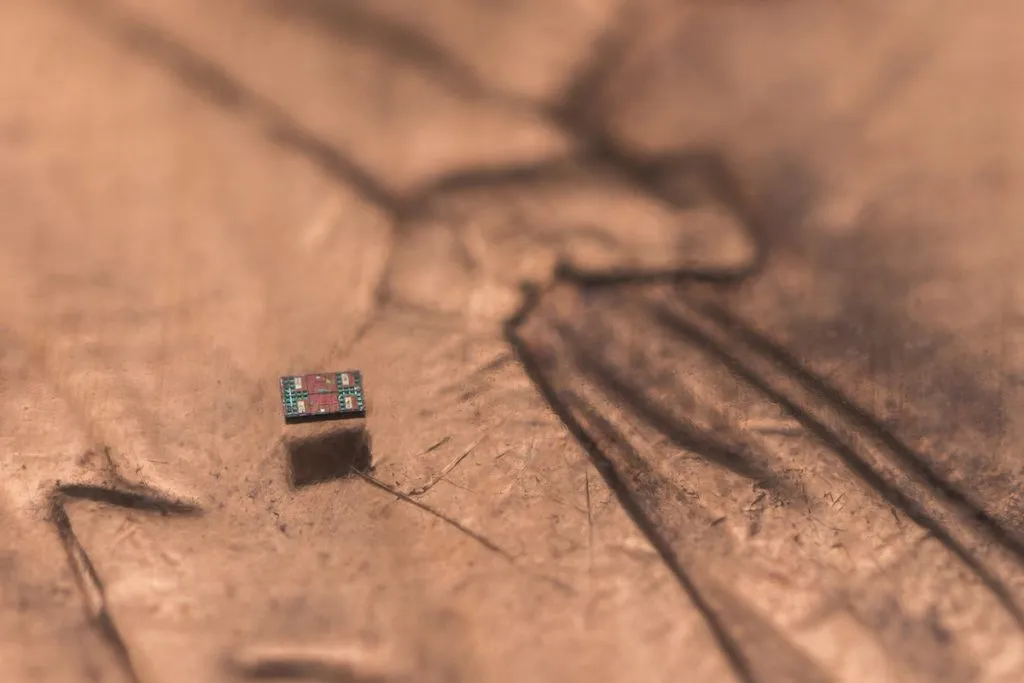
Miniaturization has long been a challenge in the history of robotics.
While engineers have made great strides in the miniaturization of electronics in the past few decades, builders of miniature autonomous robots have not been able to meet the goal of getting them under 1 millimeter in size. This is because small arms and legs are fragile and difficult to manufacture. Above all, the circumstances of the laws of physics change in the microscopic world. Instead of gravity and inertia, drag and viscosity become dominant.
Against this backdrop, researchers in the US have announced the results of a study that accomplishes a 40-year-old challenge. A team of researchers from the University of Pennsylvania and the University of Michigan has developed a new robot that is smaller than a grain of salt, measuring only 200 x 300 x 50 micrometers. At 0.3 mm on its longest side, that’s far below the 1-mm threshold. Yet it can sense its surroundings, make decisions on its own, and swim and move in water.
Moreover, it operates completely autonomously and is not dependent on any external controls such as wires or magnetic fields. The production cost is said to be as low as 1 cent per unit.
“We have succeeded in miniaturizing an autonomous robot to 1/10,000th the size of a conventional robot,” says Mark Miskin, one of the researchers, who’s an assistant professor of electrical systems engineering at the University of Pennsylvania. “This opens up a whole new scale for programmable robots.”
The Electric Slide
The propulsion system developed by Miskin and his team is a breakthrough in conventional robotics. Fish and other large aquatic organisms move forward due to the reaction of water pushing backward, in accordance with the third law of motion in Newtonian mechanics. But pushing water on a microscopic scale is like pushing sludgy tar. The viscosity of the water is so great that small arms and legs can never compete with it.
So the researchers adopted a completely new approach. Instead of swimming by moving parts of its body, the new robot moves by generating an electric field around it and gently pushing charged particles in the liquid. The robot exploits the phenomenon that moving charged particles drag nearby water molecules, creating a water current around the robot. It is as if the robot itself is not moving, but the ocean or river is moving.
The robot is driven by light from an LED and can move a distance equal to its body length in a maximum of one second. The direction of movement can be changed by adjusting the electric field, and the robot can follow complex paths or move in groups like a school of fish.
The greatest advantage of this method of movement is its extremely high durability due to the absence of moving parts. According to Miskin, it can swim continuously for months on end.
Instagram content
Micro Computer
Propulsion alone is not enough to achieve true autonomy. Autonomous robots must sense their environment and make decisions about how to navigate it. All of this must be controlled by a chip measuring less than 1 mm. David Blau and his team at the University of Michigan took on this challenge.
Blau and his team hold the record for building the world’s smallest computer. When they first met Miskin at a Defense Advanced Research Projects Agency presentation, they were convinced that their technologies would complement each other perfectly. It took five years for the idea to actually take shape.
The biggest obstacle to making the tiny robot work, he says, was power. The robot’s solar panels generate only 75 nanowatts of power. That is less than 1/100,000th of the power consumed by a smartwatch. To solve this problem, the team designed a special circuit that operates at extremely low voltages. This successfully reduced the power consumption to a sustainable level.
Space constraints were another hurdle. The solar panels took up most of the surface, leaving little space for the computational infrastructure. So the researchers radically rethought the program, which required many instructions, and condensed it into a single special instruction, which they were able to fit into the robot’s small memory space.
Tiny Dancer
The robot is equipped with an electronic sensor that can detect minute temperature changes. However, because its microscopic body can’t carry robust communications components, the robot uses a method borrowed from the insect kingdom to transit the measurements it detects.
The robot is programmed to translate the sensor readings into “dance moves.” The researchers use a microscope to observe the robot’s movements and decode the information. “This is very similar to the way honeybees communicate with each other,” Blau explains.
In addition to this, each robot is given a unique ID and is designed to upload different instructions to different units. This allows multiple robots to play different roles in performing large tasks collaboratively.
According to the team, this is the first time a complete computer with a processor, memory, and sensors has been mounted on a robot less than 1 mm in size. The micro-robot functions on the same scale as a microbe, which could be useful for applications such as helping doctors monitor individual cells and helping engineers assemble tiny devices.
This story was originally published in WIRED Japan and has been translated from Japanese. The original was edited by Daisuke Takimoto.
The post This Autonomous Aquatic Robot Is Smaller Than a Grain of Salt appeared first on Wired.