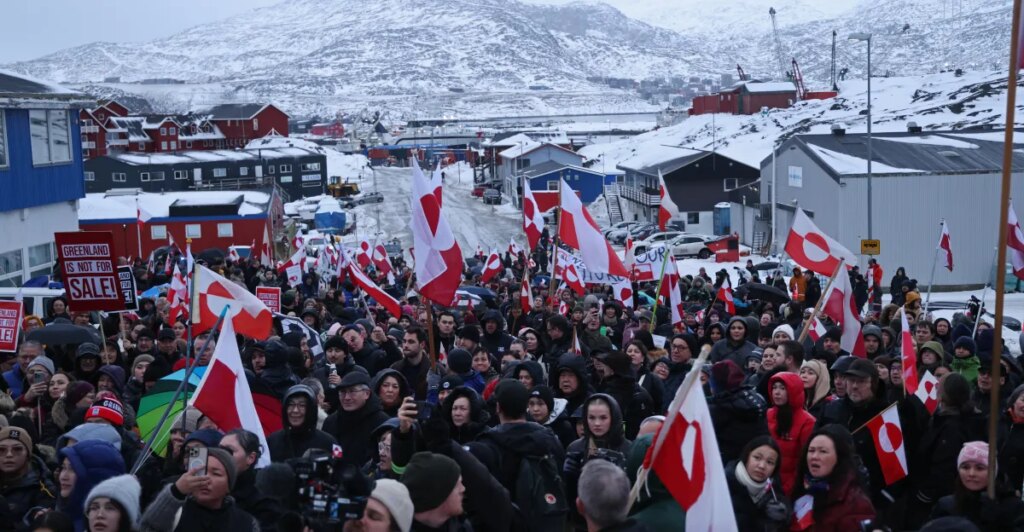
And just like, the Greenland crisis seems to have been defused.
It was a crisis of President Donald Trump’s own making. After broaching the idea of the United States taking Greenland a year ago, Trump ramped up his rhetoric in recent weeks, culminating with the threat of tariffs against Europe and the specter of military action and the dissolution of NATO if the US didn’t get what it wanted.
But this week, after speaking before world leaders at the World Economic Forum in Davos, Switzerland, Trump announced that he and NATO Secretary General Mark Rutte had reached a framework of a deal over Greenland’s future — one that did not include US ownership of the island.
The announcement was widely seen as a comedown for Trump. So why did he back down?
To answer the question, Today, Explained co-host Noel King spoke with Henry Farrell, a professor of international affairs at Johns Hopkins University. Farrell recently wrote an op-ed for the New York Times titled “Europe Has a Bazooka. Time to Use It.” In the piece, he argues that Europe had been too timid in pushing back against Trump’s threats, and that it needed a more forceful posture, one grounded in “deterrence theory.” According to reports, that’s what Europe’s leaders showed at Davos this week — and it may well explain Trump’s retreat on Greenland.
Below is an excerpt of their conversation, edited for length and clarity. There’s much more in the full episode, so listen to Today, Explained wherever you get podcasts, including Apple Podcasts, Pandora, and Spotify.
It’s been roughly 80 years since the last World War, which means we’ve been doing something right, all of us. How do big powers deter attacks from other big powers?
So I think that you really want to start with the nuclear age and the nuclear era, and you even want to start with the Cuban Missile Crisis, which was a moment when the United States and the USSR scared the hell out of each other because it was very close to a situation in which we would’ve actually had a nuclear war and possibly the extinction of humanity.
So after that, we began to see the development of a set of concepts, a set of ideas, which really tried to figure out, how can you work through the situation of nuclear crisis, the risk of nuclear armageddon, the fact the United States and the USSR have fundamentally different political interests, and how can you actually get to a place of stability?
So you begin to get the development of all of these ideas by people such as Thomas Shelling, who won a Nobel Prize for economics. He’s a game theorist who begins to work out, how do you deter? How do you in a sense use the fact that you have nuclear weapons as something that people will pay attention to without ever actually having to use them.
You want to make it so that you don’t have to use a nuclear weapon. How?
The key example, which I think shows some of the brutality in a certain sense of this way of thinking that Shelling offers, is troops in West Berlin during the Cold War. The idea behind this was that, as Schelling describes these people, these soldiers, their job in a certain sense was to, as he said it bluntly, their job is to die.
And so what the calculus is, is that if you have these soldiers there, these soldiers are in a sense not going to be able to defend the city particularly well, but they will die or be captured if the city is in fact attacked by the Soviet Union. If that happens, then any president is not going to want to be able to stand over the fact that thousands of troops have been captured and killed.
This is likely to lead to further escalation, and Shelling’s argument is that this risk of further escalation and the possibility, maybe a 10 percent possibility, that this might actually lead to nuclear war, is sufficient to deter the Soviet Union from attacking.
Nobody is threatening anybody with a nuclear weapon, but Donald Trump is making some statements that very clearly make Europe very nervous. Where do we see deterrence theory operating now, today?
First of all, we see these eight European countries who send a small military force for a brief period of exercises to Greenland. What they’re doing here is they’re setting up a trip wire, which is like a less powerful version of what the United States did with West Berlin. So really what they’re doing here is they are saying effectively to Trump that if Trump actually goes ahead and invades Greenland, that there are going to be eight other NATO allies who are willing to be on Greenland’s and Denmark’s side if this happens.
That is one of the reasons plausibly why Trump goes from these saber-rattling threats where he suggests that he is indeed going to invade Greenland, [then] moves instead to economic measures of one sort or another. In particular, these tariffs. He imposes tariffs against these eight European countries in order to punish them for what they do.
And then that leaves a second set of questions for Europe, which is, how do they respond to that? And they have this very weird, very complicated, very awkward legislative mechanism called the anti-coercion instrument, which possibly serves as a very imperfect trip wire. And that is more or less where the argument goes.
How does that serve as an economic trip wire?
This is a legal instrument that the European Union brought into being, which allows them to retaliate in a wide variety of ways. It’s one of these very vague seeming instruments, which allows the EU legally to retaliate against economic coercion by, for example, blocking investments by taking away intellectual property, by imposing import or export restrictions. It’s very, very open-ended.
It sounds like the European Union did not have to use the economic bazooka but Trump backed down anyway. Why?
[There’s] some interesting clues as to what is happening, which come from some of the statements of the people who were at Davos representing Trump before he got there. Over a period of two days, [there’s] a huge difference in the ways that they’re talking about the problem.
So it begins with [Treasury Secretary Scott] Bessent being quite insulting to Europe, more or less saying, “Well, yeah, so they’re just going to mount some kind of a committee of inquiry or words that affect sort of, let’s see how far that gets.” In other words, completely dismissing the possibility that Europe can do anything which is effective. And then a few hours later, he is saying that Europeans really shouldn’t escalate. We really don’t want you to escalate; please don’t escalate, don’t escalate, don’t escalate, don’t escalate.
And so that suggests that he has been having conversations in between the first statement and the second where clearly there has been some real sense that there is a coalition which is engaging against this measure, and that coalition is sufficiently credible that the United States has something to worry about.
So it really does look like a climbdown disguised as a declaration of enormous victory. The fact that this is happening through Rutte and through NATO rather than, for example, through direct negotiations with Denmark, suggests that what is going to happen is that we’re going to get some kind of agreement on security in the Arctic region, which everybody is more or less on the same page on and Trump will declare this a glorious victory over Greenland and then move on.
The post The strategy Europe used to save Greenland from Trump appeared first on Vox.