As the Information Revolution accelerates around the world, upending everything from the international balance of power to the future of work, American culture and American politics are undergoing perhaps their most profound upheaval in the 250 years since the 13 colonies declared their independence. It could hardly be otherwise.
The greatest wave of immigration in American history, with over 70 million immigrants arriving in the U.S. since 1965, is refashioning the demography and culture of neighborhoods all over the country. The rise of social media has disrupted both the media system and political parties. Financial markets gyrate, industries rise and fall at blistering rates, and new life-changing technologies appear faster than we can adjust to them. Legal challenges to constitutional doctrines underpinning the modern American administrative state wend their way through increasingly sympathetic courts, promising sweeping changes to the ways our most important institutions act. The financial underpinnings of government programs look disturbingly shaky, with roughly 40 percent of Americans telling pollsters that they think neither Medicare nor Social Security will last another 10 years. Meanwhile the ominous rise of adversarial great powers, continued worries over terrorism and cyberattacks, and the general sense that the foundations of the post-Cold War peace are rapidly crumbling cast lengthening shadows over the American mind.
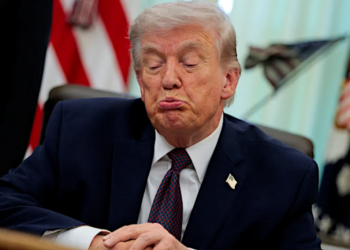
The dizzying rise of Donald Trump is more consequence than cause of the wider upheaval. But he is more than a flash of lightning in a stormy sky. The political coalition that has formed under his banner has the potential to reshape American politics. A large chunk of Silicon Valley has jumped onto the Trump bandwagon, and this alliance between the cutting edge of American capitalist enterprise and the beating heart of American populism is, potentially, a major development. Long after Trump himself has exited the scene, the fate of the coalition he has helped forge will be a principal driver of American and world history.
This is all recent. During the 2016 campaign, Peter Thiel stood out among tech leaders by openly endorsing Trump. The venture capitalist Marc Andreessen proclaimed that Hillary Clinton was the “obvious choice” for president. OpenAI CEO Sam Altman once unabashedly decried Trump as “unfit to be President” and “a threat to national security.”
Trump openly feuded with Elon Musk both during and after his first term and frequently sparred with Jeff Bezos, referring to the Amazon founder as “Jeff Bozo.” Angry about Meta CEO Mark Zuckerberg’s alleged role in the 2020 election, Trump threatened him with life in prison “if he does anything illegal this time.”.
That has changed. Trump’s second inauguration featured tech lords like Zuckerberg, Bezos, Musk, Google CEO Sundar Pichai, and Apple CEO Tim Cook laughing and shaking hands with the Trump inner circle inside the Capitol Rotunda. “In the first term, everybody was fighting me,” Trump joked in late 2024. “In this term, everybody wants to be my friend.” With figures like Anduril’s Palmer Luckey, Palantir’s Alex Karp and Joe Lonsdale, Marc Andreessen, David Marcus, and Mark Pincus jumping aboard the Trump train, Silicon Valley has shifted from a bastion of anti-Trumpers to one of the polarizing president’s chief sources of support.
Not everybody in MAGA world is happy about this shift. “I’m a populist,” Steve Bannon proclaimed defiantly on his influential podcast, War Room. “I’m not gonna kowtow to Zuckerberg. He’s a criminal. Bezos? He’s a weirdo. Musk? No. Not gonna do it. Google? … YouTube banned [us] forever.” Bannon believes that the whole purpose of the MAGA movement is to punish and crush the ruling elite—Wall Street financiers, Washington’s bipartisan donor class, and the Silicon Valley tech billionaires—responsible in his view for turning ordinary working-class Americans into the equivalent of indentured servants and serfs. For Bannon, driving the Muskian moneychangers from the temple of Trump is a sacred task.
The feelings are reciprocated. Elon Musk greeted the December 2025 release of photographs of Steve Bannon with Jeffrey Epstein with a tweet. “Only a matter of time before Bannon goes back to prison,” Musk posted on his social-media platform.
But Donald Trump wants to keep the peace in this fractious coalition, and he seems rather fond of the moneychangers. He is hardly alone. In March, Vice President J. D. Vance addressed the American Dynamism Summit, sponsored by the venture-capital firm Andreessen Horowitz. Identifying himself as “a proud member” of both the techno-optimists and the populist right in the Trump coalition, Vance argued that the alliance is anything but shallow or temporary. “This idea,” Vance asserted, “that tech-forward people and the populists are somehow inevitably going to come to a loggerheads is wrong.”
Many observers see the love affair as purely transactional. Contributing to Trump’s inauguration was a way for tech giants like Google, Amazon, and Meta—as well as prominent Silicon Valley executives ranging from Altman to Uber CEO Dara Khosrowshahi—to get help with Justice Department lawsuits and Federal Trade Commission antitrust investigations.
The same holds true of figures who joined the administration. Elon Musk’s SpaceX is one of the largest recipients of U.S.-government funding, and as of February 2025, Musk’s various companies had pulledin at least $38 billion from government contracts, subsidies, loans, and tax credits. David Sacks, the White House crypto and AI czar, reportedly sold his personal cryptocurrency investments before joining the administration, but the venture-capital firm where he remains a partner continues to invest heavily in crypto-related companies. Commerce Secretary Howard Lutnick’s former firm, Cantor Fitzgerald (now run by his sons), maintains close ties with Tether, the fintech/cryptocurrency company currently under investigation by both the Treasury and Justice Departments for possible violations of finance laws.
Dismissing such conflicts as a grotesque but meaningless assemblage of scandals—the love child of Teapot Dome and Watergate—would be a mistake. We aren’t just witnessing a few episodes of distressing insider dealing and corruption. We are watching the old system dying as disturbing but also dynamic new realities emerge. The restraining forces of custom and law are struggling to withstand the passions and power of a whole generation of business and political leaders. The Gilded Age saw an eruption of scandal and corruption that accompanied and even enabled the transformation of the American economy alongside explosive changes in technology. Donald Trump’s Washington looks like the Gilded Age on steroids.
Since its founding, the United States has been more open than any other large country to the intense activity, sometimes competitive and sometimes cooperative, of two of the most powerful forces in the modern world. One of them is the restless, rowdy, often crude and chaotic but ultimately irresistible force that Alexis de Tocqueville called democracy. The other is capitalism, the greatest engine for revolutionary social transformation the world has ever seen.
Democracy is a tiger, not a pussycat. The orderly, progressive, and highly institutionalized blending of electoral politics with stable administrative states that dominated Western European and American politics for the past half century shares little with this rude and revolutionary force. Democracy emerges from the unappeasable and ultimately ungovernable demand of ordinary people to run their own lives and institutions without the oversight of kings, nobles, colonialists, or even highly educated and credentialed professionals from elite universities who base their policy prescriptions on the latest peer-reviewed scholarship.
The advance of democracy—sometimes classified as a left-wing force (anti-colonial movements, feminist demands for women’s freedom to shape their lives without the control of male hierarchies, workers’ movements in industrial societies, demands by Indigenous peoples and ethnic and racial minorities for the right to shape their own destinies in their own ways), sometimes coded right-wing (contemporary European populism, MAGA, nativism, majoritarian identity politics)—is as unstoppable as it is problematic. American society has historically been more open to this force and given it an earlier, fuller expression than most other large societies around the world.
Capitalism is the other force that restlessly and continually remakes the world. It has the ability to drive scientific discovery and technological progress, to overcome or displace its opponents, and to dictate the terms of both internal and global hierarchies of power and wealth. Those who master its dynamics, adapt to its demands, and unlock its resources gain power within their societies. The societies that can advance to the frontiers of the productive power that capitalism unleashes while maintaining their coherence and élan advance to the front of the race for international status and power.
The remarkable thing about American history is less that populism and capitalism sometimes clash than the extent to which they have managed to work together. America’s ability to maintain popular support for disruptive economic and technological change—changes that ultimately made the country richer and stronger—was critical to the country’s long-term political stability. It was also the indispensable foundation of America’s rise to, and long reign at, the top of the global pecking order.
The distinctive task of statecraft in the modern world is to give capitalism the freedom to develop and intensify, while simultaneously satisfying the democratic aspirations of ordinary people. In practice, this means that the productivity enhancements and wealth capitalism produces must somehow be harnessed to give people more agency in their own lives, and to preserve the fabric of meaning that unites a given population in a sense of community and common destiny.
[John Kaag: A reality check for tech oligarchs]
A productive synthesis between the political requirements of an increasingly populist society and the sometimes-harsh logic of ever-accelerating capitalist development is a relatively rare and precious thing. In America, the interplay—sometimes competitive and sometimes cooperative—between the pro-corporate and business-friendly tradition of American politics that descends from Alexander Hamilton and the populist streak associated with Andrew Jackson has defined the course of the ongoing accommodation between these titanic forces. Hamiltonians have long believed that America’s international security, economic prosperity, and domestic stability depend on a constructive relationship between an enterprise-friendly state and a dynamic private sector. Hamiltonians are accelerationists, seeing capitalism as the source of the wealth and technological prowess that underwrite American comity at home and power abroad.
Jacksonian populists believe that the sources of America’s national greatness lie in the political and cultural instincts of ordinary Americans, and that the chief purpose of national policy, both at home and abroad, should be to protect the people from foreign threats while promoting their prosperity and safeguarding their freedom. Many of the changes that capitalism brings, including the destruction of old industries and the rise of mass migration, are profoundly unwelcome to the Jacksonian spirit. However, unlike populists in many other countries, who view both business enterprise and technological change with inveterate suspicion, American Jacksonians see both enterprise and technological leadership as key elements of the cultural patrimony they seek to defend.
To the extent one can speak meaningfully of American exceptionalism as a historical phenomenon rather than an idealistic aspiration or mythologization of historical experience, its roots lie here. The sense of progress and change embedded in the heart of the American populist tradition makes productive compromise between the demands of democracy and the requirements of capitalism easier for Americans to achieve than for the citizens of many other countries.
Andrew Jackson’s campaign against the Second Bank of the United States, for example, expressed a populist resentment of eastern banking on the part of western and southern states. But what they resented was not that Nicholas Biddle’s bank was capitalistic. It was that the financial structure the bank upheld placed obstacles in the path of the rapid economic development of the cash-hungry frontier. In the language of our time, they wanted to deregulate finance. While the Jacksonian program helped produce a massive depression, the Jacksonians’ intention was to accelerate capitalism by democratizing it, not to tame it by subjecting it to government planning.
Since the 1850s, the health of the Republican Party has largely depended on its ability to build bridges between the agendas of wealthy investors, entrepreneurs, and Big Business on the one hand, and often-angry, disaffected populists on the other. The Republican Congress passed the Homestead Act during the Civil War, giving essentially free public land to farmers, even as it supported the railroads, mining companies, banks, and industrial corporations that made the United States the world’s richest and most powerful state.
Presidents of both parties have pursued this formula. In very different ways, both the Republican Theodore and his distant Democratic cousin Franklin D. Roosevelt forged coalitions including populists and business interests to reshape American institutions in their time.
Donald Trump and his odd-couple coalition of tech moguls and insurgent populists need to be seen against this history. Today Elon Musk and his fellow tech lords advocate what they believe to be the necessary policies to make the United States powerful abroad and rich at home. Steve Bannon and his populist allies represent modern-day Jacksonian discontent as they fight what they see as the illegitimate economic and social privilege of the mostly coastal, well-connected elites.
Forging this fractious coalition was key to Trump’s return to power, and the fate of his second term likely depends on his ability to keep it together. He may well fail. Inflation and unemployment might break his hold on the public mind. The tensions within the coalition might explode, or its agenda might be so radically conceived or so chaotically executed that the public rejects it. The movement could be broken apart by infighting over the succession, international allies might revolt, and domestic adversaries might find more appealing methods of responding to the crisis. The stench of corruption might become so overwhelming that a revolted electorate rejects the entire enterprise.
But whatever the fate of the Trump administration, from Brooklyn to Boise, both the left and the right are testing the boundaries of the civil consensus. The accelerating Information Revolution is reshaping the American corporate landscape, opening new horizons for scientific discovery, threatening millions of jobs, and raising questions about the future of humanity in an age of intelligent machines. Long after Trump passes to his final judgment, the turbulence that brought him to power will be the defining feature of our time.
Donald Trump’s jettisoning of long-established Republican orthodoxies on trade and the role of the state stand among his most startling accomplishments. The liberalization of trade policy and the deregulation of the national economy were central to Republican policy from Ronald Reagan through Mitt Romney’s 2012 campaign. No longer.
Although Trump’s reversal of that long-standing orientation alienated some business leaders, he received more business support in 2024 than he did in 2016. This should not come as a shock. Eras of massive technologically driven change often bring struggles within the business world over economic policy.
The historical figure who did most to develop an American tradition of pro-business government and to embed that tradition in the structure of the American state was Alexander Hamilton. First the Federalists, then the Whigs, and finally the Republicans championed his ideas. The Federalists and Whigs tended to support tariffs, partly for protectionist reasons and partly to generate revenue to build domestic infrastructure. Republicans continued that high-tariff tradition into the 1930s. The Hamiltonian tradition of the Republican Party also included more support for Big Government than the party of Reagan was comfortable admitting.
Hamilton, throughout his tragically shortened career, was preoccupied by the relationship between democracy, power, and wealth. Given the rowdy disposition of the American people, he saw no way to build a stable American state that did not accommodate the demand for popular self-government. Yet, as was obvious to anyone who had studied its history, democratic governance has its pitfalls. Demagogues could prey on the emotions and ignorance of the masses. Rampant corruption was never far away.
The Founders relied on a system of checks and balances to address these dangers. But Hamilton was focused on another threat—and another sort of solution. He put capitalism and technological development front and center in his thinking about the future of the American republic. He believed that capitalist development was essential for national power and unity. Prosperity at home would strengthen and legitimize the federal government, while America’s economic prowess would provide the basis for the military strength that could keep the country secure.
Change is the natural and inevitable result of the Hamiltonians’ success. The capitalism they promote transforms the economy, and they must repeatedly redefine their agenda to meet the new conditions. Hamiltonians supported the construction of the Erie and Chesapeake & Ohio Canals in the early years of the republic, then shifted to railroads, and ultimately to interstate highways and airports. Each of these technologies required novel institutions, legal frameworks, and financial incentives. Managing their consequences required, among other things, the development of the administrative state that so many conservatives currently deplore.
This incessant and, over time, accelerating change in the nature of the economy is what drives continuous changes in the definition of pro-business policy in the United States. What was good for the railroads was not good for the canals, and what was good for slavery-based cotton production was not good for the industrializing free-labor system. The highly regulated post–World War II economy of the 1950s and 1960s was good for monopolies like AT&T, but emerging telecommunications and IT companies needed deregulation to reach their potential in the 1970s and 1980s.
The same was true of trade policy. After World War II, the Hamiltonian calculation on tariffs changed. Federal income tax provided a much larger financial base for projects like Dwight Eisenhower’s Interstate Highway System than tariffs could. At the same time, well-capitalized, professionally managed, and technologically sophisticated American companies dominated the world. And as Western Europe and Japan recovered from the war, American firms were more interested in gaining access to these growing markets than in preventing their exporters from competing in the American market. The importance of economic integration in building a robust Cold War coalition to check the spread of Soviet power was also an important part of the calculation.
With the end of the Cold War, a generation of Hamiltonian policy makers placed an even greater priority on free trade. Enabled by revolutionary advances in communications, computers, and shipping, multinational firms dramatically reduced their costs and enlarged their markets by developing global supply and distribution chains. American firms embraced the idea of a seamless global economy in which information, goods, and capital could move around the world with little friction.
Today, as the Information Revolution transforms American society, a new kind of pro-business agenda is once again emerging. Silicon Valley leaders are not only warming to Trump, they are also proposing a new vision of the national interest. These Tech Hamiltonians share their predecessors’ belief that economic policy, political stability, and national security are deeply connected, but they propose to pursue these traditional Hamiltonian goals in radically new ways.
As the definition of pro-business politics changes, the relationship of that agenda to populist politics also must change. The tech lords who have rallied to Trump see enough overlap between MAGA populism and their emergent Tech Hamiltonian agenda on key economic and culture-war issues to build, they hope, an enduring coalition.
In the post–Cold War era, multinational corporations and their associated intellectuals and politicians defined the Hamiltonian agenda, pursuing the free-trade, free-market, low-tax, and light-touch regulation approach often called “neoliberalism.” They saw American leadership as most securely grounded in a deep web of alliances and multilateral institutions, and were primarily focused on the transatlantic relationship with America’s allies in Europe. In domestic politics, the neoliberal Hamiltonians found their most reliable political partners among order-building Wilsonian idealists, and for 25 years this coalition attempted to build what they called a liberal or rules-based world order that championed human rights, a cosmopolitan post-nationalist elite culture, and a frictionless global environment for the movement of goods and capital.
Although today’s Tech Hamiltonians continue to endorse some elements of this agenda, notably the preference for low taxes and light-touch regulation, they reject much of the approach. They are nationalist, rather than cosmopolitan. They do not see the European Union as America’s preferred partner abroad, and are focused on geopolitical and economic competition with China. At home, they see Jacksonian populists rather than Wilsonian idealists as their most important allies. And while the manufacturing, retailing, and banking executives who led the top American firms in the post–Cold War era saw themselves as scientific managers, the Tech Hamiltonians—often the extremely successful founders of cutting-edge technology firms—see themselves as visionaries and leaders. They are unaccustomed to deferring to professors, think-tankers, and authors of thumb-sucking essays on public policy.
While there are differences among the leaders of the Tech Hamiltonian world, what led so many to the Trump movement is a shared vision of the challenges facing the United States. They believe that the Information Revolution, greatly enhanced by the rise of AI, will disrupt American life and American politics on a massive scale. They see the United States and China at the forefront of this revolution, racing both to develop technologies and to apply their productive power. And they think that the Chinese Communist Party’s ability to direct immense resources toward chosen areas of endeavor and to impose massive changes on its society gives it advantages that the United States will be hard pressed to overcome.
America’s most important problems, as the Tech Hamiltonians see it, are political. At least in the short term, tech-driven automation is going to reduce both blue-collar jobs and white-collar employment in government bureaucracies and private corporations. At the same time, social media will continue to undercut political parties and ideologies. As the disruption increases, political support for suffocating regulations is likely to grow.
The Tech Hamiltonians see Europe as a cautionary tale. In 2024, European regulators, driven in part by voters anxious about online disinformation and polarization inflamed by social media, passed the world’s most comprehensive regulatory framework for artificial intelligence and digital technologies. At the time, the tech industry warned that this new regulation would drive companies overseas, accelerating the mass withdrawal of capital from an already moribund tech sector and start-up ecosystem.
The economic and geopolitical consequences of European technophobia, among both elites and the general public, have been grave. Between 1990 and 2023, the EU’s share of global GDP fell from 23.8 percent to 14.6 percent. India’s GDP is on pace to be larger than that of the entire EU within the next 12 years. On January 16, 2026 of the 50 largest publicly traded tech companies in the world by market capitalization, 33 were American and only four European. Moreover, out of the 65 unicorns around the world with a valuation of at least $10 billion, only five came from countries in the EU, while 44 were American and 10 were Chinese.
[Derek Thompson: How the British broke their own economy]
The central political task for those who see the rapid development of tech capabilities as critical for the future of the United States (and for their own personal wealth and well-being) is to cultivate a permissive environment for the tech revolution even as its disruptive consequences become more widely and more painfully felt. A large number of tech moguls have come to feel that the Democratic Party is essentially useless for this purpose. Whatever sympathies they may have with some of its values, Tech Hamiltonians see the Democratic Party as tied to constituencies—big-city political machines, bureaucrats of all stripes, stand-pat academics, public-sector labor unions, and the NGO-industrial complex—that depend on the old system and will fight the very changes America most needs.
But the old-style, neoliberal Hamiltonian agenda of the classic Republican Party establishment will also never do. The fundamental appreciation of capitalism, techno-optimism, and American power at the heart of the old Republican agenda are valuable and important, but the anti-populist and neoliberal ideology of the Never Trumpers makes them, as Tech Hamiltonians see it, politically irrelevant. Never Trump Republicans simply do not have the political weight to carry forward a transformational agenda. Worse, perhaps, leadership in moments of upheaval requires a certain theatricality and improvisational creativity that establishment Republican politicians tend to lack.
What Tech Hamiltonians see that the old-school Hamiltonians do not is the potential for a coalition with MAGA populism, and a way to work effectively with Donald Trump. MAGA rage against the entitled class of upper-middle-class experts can provide political support for the disruption and wholesale destruction that Tech Hamiltonians believe many bureaucracies need, and for the revolutionary changes in health care and education they think the new technologies will both facilitate and require. And while labor-market disruption is also coming for blue-collar workers, Tech Hamiltonians are comfortable with strategies for addressing blue-collar discontent that old-school Republicans could never accept.
Free trade is the most obvious point of difference. From a theoretical point of view, the advantages of free trade are as great as ever, but as a practical matter, since tech companies do not import or export many industrial goods or raw materials, free trade in goods matters much less to companies like Meta than to those like Walmart or GM. And even tech lords who concede the intellectual case for free trade now view some degree of protectionism as inevitable to safeguard essential supply lines and preserve certain manufacturing capabilities in the United States.
Similarly, immigration is a hill that conventional pro-business Republicans are ready to die on and from which Tech Hamiltonians are ready to retreat. If you believe, as most students of the tech revolution do, that in the short run tech is going to disrupt the jobs of blue-collar workers, you are unlikely to believe that large-scale low-skill immigration is a vital economic necessity. And while the tech lords would like as many H-1B visas for skilled tech workers as they can possibly obtain, they are weighing that objective against the importance of keeping their political coalition reasonably united. Construction companies, fast-food franchisees, retailers, and others whose businesses depend on an abundant supply of low-wage workers might fight for mass immigration. Tech Hamiltonians see things differently, and are open to reducing immigration if that could alleviate blue-collar discontent.
Strong private-sector labor unions also do not pose the same problems for tech companies with small, professional, and well-compensated workforces that they do for large manufacturing and retailing companies. And if the combination of protectionism and immigration restriction results in labor shortages that drive wages higher, tech firms will likely benefit. As wages rise, companies will spend more money to automate. That will build the domestic American market for everything that the tech world produces. A populist economic agenda that looks like an attack on everything sacred to the earlier generation of establishment Republicans simply does not strike the tech world as antibusiness.
On cultural issues as well, the cowboys of the tech revolution find it easy to accommodate MAGA preferences and priorities. Despite the liberal views of more than a few employees, many Silicon Valley companies are eager to shed their DEI bureaucracies and retreat from the pronoun wars. Patriotism is a value that an IP-dependent tech company fighting Chinese rivals might well be happy to see inculcated in its employees. Many tech executives grew weary of what they saw as insubordination by woke employees opposed to collaboration with the Defense Department or other arms of the American government.
The Tech Hamiltonians may see the greatest opportunity for collaboration with the MAGA populists at the intersection of culture and class. AI and related technologies promise to drastically downsize bureaucracies of all kinds, disrupt high-cost economic sectors like higher education, and restructure the delivery of high-value services like health care. Those who profit from the status quo and whose identities and interests are grounded in the high salaries and high-status jobs it currently provides are sure to mount a skilled, determined, and prolonged resistance. That opposition is perhaps the principal obstacle in the path of both the economic goals of the tech industry and the national strategy they believe is necessary. Overcoming that resistance is also very much in the economic and social interest of the tens of millions of Americans who rely on the high-cost services that lawyers, bureaucrats, professors, doctors, and other highly trained, well-compensated professionals currently provide.
The DOGE attack on the federal bureaucracy early in Trump’s second term provided an early glimpse into this future of rapid overhaul and radical downsizing of established, entrenched public bureaucracies. The more substantive assault on independent agencies currently winding through the courts underscores the importance for the Trump movement of the attack on bureaucracy. It is tempting to look at the errors, confusions, casual cruelties, and missteps of the teenage DOGE operatives—reforming agencies whose history, function, and legal position they do not always understand—and dismiss the entire project.
That would be a serious mistake. It is more than ideological opposition to some bureaucratic decisions or regulations that drives the Tech Hamiltonian assault on the administrative state. From a technology point of view, a bureaucracy is a primitive form of AI, with well-paid human professionals applying algorithms—that is, laws and regulations—to facts. There is no reason, as many tech enthusiasts see it, why most of the work now done by these bureaucratic organizations could not be done by AI. And the AI versions of bureaucracy will likely be cheaper, faster, and easier to reprogram when circumstances change than their human counterparts.
Compared to the blue-collar workers displaced in earlier waves of modernization, the highly educated members of the bureaucratic class have a much greater ability to make their pain heard and felt in the political system. In a MAGA movement that mobilizes blue-collar Americans around the cross-racial class resentment of elites to drive big changes through the service professions, the Tech Hamiltonians have, they hope, found an invaluable ally.
No political ideology, no matter how coherent, and no political coalition, however robust, ever achieves total victory in American politics. The Tech Hamiltonians, who bring an ambitious program with a fragile coalition to a tumultuous era, will be no exception to this rule.
In the short term, their alliance with Donald Trump can go sour. Trump’s popularity may wane and his friends and allies be tarred by their association with a figure most of the country would rather forget. Alternatively, Trump’s pursuit of his political interests could lead him to break with the Tech Hamiltonians as enthusiastically as he once embraced them. In the Trump Age, no alignments are stable.
But over the long run, the relationship of Tech Hamiltonianism to the ideas and interests of the larger business community, the degree of competence and coherence they can bring to the implementation of their agenda, and their ability to forge deep and constructive links with MAGA populists will matter more than their relationship to our current president.
The Tech Hamiltonians are the voice of only one part—although perhaps the most dynamic and most rapidly growing part—of the American business community. But in the foreseeable future, the American business community will not speak with one voice. The legacy multinationals will still be among us. Construction and hospitality firms dependent on cheap labor will still have a voice. Should the AI frenzy on Wall Street turn out to be a bubble that pops, should AI fail to live up to the sweeping claims made in its name, the pendulum of power in the business world could rapidly shift.
The tech world’s rise to its current economic dominance has been dizzyingly fast. As recently as 2005, only eight of the top 100 firms on the Fortune 500 list were info-tech companies, and as recently as 2013, ExxonMobil remained the most valuable publicly traded company in the world. Today, tech stocks are a key driving force within the S&P 500, while boasting nine out of the top 10 most valuable companies by market capitalization. The so-called Magnificent Seven—Apple, Microsoft, Amazon, Alphabet, Meta, Tesla, and Nvidia—now represent roughly 35 percent of the S&P 500, a stunning increase from their roughly 12 percent share in 2015. In 2008, when Mark Zuckerberg made his first splash on the Forbes richest-persons list, he was one of the few U.S. billionaires who had made his fortune primarily in tech. In 2025, nine out of the top 10 richest business tycoons in the country derived their wealth, which totals more than $2.2 trillion, from tech companies.
Even so, roughly 65 percent of the value of the S&P 500 remains in non-tech companies. Amazon might be one of the Magnificent Seven, but its business model requires cheap imports and, until it can fully automate its distribution network, cheap immigrant labor. Plenty of companies, including some of the most important Wall Street banks, think competition with China is a cost to contain rather than a cause to embrace. Tech Hamiltonians might dominate the tech sector, but much of the Republican establishment and the American business world remains attached to the older model of Hamiltonian policy. The ability of the Tech Hamiltonians to define what pro-business policy looks like is tied to the degree to which the tech industry continues to displace older firms and industries.
And then there is the pesky problem of execution. Celebrating AI’s potential to make bureaucracies smaller, cheaper, and more effective is easy, but realizing that potential is a task that requires a lot of skull sweat. AI might bring advances to medicine, or make the law cheaper, but making any of these things happen on a large scale is hard, as Elon Musk’s not-always-artful DOGErs discovered early in the Trump administration. Those who might be displaced or de-skilled by the advancing tech wave will fight in the office with passive aggression, in the media with poisonous leaks delivered at just the worst time, and in legislatures through the voting power of the bureaucrats, teachers’ unions, and other interest groups.
Beyond that, the tech lords often suffer the vices of their virtues. Having built multibillion-dollar companies, often at a young age, their self-confidence frequently leads them to underestimate the complexities of public policy, to misunderstand public opinion, and to overestimate their ability to push large changes through quickly. For the tech revolution to reach its potential, the forces of reform and renewal will need managers who understand the inner workings of industries like America’s insanely complex system of health care. Every Cortés needs a Malinche.
All too often, the implementation of the tech revolution in a given enterprise or bureau depends either on outsiders who don’t know how things work and break more than they constructively change or on captives of old ways of thinking and old professional and intellectual networks with blinkered ideas about change. In the private sector, the driving need to earn a profit often tips the scale in favor of change. In government, different voices tend to prevail.
Tech Hamiltonians and Silicon Valley enthusiasts are often inexperienced in the ways of government and unaccustomed to the compromise and diplomacy that successful policy implementation often requires. And the old hands who know their way around the Washington labyrinth mostly see the Tech Hamiltonians as a menace to be thwarted, and so use their talent and knowledge to work against rather than for the new regime.
[Ali Breland: So much for the MAGA divorce]
The Tech Hamiltonians must also find some means of maintaining their strained coalition with the growing universe of disaffected voters, both on the right and on the left, who identify with some form of populism. Few Jacksonian populists expected or welcomed the participation of people like Elon Musk in what they thought of as their movement. When Trump gratified his Tech Hamiltonian supporters with his December 2025 executive order banning state AI regulations, much of MAGA was horrified. The gaps in worldview and economic and political interest between blue-collar Americans and uber-rich tech lords are real and consequential. Their economic interests may further diverge as tech-driven restructuring throws millions of working-class Americans out of work.
Flag waving, immigration restriction, and culture-war rallying cries can shore up the MAGA-tech coalition, but more will be needed to achieve lasting success. In the 19th century, the Homestead Act offered free public land to any American citizen who lived on a claim for five years, cementing the loyalty of millions of voters to a Republican Party that was simultaneously gifting public resources to railroads and mining companies. In the 20th century, the 30-year mortgage and highway construction combined to make suburbia possible, creating strong bonds between middle-class Americans and the political and business establishments. Tech Hamiltonians will have to find their own way to link the economic and social well-being of ordinary American families to the new economy they seek to create.
Even Americans unsympathetic to this emerging coalition need to recognize that we are dealing with something deeper and more lasting than the eccentricities of a particularly gifted politician and the greed of a few companies. The success of this new coalition is by no means guaranteed. But whether it fails or whether it succeeds, the results of this latest attempt to build an alliance between the heirs of Andrew Jackson and Alexander Hamilton could define American politics for a generation to come.
The post The Rise of the Tech Hamiltonians appeared first on The Atlantic.