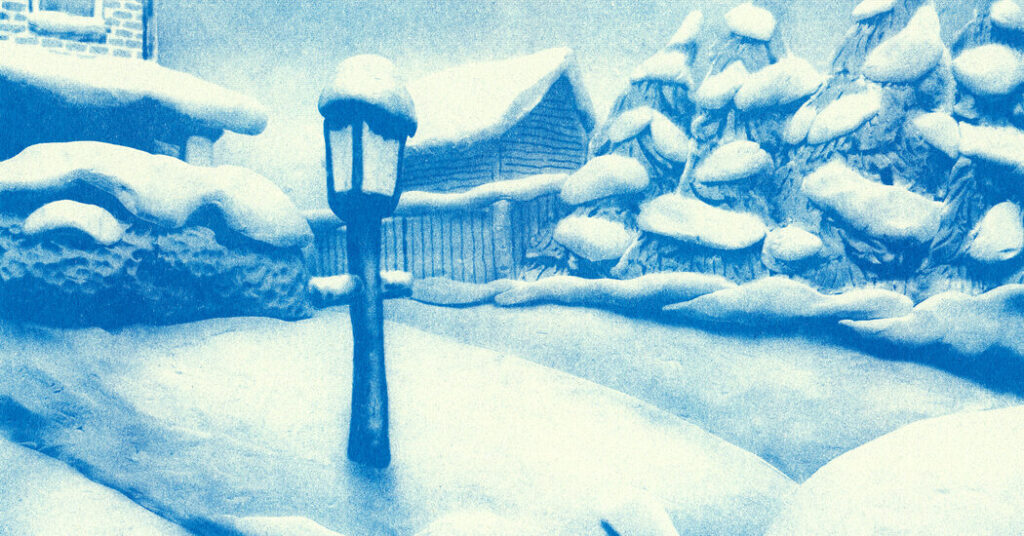
During the past several weeks, the ground in Bethany, Conn., where I live, has been pocked with wildlife tracks, a ledger of activity made visible by snow. Unlike last year, when hardly a flake fell or stuck, this year we wake to white drifts and forecasts of more on the way. Significant snowfall arrives overnight into days as hushed as prayer. The blanketed evergreen boughs hang heavy, and the twinkling lights winding up the driveway eke out their glow from under milky domes. The dog wakes early to bark at a dry ball of hydrangea blowing across the white canvas of the lawn.
After snowfall, for a moment, everything is different than it was the day before. Each shape softens, as if the world has been converted from all caps to lowercase. The outdoor palette simplifies into fewer hues; the muddy footprints and paw prints and the mangy doormat on the front step are buried, as if erased. A blanket of forgiveness.
Philosophers have not had much to say about snow. In a short essay about the cold from 2011, the poet Charles Simic writes, “If only Plato and Socrates had to scrape the ice off their windshields. …” How different might things be if, instead of lazing under a plane tree with Phaedrus at high noon in the Grecian summer, Socrates and the beautiful boy had trudged through knee-deep snow. Would they have talked, as they did, about love, language and memory, about the myth of the Muses who were so moved by humans singing that they turned them into cicadas? I doubt it, but we’ll never know.
Snow never lasts. But, notwithstanding Western philosophy’s infatuation with the infinite and the unchanging, the finite and the ephemeral are no less divine. In the rare moments when philosophers have mentioned snow, it seems as if they are actually talking about something else: Nietzsche’s “snow-bearded winter sky” standing for a vast, concealing silence, Thoreau’s wintry morning for “sturdy innocence” and “Puritan toughness.” The Norwegian writer Karl Ove Knausgaard has a book titled “Winter,” in which he describes the season as a transient, ignoble trickster trying (and failing) to compete with spring, summer and fall. It’s true that snow yields almost immediately to brown slush and icy walkways that can wreak havoc for those trying to go places. But the transience of snow is part of its magic. Thick drifts of white last for only a day or so. The sky confettied, a hush descending.
Poised between solid and fluid, snow shares the poignancy of anything that lives only in what Emerson calls “a narrow belt,” a special zone between rigid geometry and chaotic sensation. A child’s innocence, poetry, toast before it goes cold, amaryllis blooming. They exist in just the right space at just the right time, precariously balanced on an edge. Catching them in that glorious moment in which they are fully themselves is lucky and rare, like catching snowflakes in your eyelashes before blinking them away.
Whenever it snows, I think not of philosophers but of William Kentridge and a gummy eraser going over a charcoal drawing, pushing light into the dark. Most of the best writing about snow has come from poets and novelists: Wallace Stevens urging us to listen in the snow for the “nothing that is not there and the nothing that is,” James Joyce describing the snow “falling faintly” and “faintly falling” in the last lines of “The Dead,” Ezra Jack Keats’s beloved Peter storing a snowball in his pocket in “The Snowy Day,” Jack London reminding us of the difference between knowing a fact and acknowledging a reality in “To Build a Fire,” William Steig teaching us about heroism in “Brave Irene.”
The last one, in particular, has a special place in my heart. The story, in case you don’t know it, is about a little girl, Irene, whose mother, a seamstress, falls ill after completing a dress for a duchess. Irene puts her mother to bed with blankets and tea and sets off on foot in a snowstorm to deliver the dress herself. I read it aloud to my daughter on a snowy night several years ago, just before she outgrew the ritual of bedtime stories.
Irene gets caught in a fierce storm. The wind howls and eventually snaps the tree limbs around her and blows the dress right out of the box and out of her arms. She’s too far away from home to turn back, and she presses on with the empty box, ashamed and upset. Snow falls as Irene trudges through deep drifts. Night descends, and Irene twists her ankle. After several pages showing Irene freezing and alone, everything getting harder and worse, Steig changes course. Irene sees the duchess’s mansion aglow through the trees. She uses her box as a sled and flies down the slope toward the light, finding (remarkably!) the pink dress splayed against a tree just outside the door. She folds it in her box and delivers it just in time for the start of a party.
After we finished the story, I remember, my daughter looked visibly relieved, if unconvinced. She had questions: Isn’t the dress wet and cold? Isn’t Irene scared to knock on the door? Doesn’t she need a doctor? The book, which was meant to lull her to sleep, instead left us debating the details with our heads pressed into a pillow. I didn’t have the answers. Still, the ending is happy. The child is cozy. The mother gets well. How unusual. How blessed. The snow falls gently in fat flakes, settling into the grooves of everything like mortar mending all the cracks.
The French philosopher Jean Wahl coined a term, “trans-descendence,” to describe how spiritual things descend. They fall sometimes like snow, coming all the way down to earth. Maybe not forever. But it’s good to be reminded, however briefly, that the short, dark days of winter include pristine quiet, epic cold, the equanimity of nature, the sun rising, visible breath, icy limbs, rosy cheeks, and every now and then, light falling out of darkness to blanket a rough world. Let it snow.
Megan Craig is an essayist, a visual artist and an associate professor of philosophy at Stony Brook University.
The Times is committed to publishing a diversity of letters to the editor. We’d like to hear what you think about this or any of our articles. Here are some tips. And here’s our email: [email protected].
Follow the New York Times Opinion section on Facebook, Instagram, TikTok, Bluesky, WhatsApp and Threads.
The post The Peculiar Magic of a Winter Snowstorm appeared first on New York Times.