While President Trump seemed to threaten military action this month in Greenland over a national security crisis that no one else could see, he has been nonchalant about a far more serious risk of war in the Taiwan Strait — in ways that elevate the peril.
Late last month, China launched missiles around Taiwan in live-fire military exercises that looked like a practice run for a blockade of the island. Major countries, including Britain, Germany and France, promptly called on China to grow up (though a bit more diplomatically). There was one conspicuous absence: the United States.
Trump downplayed China’s military exercises. It wasn’t until two days after they had wrapped up that the Trump administration issued a statement — from just a deputy State Department spokesman — expressing concern.
All of which raises a question: If Trump can’t even respond promptly to a straightforward provocation by China, what hope is there that he would respond decisively if President Xi Jinping of China actually attacked Taiwan? And another question: Does Trump’s passivity increase the risk that Xi will take reckless actions toward Taiwan?
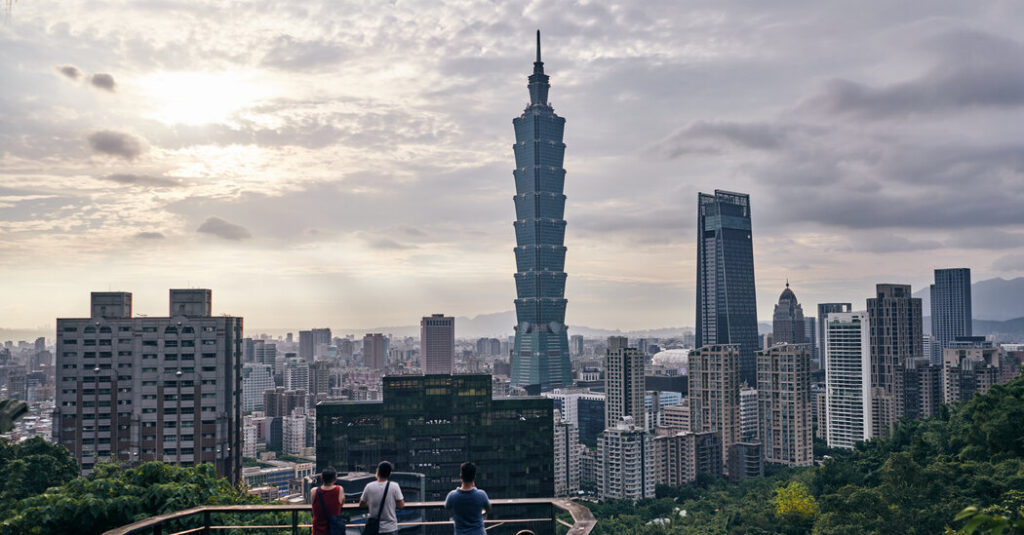
As I wrote in a recent column from Taiwan, of all the calamities that might befall the world in the coming decade or so, a war in the Taiwan Strait would be among the worst. It would risk an exchange of nuclear weapons between the United States and China.
Wars are expensive in every way, while deterrence is a bargain. And while deterrence will depend heavily on Taiwan’s political will, Trump should be doing everything possible to convey to Xi that China would face devastating costs if it attacked Taiwan. Alas, Trump seems to be doing the opposite, signaling to Xi something closer to a yawn.
“That’s up to him, what he’s going to be doing,” Trump said in an interview with The Times this month, referring to how Xi might handle Taiwan. “But, you know, I’ve expressed to him that I would be very unhappy if he did that, and I don’t think he’ll do that. I hope he doesn’t.”
That was a shockingly mild response, and it contrasted with the concern in Trump’s own Defense Department. Adm. Samuel Paparo, head of the Indo-Pacific Command, warned last spring that “Beijing’s aggressive maneuvers around Taiwan are not just exercises — they are dress rehearsals for forced unification.”
And just last month, the Pentagon issued a major report warning about China’s gains in military power, including cyber, space and nuclear weapons and artificial intelligence, and asserting that “China expects to be able to fight and win a war on Taiwan by the end of 2027.”
That may be alarmist. My view is that Xi would much prefer to avoid war. But he is hard to gauge, and Trump’s seeming lack of interest in the topic surely plays into Xi’s calculations of the costs and benefits of aggression against Taiwan.
Ko Chen-heng, a longtime Taiwan security official who now leads a military think tank in Taipei, told me that Chinese generals are probably sobered by Trump’s decisiveness in attacking Venezuela and by the ease with which American forces foiled Chinese-made radar systems in Venezuela.
But Ko also noted that Trump’s mild reaction to China’s military exercises may encourage China, Russia and North Korea to test America in the Pacific.
If a test is underway, I fear Trump is failing it. And some in Taiwan are nervous that Trump’s desire to make his April summit with Xi a diplomatic triumph will lead him to casually make concessions that damage Taiwan’s security.
Trump’s puzzling deference to Xi has been on display over the last two months, as Beijing has undertaken a frenzied campaign against Japan. The campaign began after the Japanese prime minister, Sanae Takaichi, indicated that her country might respond militarily if China used force against Taiwan.
“If you stick that filthy neck where it doesn’t belong, it’s going to get sliced off,” a Chinese diplomat publicly warned Japan.
Any normal president would have called Takaichi to show support. Instead, Trump had a call with Xi and then reportedly advised Japan to pipe down. This felt like a betrayal of an ally essential to deterring Chinese aggression.
Why should we care about Taiwan? For starters, it’s now arguably the most democratic place in Asia, and it would be better if it didn’t fall under a rival nation’s oppressive thumb. More broadly, Taiwan manufactures most of the world’s advanced chips, so a war there might trigger a prolonged global depression and deprive the U.S. economy and military of critical inputs. In addition, Taiwan is part of the first island chain that limits China’s ability to project power across the Pacific, so its loss would be an immense setback for American military, political and economic influence.
The United States traditionally has declined to say whether it would defend Taiwan from a Chinese invasion. But this policy of “strategic ambiguity” oscillates with the president, and Trump seems much less inclined to protect Taiwan than some of his predecessors.
To the Trump administration’s credit, in December it announced an $11 billion arms sale to Taiwan, a huge package that will help with deterrence. But overall I fear that Trump has projected a dangerous weakness.
One reason for Trump’s diffidence may be his dismissal of Taiwan as a tiny island far less significant than China. Another may be vulnerability: Americans don’t seem to understand how much Xi outmaneuvered Trump in 2025. Trump started a trade war with Beijing, and Xi responded to Trump’s tariffs by restricting exports of rare-earth elements, forcing an American surrender and leaving Trump in effect on a Chinese leash.
In 1996, President Bill Clinton dispatched two aircraft carrier strike groups to support Taiwan during a crisis. But Trump knows that if he made a similar move today, China would most likely cut off rare earths and hobble the American economy.
So instead of America’s deterring China from aggression against Taiwan, Xi may be deterring Trump from defending Taiwan.
Trump should take two critical steps to boost deterrence. First is to ensure that Russia loses in Ukraine or pays a staggeringly high price. If Xi saw the world united behind strong anti-Russia sanctions and asset confiscations as well as overwhelming support for Ukraine that made Moscow likely to lose, he would hesitate to attack Taiwan.
Second, the United States should cultivate friends that would stand with us in a conflict over Taiwan. President Joe Biden knit together Japan, South Korea, the Philippines and Australia for that purpose. It would also help to have friendly countries ready to sanction China and to support a blockade of Chinese shipping through the Malacca Straits.
Trump is taking neither step, of course. And by chasing a fantasy in Greenland and seemingly running away from Taiwan, he elevates the risk of an actual nightmare of a war.
The Times is committed to publishing a diversity of letters to the editor. We’d like to hear what you think about this or any of our articles. Here are some tips. And here’s our email: [email protected].
Follow the New York Times Opinion section on Facebook, Instagram, TikTok, Bluesky, WhatsApp and Threads.
The post The Island That Actually Matters to American Interests appeared first on New York Times.