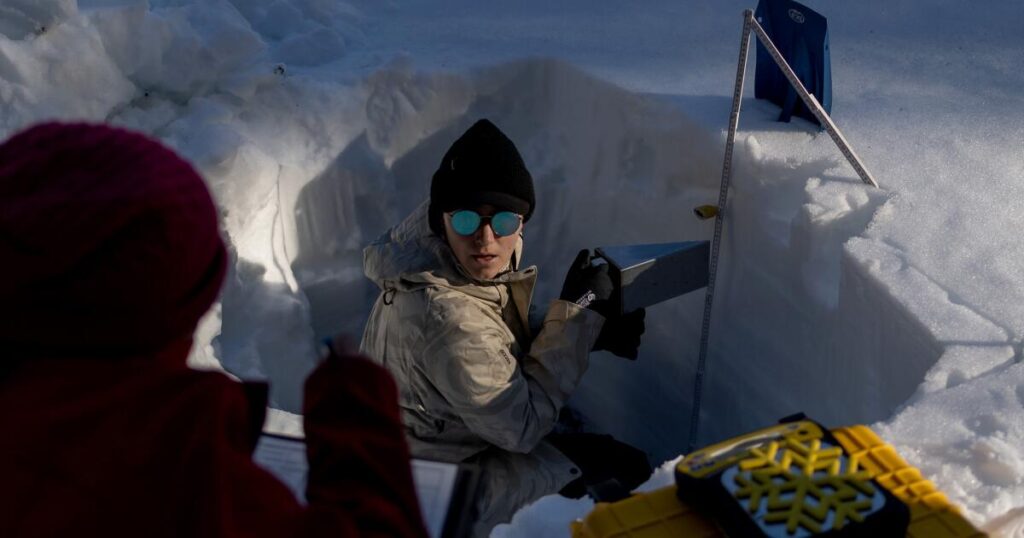
At UC Berkeley’s Central Sierra Snow Laboratory, located at 6,894 feet above sea level near Donner Pass, researchers collect detailed measurements of the snowpack each day.
There is still some snow on the ground to measure, but less than they usually see in late January.
The reason: Extraordinary warmth has been the norm across the West this winter. Many areas, from the Sierra Nevada to the Rocky Mountains, have experienced record or near-record high temperatures since November.
The result is a snowpack far smaller than average for this time of year in most parts of the mountains, especially at lower elevations.
“The story so far at the lab has been that we’ve had a warm winter where we’ve had plenty of rain, not necessarily as much snow as we would hope,” said Andrew Schwartz, the lab’s director.
So far this winter, the lab has recorded precipitation that measures 120% of average, but the warm temperatures have meant more precipitation falling as rain rather than snow.
As of Jan. 23, the snowpack at the lab stood at 61% of average for this time of year, with about 2 feet of snow covering the ground around the facility.
Other areas are faring worse. In parts of Utah, Colorado and other Western states, federal data show snow levels at some locations are at or near record lows.
Across the Sierra Nevada, measurements show that California’s snowpack stands at 66% of average for this time of year. There are regional differences, with the northern Sierra measuring 50% of average and the southern Sierra at 86% of average — boosted by above-average snowpack on some of the high peaks.
There has been very little snow in low-elevation and mid-elevation areas this winter — a symptom of climate change, as warmer temperatures push average snowlines higher.
“That is the classic global warming mountain snowpack signature,” said Daniel Swain, a climate scientist with UC Agriculture and Natural Resources.
“If it’s 2, 3, 4, degrees Fahrenheit warmer on average today, which it is in many of these places, that now means on average you’re well on the wrong side of the freezing line,” Swain said. “You’re more likely to have rain rather than snow.”
California’s snowpack has traditionally provided nearly a third of the state’s water supply, but the snowpack and runoff patterns are shifting as the use of fossil fuels and rising concentrations of greenhouse gases continue to push global temperatures higher.
“Everything that’s below about six or 7,000 feet anywhere in the West is not doing well in terms of snowpack because it has been record warm,” Swain said.
But in terms of California’s overall water supplies, he said, the state is in good shape this year.
The state’s major reservoirs sit at 126% of their average levels. Reservoirs rose over the last three years thanks to average or above-average amounts of snow as well as rain.
Statewide precipitation has been well above average since October. In 2025, parts of Southern California experienced the wettest November and December on record.
No part of California is currently experiencing drought conditions, or even abnormally dry conditions, according to the U.S. Drought Monitor website.
“From a water supply perspective, we’re doing just fine, and we will be regardless of what happens the rest of the winter,” Swain said. “We can take a bit of a breather, at least from a drought perspective. This is not going to be a problematic year in California.”
It’s a very different situation, however, in the Rocky Mountains, where snowmelt sustains the Colorado River.
Across much of the watershed, the snowpack this winter is “abysmal,” Swain said, with some areas now having record or near-record low amounts of accumulated snow.
The snowpack in the upper Colorado River region now measures 61% of average for this time of year, according to federal data, after the warmest November-December in 130 years of records.
That ranks among the smallest accumulations of snow at this time of year in more than a half-century of records, with only 1981 having a significantly smaller snowpack, said Jeff Lukas, an independent climate researcher in Colorado.
In the lower Colorado River region, which contributes minimal runoff to the river, the snowpack is now a paltry 32% of average for this time of year.
Big fluctuations from wet to dry are a natural feature of water in the West. But in the last quarter-century, the Colorado River has lost about 20% of its flow, and research shows climate change has intensified the long stretch of mostly dry years.
The river provides water for farms and cities across seven states, from Wyoming to California, as well as northern Mexico. Its reservoirs have dropped dramatically as drought has persisted and water use has outstripped the shrinking supply.
Negotiators for the seven states that rely on the Colorado River have been holding talks to try to agree on a long-term plan for cutting water use.
The meager snowpack could mean the long drought in the Colorado River Basin intensifies again this year, Swain said.
The weather could still turn around and bring more snow in February and March, he said. But based on how far below average the snowpack remains in the Rocky Mountains, a full rebound seems very unlikely this year.
The post Rain, not snow: Extraordinary warmth leaves mountains less snowy across the West appeared first on Los Angeles Times.