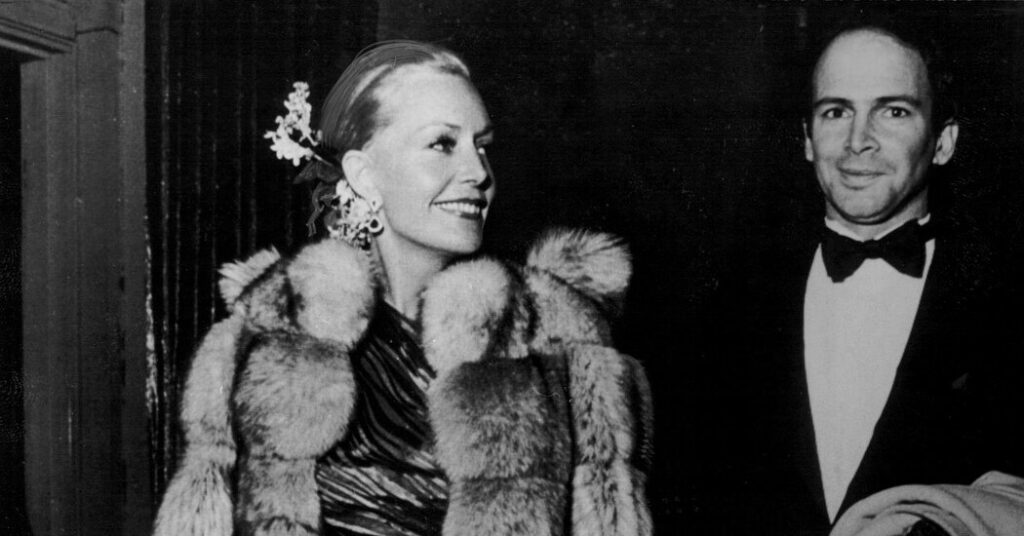
Pat Montandon, the inexhaustible San Francisco society figure, gossip columnist and author who turned her attention to world peace after being left by her wealthy husband, the food and real estate magnate Alfred Wilsey — a drama covered avidly by the press and with wry candor by Sean Wilsey, her only son, in his best-selling 2005 memoir, “Oh the Glory of It All” — died on Dec. 21 at her home in Palm Desert, Calif. She was 96.
Ms. Montandon’s death was confirmed by her son.
In 1960s San Francisco, Ms. Montandon was known for her beauty — “Pretty Pat,” the local papers called her before they turned on her. She was also known for her lavish, themed dinner parties and for her “round table” lunches on various topics — crime, say, or women’s liberation — at which you might run into a Black Panther like Eldridge Cleaver or a folk singer like Joan Baez or a well-known psychologist like Rollo May
She dispensed party tips on the radio, wrote a book called “How to Be a Party Girl” (1968) and wore evening gowns and feather boas to introduce movies on local TV.
Esquire magazine once declared her the West Coast’s No. 1 hostess, and Armistead Maupin lampooned her in “Tales of the City,” his serialized novels about San Francisco, as the character Prue Giroux, a striving and batty socialite (although they later became friends). Herb Caen, the society columnist at the San Francisco Chronicle, made it his mission to skewer her regularly, particularly after her divorce from Mr. Wilsey, referring to her variously as Pushy Galore and the Dumb Blondshell.
“Meeting mom,” Mr. Wilsey wrote in his memoir, “is like meeting a celebrity you’ve never heard of.”
She was game and resourceful, the seventh of eight children of itinerant evangelical preachers whose tent revival ministry took the family throughout West Texas, New Mexico and Oklahoma. During childhood, she picked cotton for pennies. At 19, she survived heart surgery.
Later, she had a chaste summer-long courtship with Frank Sinatra and endured a 12-year marriage to an abusive rancher, a six-month marriage to a gay man and a faux marriage to Melvin Belli, the roguish consumer-rights lawyer also known for representing Jack Ruby, who shot Lee Harvey Oswald, the man accused of assassinating President John F. Kennedy. Mr. Belli was 25 years her senior, and to her relief, their wedding, a Shinto ceremony in Japan, was not legally binding. “Thirty seconds over Tokyo” was how Mr. Caen, the society columnist, described their 36-day union.
Her marriage in 1969 to Mr. Wilsey, who had turned his family’s dairy business into a multimillion-dollar concern, was charmed, until it wasn’t. He wooed her with a home-cooked meal and by cleaning her kitchen, and after they married, built her an idyllic country house in Napa Valley. But after 10 years of marriage — a week after throwing her a 50th birthday party — he told her he wanted a divorce. And then he played hardball.
Suddenly, she was no longer a darling of the press. Reporters, especially Mr. Caen, covered the divorce trial in forensic detail, pillorying Ms. Montandon for requesting a $57,000 monthly settlement and roasting her for her expenses. A local D.J. spent an entire day repeating, “$500 a month on flowers!” in the time slot reserved for announcing his station’s identification. The National Enquirer also weighed in, running a full-page photo of Ms. Montandon under the headline “World’s Most Expensive Wife.”
The judge sided with Mr. Wilsey, who represented himself, awarding her the couple’s marble-lined penthouse, $20,000 a month for eight years and none of Mr. Wilsey’s vast fortune.
In the meantime, Mr. Wilsey had married Diane Buchanan Traina, known as Dede, a Napa neighbor and close friend of the couple’s who was 15 years Ms. Montandon’s junior and who had perhaps been more strategic than neighborly in her attentions to the family. Her former husband, John Traina, coped by marrying Danielle Steel, the romance novelist.
Ms. Montandon did not cope as well. She sank into a depression so deep that she pleaded with her son, who was then 11, to die by suicide with her.
Then she found a New Age therapist and had a vision of nuclear annihilation, followed by an epiphany that involved marshaling groups of children, including her son, to travel the globe with her, delivering pleas for peace to world leaders.
The concept was unformed and a bit loony, but it worked. World peace may not have been achieved, but Ms. Montandon, dogged and glamorous, and her band of youngsters proved irresistible to heads of state. Film crews documented their adventures. They met with Pope John Paul II; Indira Gandhi, who was then prime minister of India; Menachem Began, then prime minister of Israel; and Helmut Kohl, then chancellor of Germany. They unfurled banners at the Berlin Wall. They visited Hiroshima, the Japanese city where the U.S. had dropped an atomic bomb in 1945. And they made former President Mikhail Gorbachev of the Soviet Union cry.
In 1986, a friend told Ms. Montandon that she had been nominated for the Nobel Peace Prize. (The author and Auschwitz survivor Elie Wiesel won that year.) She was not without a sense of humor, noting in her memoir that she had postponed a face lift, as that had seemed inappropriate under the circumstances: “Unfortunately my sacrifice did not impress the Nobel committee,” she wrote.
“She was like a character out of a Tennessee Williams play,” Mike White, the filmmaker and creator of the HBO series “The White Lotus,” said in an interview. At 14, he was among the children that Ms. Montandon brought to Eastern Europe in the winter of 1984.
“She was self-mythologizing,” Mr. White added, “and a perfect marriage of feminine warmth and steely determination. We met world leaders and lit candles. She was the girl who couldn’t hear no. If she did, she doubled down. I was mesmerized by her.”
For years, lore about Ms. Montandon’s adventures was confined to the Bay Area and diplomatic circles. (She was apparently a celebrity in Russia.) But in 2005, her son’s memoir was published to glowing reviews, and serialized in the San Francisco Chronicle and The New Yorker, and her notoriety grew.
“Oh the Glory of It All” is Mr. Wilsey’s harrowing, and often hilarious, account of surviving the carelessness of his wealthy, self-involved parents, and the startling cruelty of his stepmother.
“The reader can only be thankful that Pat Montandon’s peace-and-love agenda has so far failed to persuade her son to forgive his enemies — specifically, Dede,” Francine Prose wrote in her review for The New York Times. “Wilsey’s portrait of a scheming stepmother is so deliriously searing and so convincing that it might prompt negligent parents to consider the probable downside of providing Junior with subject matter for the tell-everything autobiography. Among the true glories of it all, as Sean Wilsey so aptly reminds us, is the fact that writing well is indeed the best revenge.”
Ms. Montandon took some hits, too, but she rallied. His portrait of her — her often-delusional thinking, her grandiosity and her sheer dottiness — was astute but loving.
“The first thing she said when she read it was, ‘Sean, it’s such an accurate portrait of so many people I know that I have to conclude it’s also an accurate portrait of me,” Mr. Wilsey said in an interview. “And I’m going to have to think about that.’”
He added: “It was agonizing for a while but we got to a truly good place with the whole thing. I would never have written that book later in life” — Mr. Wilsey was 34 when it came out — “but it was something I had to do then, and it was really generous of her to put up with it.”
Ms. Montandon’s own memoir, originally titled “Whispers From God,” came out in 2007. She didn’t intend it as a rebuttal to her son’s book, but without her knowledge, her publisher, Judith Regan, changed the title to “Oh the Hell of It All,’’ with a cover design that mimicked Mr. Wilsey’s. It was a good marketing ploy, but despite the subject matter, which included a chilling encounter with the Russian mafia, after it had commandeered 70 tons of the food aid Ms. Montandon had delivered to Moscow — and despite a blurb from Mr. Gorbachev — it was not the blockbuster her publisher had hoped.
Patsy Lou Montandon was born on Dec. 26, 1928, in Merkel, Texas, to Myrtle Caldonia (Taylor) Montandon and Charles Clay Montandon, ministers in the Church of the Nazarene, an evangelical Christian denomination. Her mother was ordained, but it was her father who preached. His sermons were heavy on the wages of sin — lots of fire and brimstone.
During the Depression, the Montandons were often on government relief. When Patsy Lou was 13, her father’s health failed, and they settled in Waurika, a small town in Jefferson County, Okla. He died soon after.
As a teenager, she worked as a waitress, and then as a model for Neiman Marcus in Dallas. She landed in San Francisco in 1960, after divorcing her first husband, the rancher Howard Groves, and went to work at Joseph Magnin, the department store.
In the late 1990s, when Ms. Montandon was in her 70s, she left San Francisco for Beverly Hills, Calif. “I’m going to repot myself,” she told her son.
In addition to Mr. Wilsey, she is survived by two grandchildren.
As for her old nemesis, Mr. Caen, Ms. Montandon got her own back long ago, when she reported on his divorce in her society column for the San Francisco Examiner.
His communal assets, she noted, included a family home, a ’69 Mercedes and a ’77 Honda Civic.
“Life ain’t easy, honey,” Ms. Montandon wrote. “Ask one who knows.”
Penelope Green is a Times reporter on the Obituaries desk.
The post Pat Montandon, Socialite Who Sought Publicity, and Then World Peace, Dies at 96 appeared first on New York Times.