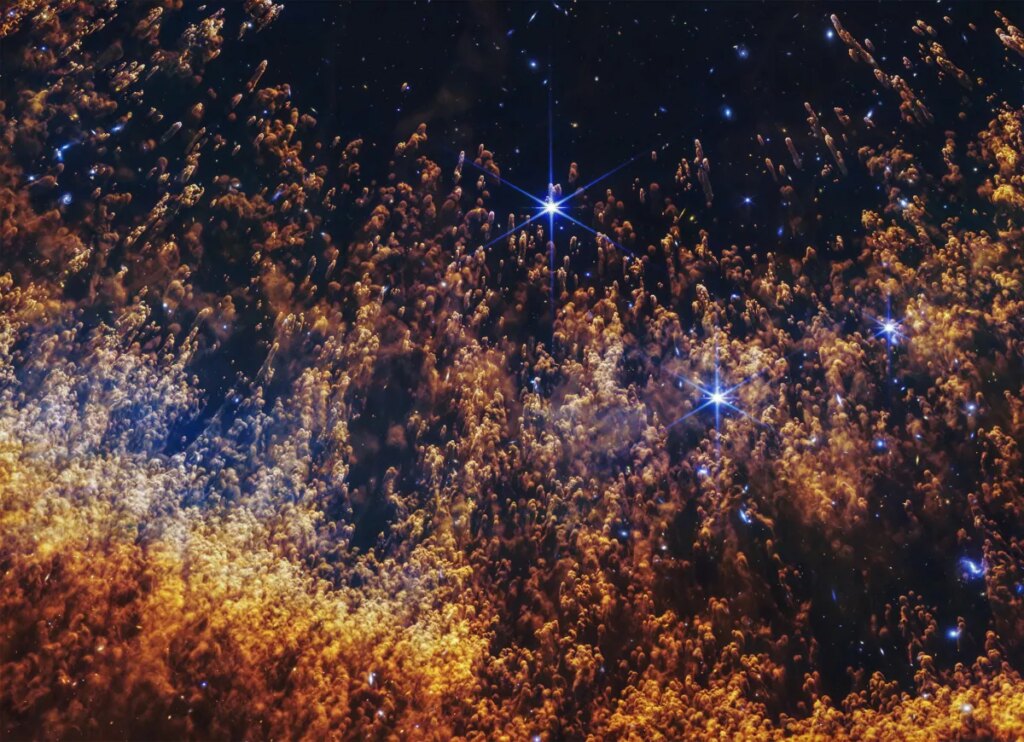
A new image taken by NASA’s James Webb Space Telescope provides an astonishingly close up look of a dying star crumbling into gas and dust — as well as a morbid preview of the fate that could eventually befall our Sun.
Taken with the Webb’s NIRCam infrared instrument, the image shows the inner ring of a luminous, expanding cloud of hot material that was exuded by a star that shed its outer layers to become a dense core called a white dwarf, which is now in the middle of blasting the billowing cloud with ionizing radiation.
Galactic upcycling Webb captured a new close-up of an old favorite, the Helix Nebula. We’ve seen this region before with telescopes like @NASAHubble and the retired Spitzer Space Telescope, but Webb zooms into this dying star with a deeper, more detailed view.… pic.twitter.com/cCxWeMM045
— NASA Webb Telescope (@NASAWebb) January 20, 2026
Zoom out, and you may recognize the cosmic scene as the famous Helix Nebula, known for its resemblance to the “Eye of Sauron” from the “Lord of the Rings” saga. Located 650 light years away, the iconic object is specifically what’s known as a planetary nebula, but this classification is a misnomer: such nebulas have nothing to do with planets, and everything to do with stars. The white dwarf was once a moderately massive star like the Sun. At the end of its life, it puffed out and became a red giant, before casting off its shell and exposing its depleted core.
All that material it shed doesn’t vanish into thin air. When animals die on Earth, they decompose and replenish the environment with nutrients, and a comparable process plays out with stellar deaths, only at a scale that could swallow the inner solar system, and over the course of millions of years. The nebula seeds the cosmos with heavier elements forged in the star and other materials crucial for forming future planetary star systems around other suns.
A mosaic of these cosmic-nutrient-giving interactions can be seen in the Webb image, in which the faint blotches of blue indicate the hottest gases, while the yellower, cooler regions contain hydrogen and pockets of dust clouds where complex molecules can form, according to NASA.
The Helix Nebula contains a solitary white dwarf. But these stellar remnants are often found in binary pairs that provide a formidable spectacle in their own right. If the white dwarf’s companion orbits too closely, the dense core can start stripping material from the other star. Once enough of it accumulates on the white dwarf’s surface, it explodes in an epic thermonuclear blast called a nova. These can be even more luminous than nebula, but are shorter lived.
More on stars: Astronomers Appear to Have Caught a Star Splitting In Half, With Catastrophic Results
The post Mind Blowing James Webb Photo Shows Star Crumbling Into Dust appeared first on Futurism.