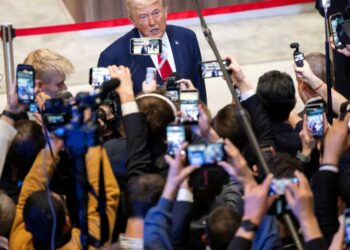
President Trump’s vision of executive power is reshaping America and the world. For “The Opinions,” Aaron Retica, an editor in Opinion, sits down with the Opinion writers and lawyers Emily Bazelon and David French to discuss Trump’s record so far, and what it portends for the next three years.
Below is a transcript of an episode of “The Opinions.” We recommend listening to it in its original form for the full effect. You can do so using the player above or on the NYTimes app, Apple, Spotify, Amazon Music, YouTube, iHeartRadio or wherever you get your podcasts.
The transcript has been lightly edited for length and clarity.
Aaron Retica: I am Aaron Retica, an editor at large for New York Times Opinion. I’m here with Emily Bazelon and David French — both of whom teach the occasional class in law schools — but they work full-time as writers for The New York Times on legal questions and other political subjects. Hi, guys.
Emily Bazelon: Hey.
David French: Hi, Aaron.
Retica: So, David, you’re in Nashville right now. What are you doing down there?
French: Well, in Nashville, Aaron, we are prepping. We are prepping for the snow apocalypse. But for some of us, maybe me included, this is a glorious moment — because this is the moment we get to turn to our wives and say, along with all these other Southern lawyers, accountants, doctors, et cetera: Hey, this is why I got a four-wheel drive.
Finally, I can use it to do something more than just haul groceries from Kroger. So I’m looking forward to it. I’m going to put my Chevy in four-wheel drive and I’m going to have a blast with it, Aaron.
Bazelon: If they don’t plow the streets, how does your four-wheel drive help you?
French: You have the four-wheel drive, so that they don’t have to plow the street. You just go right through it. In fact, please don’t plow, guys. Not right away. I want to get out there and just see what my Chevy can do.
Retica: I want to cast us back to Jan. 20, 2025, a year ago, in the Capitol Rotunda. We sort of knew what to expect — and yet, we didn’t. Sitting right there were Jeff Bezos, Elon Musk, Mark Zuckerberg — a murderer’s row of tech oligarchs. That suggested that this was all going to go one way.
I want to talk about how the administration has operated power during their first year. Machiavelli famously said that … his advice to the prince was that people should either be caressed or crushed. So, what pathway have they chosen over the course of this year?
Bazelon: I see much more crushing than caressing — or much more creating fear than building trust. I think if you were going to put the actual most powerful people in the Trump administration on that dais or whatever it was, it would obviously be Stephen Miller and then Russell Vought, who is a real architect of policy. Then also Susie Wiles, who was playing a more behind-the-scenes role until her Vanity Fair breakout article. But those are the three obvious officials.
What’s equally interesting to me is to think about who is not exerting power and the effect that absence is having. I’m thinking especially of Congress, and then I have a question mark in my head about the Supreme Court.
I could argue it both ways. On the one hand, I think the court set the terms for a lot of this administration with its decision granting presidents immunity for most of their official acts. On the other hand, they have basically just gone along with a lot of what the administration is wanting to do. So that is a conciliatory, enabling role, as opposed to directing all the action.
David, what do you think about that?
French: So I’m going to go with two fantasy analogies — “Game of Thrones” and “Lord of the Rings.” Way too on brand!
Retica: Two great tastes that taste great together.
French: Think of Jan. 20, 2025, as the coronation at the Red Keep, where you have the king being crowned and the nobles are gathered there to pay homage to their new liege lord.
Make no mistake, when you had Bezos and these billionaires in the room, they were not there as Trump’s peers — they were there as Trump’s subjects. So that was not necessarily an array of the power structure of the administration. Trump has always been a billionaire with pretenses to be seen as the alpha billionaire. And this is the alpha billionaire showing the other billionaires who was boss.
So, that’s Jan. 20, 2025. But you fast-forward to right now, and I would even narrow the circle that Emily had — smaller. I would say the real power is Stephen Miller, primarily. This gets to the “Lord of the Rings” analogy — Grima Wormtongue and Théoden ——
Retica: You are really so insane!
French: I know, I can’t help it. You have an old decrepit king who is being influenced by a malignant and malicious voice, but it’s a little bit more complicated than that, obviously. I would say the real power is, of course, Stephen Miller at apex. Vought, also.
Also, I think Rubio has had a surprising amount of influence, but then there’s also this other dynamic that always exists with Trump. He’s got Stephen Miller, he’s got his advisers, and then he’s got the last person he talked to. It is very well known that Trump is often influenceable in the moment. Then Stephen Miller will come in and backfill and get Trump back on track — in Stephen Miller’s track.
So, I really do see that, one year apart, he was marking who he lorded over on Jan. 20, 2025, and on Jan. 20, 2026, we are now much more aware of who the real powers are within his kingdom. And Stephen Miller is at the top of the adviser pecking order.
Retica: Let’s talk about how power is actually operating, which brings us to the subject of Greenland. We’re taping on Wednesday, Jan. 21. This morning, the president spoke at Davos — pretty feistily, saying that while he wouldn’t use force to take Greenland, he wants it. Then, later in the day, and we’re only halfway through the day, there was a Truth Social post saying that actually everything’s going to be cool. They’re having some negotiations, there’s a framework, it’s all going to work out.
We’re not going to resolve that issue, but I want to talk about the way they’re doing it. We’ve also gotten somewhere very weird. Emily, do you want to try to describe it? It’s a tricky one, but where are we?
Bazelon: I think that Trump uses his mouthpiece — like the presidency and what he says — as his main mechanism of power. So, we started the year with the flurry of executive orders, and those have continued — and that’s the president just declaring: This is basically what the law is now; you can go ahead and sue me and try to stop me. It’s not making a deal in Congress. It’s making a declaration, planting a flag, and then seeing if people are going to go along or not — which, in the Republican Party, they almost entirely have.
And as of late, and Venezuela is another example of this, we see him taking this same idea of edicts and decrees into the international realm, and then it sets off a diplomatic crisis. Then Trump undermines our allies by posting their private Signal and text messages to him on social media. Then he declares that he’s reached an agreement, like somehow it’s all going to be OK. It’s all a drama of words that he instigates and then tries to see where the dare leads and how other people react.
Retica: You also mentioned alliances. David, I want you to take this up, too. For a long time, you would say: Oh, he’s undermining the alliance, he’s undermining the allies. That’s bad. But of course they don’t see it that way.
French: Well, they don’t appreciate the alliance. It’s been fully imbibed within Trump world and MAGA broadly that our alliances are actually a drag on us, that we’re carrying around people. Imagine a basketball team where you had Michael Jordan and then four stiffs on the court — they’re just a liability more than they’re an asset. America will be stronger, America will be more prosperous if it sheds these alliances that pull us down, that drag us down. They see their influence as nefarious on American life and culture.
Retica: The idea is that we’re suckers.
French: Totally.
Retica: Emily, in looking over this year, there’s two ways of doing it, right? We can say they had a set of intentions and they did it all or they’re doing a lot of it — or we could say they had a set of intentions and they’re kind of shambolic and they’re not actually doing what they wanted to do, or said they were going to do, or at least the effects are not what they wanted them to be. I’m wondering where you come down in that discussion.
Bazelon: It depends on the area of policy. David was talking about one way to think about the foreign policy goals.
Then there’s immigration, where we really have seen enforcement step up in the interior of the country in a way that exceeded a lot of people’s expectations. It’s just such a giant project. Turns out, if you’re willing to vastly increase the budget for ICE and just snatch people up off the street, you can pick up a lot of people and put them in detention and into deportation proceedings. So, that’s effective — with enormous costs.
Then I think the tariffs have been all over the place. They’ve gone up and down, they’ve been slapdash. We’re waiting for the Supreme Court to decide whether they can remain. But until they’re gone, they have also had a real impact in terms of America’s place in the world.
Retica: The alliances that are against Trump, whether they’re domestic or foreign, have a problem, and that is: They’re about the rule of law, they’re about alliances, they’re about all these nice things, they’re about norms. And no one wants to hear about any of those things. None of it.
But as you guys were saying earlier, the cost of not having it is enormous. And one way in which we’ve seen that — which Emily was just alluding to — is in Minnesota. I want to talk specifically about what happened to Renee Good. We’ve all been talking about this, but I want to just set it out very clearly.
David and I were working on something together, and so I was — it’s an occupational hazard of this job — watching angles of the videos over and over again. And besides the fact that she was being killed, something was really bothering me about it and I could not figure out what it was. Then I realized: OK, she has crossed over a border without realizing it. She thinks she’s still living in the regular world and she has moved into an irregular world. David wrote about this recently, that distinction, which seems to be a growing part of American life.
I’m not making a direct comparison to Hitler; this is just a useful way of thinking about this. Ernst Fraenkel was an actual practicing lawyer in Nazi Germany until 1938, defending dissidents in court. Meanwhile, he was secretly writing a book called “The Dual State.” David, do you want to pick up from there and just explain what it is and why it’s relevant to Renee Good?
French: What he’s arguing is that one of the things that aided the rise of the Nazi Party was that it is not as if the Nazis came into power and then everything changed for everybody — most Germans were still living under what he calls the normative state. That would be the normal life and existence that we all enjoy, where you can start a business, you can enter into a contract, you can go to court and enforce your rights against somebody who’s violated your rights. It all is normal.
But what he said is that along this normative state that was still existing, there was something he called the prerogative state. The prerogative state was the zone of lawlessness. This was the zone of aggression for the state. So, where the state’s interests intersected with the normative state, then the prerogative state would take over, and this would impact only a minority of citizens.
For example, Jews in Germany were subject to the prerogative state. This is where the law didn’t really protect them, they were at the mercy and the whim of the government. They were at the mercy and the whim of the shock troops of the Nazi regime. If we don’t want to use Nazi analogies, I think we can actually use an American analogy that works really well, and that would be the Jim Crow South.
In the Jim Crow South, you had a normative state that was enjoyed by white Southerners. They lived in the land of the free and the home of the brave, they had free speech rights and they had free association rights and they had economic opportunity. But then you had a prerogative state that applied to Black Americans in the South, and they lived at the mercy and at the whim of the government — or even just their white neighbors could end their lives at their will and at their whim.
So, this is not something that is unique to Germany. Something that happens when you have rising authoritarianism is that the authoritarian segment of society acts with impunity, and it sustains itself in part by making sure that large numbers of people don’t experience that. So long as they live their normal lives and they don’t interfere with the government, they get something that looks very routine.
I used to think: How did Jim Crow happen? How does stuff like that happen? And I don’t wonder anymore. I don’t wonder anymore because as soon as you allow a large segment of the society to live normal lives, even while you oppress others, it takes a lot to rouse the majority to do anything on behalf of the minority.
Bazelon: One thing I think about and wrestle with is the clever move that the Trump administration has made — the group of people who are “other” in our scenario right now are undocumented immigrants to start with. They don’t have the same rights as Americans. It is true that they’re subject to deportation.
So, I feel like that was the crack, the way into this dual state. Now we’re at the point where, yes, it’s the undocumented immigrants and there’s a lot of injustice going on in how they are being subject to the force of deportation and detention through ICE, but then there’s also everybody else who might try to ally with them or help them.
Renee Good obviously paid the price of her life. Then there are the protesters who are also subject to harassment, sometimes violence, lawbreaking. Then, if you take another step back, there are parts of civil society — like universities or law firms — that might ordinarily try to defend and protect people in these positions. And they’re also getting a very clear message that’s supposed to chill all of that speech and activism.
So, by being so clear that Renee Good is immediately an enemy of the state — in Trump’s eyes — as soon as she parks her car in a way that gets in ICE’s way, Trump talked about the idea that she’d been disrespectful, as if that justified her death, which of course doesn’t make any sense. You start with her, then you think of the chilling effect on other moms or parents, or just ordinary Americans who might come out on the streets. Then there are these other moves that take out other players, and it just seems like that is the creep that we’re seeing here. But somehow, because it starts with undocumented immigrants, it seems distinct enough from the Nazis, or even Jim Crow, that a lot of Americans seem to be going along with it.
French: Yeah, I think that’s a great point, Emily. I hear a lot of people describe Trump as dumb, and I think that’s just totally wrong. He’s in many ways diabolically shrewd, and one element of his diabolical shrewdness is that he picks on targets that are hard to mobilize people to defend.
.op-aside { display: none; border-top: 1px solid var(–color-stroke-tertiary,#C7C7C7); border-bottom: 1px solid var(–color-stroke-tertiary,#C7C7C7); font-family: nyt-franklin, helvetica, sans-serif; flex-direction: row; justify-content: space-between; padding-top: 1.25rem; padding-bottom: 1.25rem; position: relative; max-width: 600px; margin: 2rem 20px; }
.op-aside p { margin: 0; font-family: nyt-franklin, helvetica, sans-serif; font-size: 1rem; line-height: 1.3rem; margin-top: 0.4rem; margin-right: 2rem; font-weight: 600; flex-grow: 1; }
.SHA_opinionPrompt_0325_1_Prompt .op-aside { display: flex; }
@media (min-width: 640px) { .op-aside { margin: 2rem auto; } }
.op-buttonWrap { visibility: hidden; display: flex; right: 42px; position: absolute; background: var(–color-background-inverseSecondary, hsla(0,0%,21.18%,1)); border-radius: 3px; height: 25px; padding: 0 10px; align-items: center; justify-content: center; top: calc((100% – 25px) / 2); }
.op-copiedText { font-size: 0.75rem; line-height: 0.75rem; color: var(–color-content-inversePrimary, #fff); white-space: pre; margin-top: 1px; }
.op-button { display: flex; border: 1px solid var(–color-stroke-tertiary, #C7C7C7); height: 2rem; width: 2rem; background: transparent; border-radius: 50%; cursor: pointer; margin: auto; padding-inline: 6px; flex-direction: column; justify-content: center; flex-shrink: 0; }
.op-button:hover { background-color: var(–color-background-tertiary, #EBEBEB); }
.op-button path { fill: var(–color-content-primary,#121212); }
Know someone who would want to read this? Share the column.
Undocumented immigrants are a prime example. Here’s another one: How many people are going to go in the streets to chant “Hands off Harvard,” “Hands off Skadden, Arps”? Nobody. Nobody is going to do that because he’s picking on within these major educational and legal institutions, some institutions that are actually quite not popular, especially with his base.
He’s very good at picking targets, and that’s one of the things that makes opposition so difficult. Because if you say: Hey, suspected members of Tren de Aragua deserve due process. How dare you deport people without due process? Then the immediate response is: Oh, look at you. You’re the best friend of narco-terrorists.
Retica: This brings us to a question of power over everything, dominion in every way. That also brings us to the case of Lisa Cook. The oral argument was heard Wednesday morning. Lisa Cook is on the Federal Reserve Board. Trump fired her, and there are all kinds of crazy things about this case. But the court seemed like it was not going to go along with this.
Emily, I want you to answer two questions. One is: What do you think is going to happen specifically with Lisa Cook and the Federal Reserve? And: Why is the Federal Reserve, among all these agencies, somehow exempt from the court’s other rulings where it does seem to have been like: Yeah, sure, fire whoever you want? But also this question: Is the court trying to carve out a space for presidential power, a conception of presidential power that is not quite as absolute as what appeared to be the case when they released the immunity decision in 2024?
Bazelon: The court has already said it considers the Fed to be different from other federal agencies. There’s like one half a sentence about why, but I think it’s the idea that the independence of the Fed is really important for the American and the global economy — the justices get that.
It seemed clear, after oral argument, that they were going to leave Lisa Cook in place while this lawsuit about whether Trump has properly fired her for cause based on these allegations of mortgage fraud — which she’s never been charged for. She says she’s had no opportunity to be heard. He says that his Truth Social post was her notice.
The court did not seem to buy the president’s arguments. So, in a lot of ways, the argument ended and it seemed like: OK, well, rule of law still exists in some way and the president is not actually the king and doesn’t have absolute dominion.
I have to say, though, that the arguments Solicitor General John Sauer was making were so out there that I was not entirely reassured by the fact that they were going to lose — because he was literally asserting that Trump saying that he planned to fire Lisa Cook on Truth Social was enough, and he could assert any reason that he wanted and that would count as being for cause, and the courts would have no power to review any of it.
That was the position they were taking. That seemed so extreme to me that hearing it come out of the mouth of the solicitor general seemed like a problem — even though I don’t think the justices are going to accede to it. David, what was your sense? How did you feel coming out of this argument?
French: Now, I’m not predicting this, but I would not be remotely surprised if this decision is at 9-0.
Bazelon: Or maybe 8-1. Clarence Thomas, I couldn’t tell.
French: 9-0 in the sense that, no, Trump doesn’t have the ability to fire her at will.
It was very clear to me that an overwhelming majority of the Supreme Court had two propositions in their mind. One was that the Fed is different. The Fed isn’t like the C.F.P.B., the Fed isn’t like the Securities and Exchange Commission, the Federal Trade Commission or the others. It’s just different.
And No. 2: Because it’s different, the president doesn’t just get to make it up as he goes along, including by substituting Truth Social posts for proper notice and opportunity to be heard when you’re going to fire somebody who can only be fired for cause. So, I think I could almost count to eight or nine for that position — leaving aside Thomas, I agree with Emily that he was more opaque.
But there’s another thing that was very interesting, and I don’t think enough people have noticed this. The advocate for Lisa Cook was Paul Clement. This is significant because what you had was a fight between the archetype of MAGA legal philosophy in the solicitor general — probably the best advocate for MAGA legal philosophy in America is the current solicitor general, John Sauer — against not just any conservative attorney, but a guy who would be at the Council of Elrond of originalism.
I mean, this is a guy who is the archetype of the conservative attorney. So, you had MAGA law versus classical conservatism, quite frankly, in that fight. What Clement was able to do was to ping all of Justice Roberts’s and Barrett’s and Kavanaugh’s and Gorsuch’s originalism — set off all of their originalism bells — and he was able to do that fluently.
It was fascinating to listen to the argument because as it went on, I felt like Clement was getting so much more confident. It was like: Oh, I win through door No. 1. But if you don’t like door No. 1, door No. 2 is fabulous, as well. I win through door No. 2.
Rarely have I left an oral argument or listened to an oral argument and emerged from it thinking that the outcome was more clear than this one. Now, watch those be famous last words. You watch an oral argument and you’re pretty convinced it could go one way and it goes the other. But I would be stunned if Trump wins.
Retica: Let’s talk about this as the exception that proves the rule, though. If the Federal Reserve is the part of the government that he can’t mess with — because people are worried about the economy, people are worried about precedent, other things — nonetheless, in almost every other way, they have licensed him to do almost anything he wants to do. As Emily was saying, their imaginative idea of what the presidency should be appears to exceed even the bounds of the unitary executive theory that they used to love.
The last time you guys were together online, we asked readers to send in their questions. As always, there were a million of them and we can only use a few, but there’s one right on point here.
Joe Kennedy from Mercer Island, Wash., wrote in to ask specifically about the immunity decision in Trump v. United States. He asked: Does this decision give Trump a get out of jail free card? Can he be held accountable for any of the things he’s doing if he calls them official acts?
And the reason I’m connecting it to the Federal Reserve thing is — the Lisa Cook mortgage allegations that preceded her being on the board in the first place, you knocked that out, but have you actually done anything? That should be something that’s not even coming before the court. And there you are having a serious Supreme Court discussion about an absolute absurdity. So, maybe they won — even if they lose 9-0.
Emily, why don’t you go first. With the immunity ruling and everything else that has happened with the Supreme Court, where are they holding him back? Where is he liable? What is their conception and do you see any sense of alarm on their part about where he’s taking the country?
Bazelon: I do think that the immunity decision set the table. It emboldened Trump. He talks about it, the solicitor general’s office cites it a lot in these expansive ways, claiming more and more power for the president. So, I do think it’s underpinning part of what we’re seeing.
I also think you’re right that they have thrown up a bunch of really unlikely Hail Marys — like this case, which would totally undermine the independence of the Fed. Then there’s the challenge to birthright citizenship. There it is sitting there in the 14th Amendment in the Constitution and they’re claiming, no, that’s not the law.
Retica: That’s another one where they win just by raising it, right?
Bazelon: Exactly.
I think generally, though, Aaron, I would agree with you that the conservatives who dominate the court right now had an expansive theory of executive power, that it allows for a lot of firing of agency leaders, board members of the Federal Trade Commission, et cetera, et cetera. And I think that challenge to how our agencies have operated in this quasi-independent way is going to succeed and it’s going to really shift power toward the president.
I feel like I’ve learned this from writing back and forth with David about it. This is a longstanding conservative principle and it would be surprising for the conservative justices to walk away from it. Yet the timing of it means that the person who they are giving much more power to, the actual president in office, is Donald Trump. Maybe for some of them, that’s kind of inconvenient.
You could imagine that Chief Justice Roberts would prefer that a more honorable president was actually in office while he was doing this. But when people who’ve been eyeing a goal for a long time — whether it’s jurisprudence or legislation — get a chance to enact it, it’s hard for them to resist. So I feel like that is part of the dynamic here. I wonder, David, how you think about that part of how our legal landscape is changing.
French: I think it’s changing with more presidential control over a diminished executive branch. If you look at the totality of Supreme Court authority — and I fully acknowledge this could age very poorly depending on how the tariff case comes out, how the Lisa Cook case comes out ——
Retica: You don’t have to worry too much about that, right? It’s not like people are going to go back and rewind two years from now to see what you said today. Just go for it.
French: But by the end of June, we’ll know a whole lot more. That’s when the Supreme Court issues all the opinions for this term. But here’s the way I would phrase it: What the unitary executive theory says is the president has control over the executive branch. However, the original separation of powers conception would say that the president doesn’t have control over Congress. There’s even limits as to what Congress can delegate to the president.
So, for example, tariffs — that is an enumerated Article I authority of Congress. Can Congress just delegate that to the president without using even those explicit terms to grant worldwide tariff taxing authority? I think the answer to that is going to be no. Similarly, when you’re talking about the Fed, the court has determined so far, at least in dicta, that the Fed is different from the S.E.C. and the F.T.C. And in that circumstance, the president doesn’t have that unfettered authority.
Birthright citizenship — you have an actual constitutional provision and a statutory provision enacting birthright citizenship as we understand it. I think they’re going to find that the president doesn’t have the unilateral ability to change all that by executive decree. So, I would say that the originalist conception in which a majority of the majority is operating under is that the president should have more control over the executive branch. However, the executive branch should have less control over the American government, and I think that is where they’re heading.
What that will mean is Trump is going to, at the end of the day, have more ability to hire and fire the head of any given agency or independent agency other than the Fed. But those agencies are going to have less power to do what Trump wants them to do.
Now, I think that’s going to be the ultimate resolution by June 30 of this year. If it is not, then I think we’re in a hyper dangerous moment. We’re already in a dangerous moment. But if the Supreme Court, at the end of the day, says the president has extraordinary authority over an extraordinary, powerful — even more powerful than we knew — executive branch, that’s when you’re disrupting the very republican form of government that we’re supposed to have.
Retica: That’s a perfect transition to the final two reader questions. I’m going to combine them into one.
Paul Gutermann in Bethesda, Md. — near where all this is happening — wrote: “The wheels of justice grind slowly, but the Trump administration breaks laws at the speed of light. Isn’t this a recipe for the end result that the law never catches up with the wrongdoing?”
And let me add to that what Stephanie Wolkin in White Bear Lake, Minn., wrote. She wrote that she was deeply concerned about the rule of law with regard to the separation of powers that congressional Republicans are incapable of acting independently, and the result is that there are no checks and balances.
What’s the famous Madison line — ambition counteracts ambition, right? It shouldn’t matter that they’re all the same party, the Supreme Court’s acting in the same way. How do we take back our country when the rule of law has been systematically destroyed?
I’m not going to ask you to tell the future, but I am going to ask you: With so many of the elements that are supposed to support the rule of law weakened, how do we support the rule of law?
Bazelon: One way to think about both of those questions is: Can courts save American democracy? What is their actual role here? I think what we’re seeing is they can’t do it on their own. I would argue that the lower courts have been really pretty stalwart since Trump took office in standing up for the rule of law and pushing back and calling the president’s bluff on a number of fronts.
I think the Supreme Court has been far less effective. Whatever his frustration with the emergency docket until the decision about the National Guard in Chicago, Trump and the administration had an almost unbroken string of victories on the emergency docket.
So, we’ve seen the Supreme Court exceed in a number of domains, and yes, they probably are going to push back in some of the most extreme cases. But I agree with you, Aaron, that we’re still going to end up with expanded presidential power for this particular president.
I think the other insight of the questions that you asked is that when the political system is not operating in a way that there are obvious consequences for someone who is abusing power, then it’s really hard for the legal system to fix the whole thing.
Retica: It’s not designed for that at all.
Bazelon: Yeah, to me, the most important question is what happens in the upcoming elections? Are they free and fair? Are Americans taking in and absorbing the threats and risks that you and David are laying out there in a way that affects how they vote? What message do they send to the Republican Party, which has been so behind Trump? And then, eventually, what message are they sending in 2028, when they’re electing the next president?
In some ways, because the polls have sagged, Trump is not popular. But he’s not in the basement. Also, the stock market, while it seems shaky with this latest threat to Greenland, has not totally tanked either. The indicators are not blinking red in a way that if you are a politician other than Trump, you can conclude that you obviously should run as far as you can from him. It’s those political and market indicators that matter in the end, as much or more than the courts — even though I don’t want to let the courts off the hook.
Retica: David?
French: I think of the courts as a rear guard to a retreating army. That rear guard can either be very effective or ——
Retica: Is it an army of orcs?
French: A retreating army of Congress. That rear guard can be really good, or it can be not so good. But the bottom line is the rear guard isn’t going to win the war.
One of the fundamental problems is Article I, which spells out legislative powers, is Article I for a reason. It is supposed to be, whatever term you want, first among equals. It is supposed to be the alpha branch of government, not uncheckable, but it’s supposed to be the alpha branch of government.
Now, it’s not the beta branch — it’s the last branch. It is the least powerful branch of government. And so the entire system, the entire structure is warped right now. Many members of Congress, especially the Republicans, are just very eager to send everything to Donald Trump. All the power you want to use, Donald Trump, you can have it.
Until that dynamic is fixed — and it can only ultimately be fixed by the voters — the courts are going to be a delaying action at best. Then we’ll end up fighting ferociously over whether they’re delaying Trump more or less, but they can only, ultimately, delay him. That’s all the courts can do. They cannot save us.
Retica: Can I just say that if you’re from New York City, the idea that you would be — however much you wanted executive power to expand — that you would be depositing it in the bank of Donald Trump is so preposterous.
My mother died right after Obama was inaugurated. I always think about telling her, “Guess who came next!” It would be the most unimaginable thing to a lot of people, but certainly to people who were living through the Trump ascendance here. And that these constitutional issues are being played out through this person and this way, while we’re living it, it’s very hard for us to recognize how completely insane it is. But it is actually, in fact, total nutsville.
You often talk about TV shows that you like when we’re doing online conversations, but I wanted to ask you about lawyers and novels or long nonfiction books about the law that you think really capture what it’s like to be a legal thinker, a lawyer, a practitioner. Who wants to go first?
Bazelon: David, you go first.
French: It’s funny — let me cheat a little bit, because —— I have been thinking a lot about the civil rights movement over the course of the last several years because I feel like, as people were in the civil rights movement, you’re living through a moment in time where your grandchildren will be looking and asking: What was it like then, and what did you do then?
We often think a lot about the heroes of the civil rights movement, like Martin Luther King, and how they had such an incredible political and cultural influence. But I also think we need to really be looking at the lawyers of the civil rights movement and the way they very courageously and also shrewdly stood up for people who were among the most marginalized in the country, in legal systems that were far less functional than ours.
We raised our kids in a town in Tennessee called Columbia. It’s a relatively small town, about an hour south of Nashville. And Thurgood Marshall is part of the story of Columbia, Tenn., because he came there at some of the darkest times in the civil rights movement to represent some embattled defendants in that little town.
What is so compelling to me about that narrative and about that story is he’s willing to go anywhere, into any place with any degree of danger to stand for justice. When you think about a lawyer, you cannot think about a good lawyer without thinking of both intellect and moral courage.
When I’m thinking about the law and when I’m looking for the people I’m going to look up to in the law, I’m not just looking at intellect; I’m looking at moral courage. And when I want a story of moral courage in American law, you can go to fiction like “To Kill a Mockingbird.” But you don’t need fiction — you’ve got reality with the lawyers of the civil rights movement.
So, I think it’s their story. And again, we are not even there. We’re not there. We’re not in the kind of danger that they were. So, when there’s less danger, can the legal profession show at least as much courage? I think the answer to that question may set the future course of the country.
Bazelon: Well, that gives lawyers in courts a lot of power. It reminds me of a nonfiction book that I really love called “Devil in the Grove: Thurgood Marshall, the Groveland Boys and the Dawn of a New America.”
Retica: That’s the Florida case, right?
Bazelon: Yeah, it’s from 1949, so it’s a precursor to the civil rights movement.
I was thinking about a character who looms very large for me, from a different era entirely. Portia from “The Merchant of Venice,” who deploys all the tactics of clever lawyers to try to change what we think of now as the quality of mercy in the courts in her Shakespearean time.
Somehow that was a comforting, reassuring trial to go back to. It’s a time, obviously, of deep prejudice without a lot of the safeguards of the rule of law that we think of now, but she was able to achieve a better result by making legal arguments. Maybe I’m trying to be with you David, and going back to a touchstone where we can imagine lawyers having a good effect.
Retica: The quality of mercy is not strained. Thank you both so, so much. We’re all uneasy, but you made it easy — so, thank you very much.
French: Thanks so much, Aaron.
Bazelon: Thanks.
Thoughts? Email us at [email protected].
This episode of “The Opinions” was produced by Jillian Weinberger. It was edited by Alison Bruzek and Kaari Pitkin. Mixing by Carole Sabouraud. Video editing by Julian Hackney. The post-production manager is Mike Puretz. Original music by Pat McCusker and Carole Sabouraud. Fact-checking by Mary Marge Locker and Kate Sinclair. Audience strategy by Shannon Busta and Kristina Samulewski. The director of Opinion Video is Jonah M. Kessel. The deputy director of Opinion Shows is Alison Bruzek. The director of Opinion Shows is Annie-Rose Strasser. Special thanks to Derek Arthur.
The Times is committed to publishing a diversity of letters to the editor. We’d like to hear what you think about this or any of our articles. Here are some tips. And here’s our email: [email protected].
Follow the New York Times Opinion section on Facebook, Instagram, TikTok, Bluesky, WhatsApp and Threads.
The post ICE Is Splitting America in Two appeared first on New York Times.