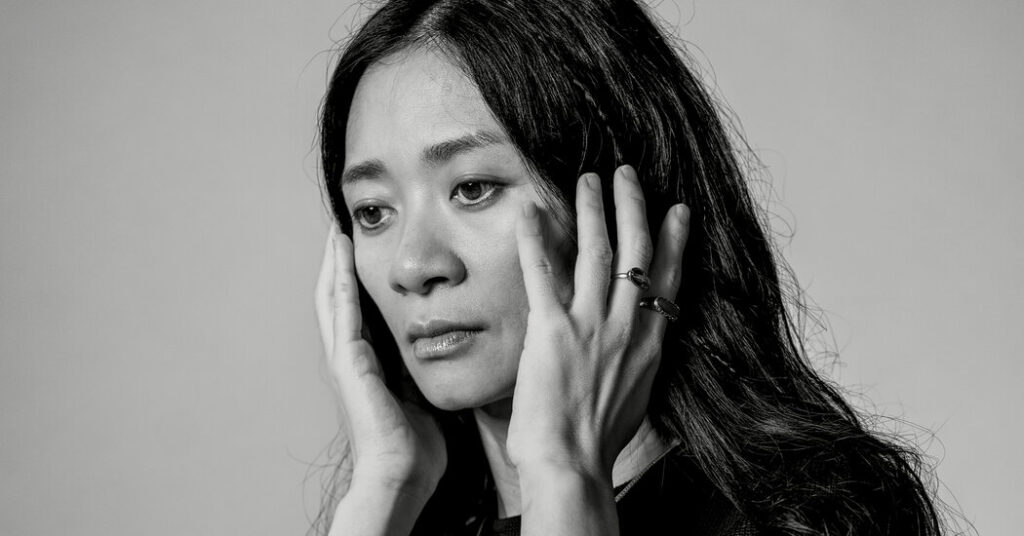
Chloé Zhao is an anomaly. At only 43, with just five feature films under her belt, she has already established herself as one of cinema’s most distinguished and distinctive directors. And she has done it at a time when the movie business is increasingly averse to artistic risk and originality — two qualities on shimmering display in all her work.
She started out in indies, often working with nonprofessional actors. Those films culminated in the sparsely poetic neo-western “Nomadland,” released in 2020, which won three Academy Awards, including for best picture and best director. From there she took a radical swerve (to mixed critical reception), directing a visually ambitious mega-budget Marvel movie, “Eternals” (2021). Her latest film, from last fall, is the heart-wrenching drama “Hamnet,” an adaptation of Maggie O’Farrell’s historical novel about the death of Shakespeare’s titular young son from the plague and the ensuing grief of his parents, the aforementioned playwright (played by Paul Mescal) and his mother, Agnes (played by Jessie Buckley). The film won the Golden Globe for best motion-picture, drama, and received eight Academy Award nominations, including for best picture and best director.
So how has she carved out such an impressive career? It must have taken some steel, but in person Zhao is an enigmatic, even somewhat mystical presence, not exactly the sort of swaggering, take-charge personality we often associate with big-time Hollywood directors. So there was plenty to dig into with her, but as it turned out, Zhao wasn’t much interested in simple or straightforward answers.
Subscribe: Apple Podcasts | Spotify | YouTube | Amazon | iHeart
I’m curious about what awards season stirs up for you. I imagine it could involve envy or competition, salesmanship and glad-handing, which I feel are not ideas that are interesting to you. So how do you deal with this moment? You think of me a lot more highly than I do! [Laughs] All those basic emotions, none of us can escape them — especially artists. So many of us started telling stories because we didn’t have the easiest childhood. So when your work, which is the only way that you can seek connection and validation since you were a child, is being compared and judged, you could go as far as feeling that a rejection of that work is a rejection of who you are and your ability to be safe or loved. And it does go that far to me at times. But what I like about it is, filmmaking is quite a lonely process, at least as a director. You’re like a ronin.
A wandering samurai? Yeah. You’re getting hired to do jobs, you create this family and then you have to leave. So to be brought together and hang out at these events and round tables is really nice. I try to ask other directors to let me come to their set and shadow them. There should be a system where directors get to be on each other’s sets. Because otherwise how do we keep learning?
What could someone learn from watching you work? How to embrace chaos. “Hamnet” was created that way. For example, when Hamnet died — on that day, Jessie Buckley and I did not talk about the scene. In the morning, she would do fever writing about her dreams and then would pick some music, and as soon as I got to set, I would put the music on repeat so the whole set was harmonized to the vibration she wanted. Other than a conversation about which setup we want to do, we just go in there and do it. When she let out that very guttural scream of grief [in the scene of Hamnet’s death], that was not planned. But I believe it didn’t just come from her; it came from the collective. When that happens, it’s the most exciting thing for me as a director, because there is no way any of us could have thought of that. That is truth happening in the moment.
There are tropes for how a director behaves. Francis Ford Coppola, for example, compared being a director to being like a ringmaster of a circus. Sometimes you hear directors compared to generals — these alpha, macho metaphors. But that’s not what you’re describing. I like thinking about myth. In myths, what are the types that can lead? Traditionally, yes, you have a general, but you also have a priestess. Both can evoke the desire for people to follow their vision; both of these archetypes are within ourselves. So there is a general inside me but also a priestess. If you have only the priestess, it’s total chaos. If you have only the general, it’s total order and nothing else.
In Shakespeare’s time, the period in which “Hamnet” is set, the death of a child was a more common occurrence than it is now. I assume that as a result people had a different perspective on what it meant to lose a child. I’m curious if you think it’s possible to recreate older emotional perspectives. I think about that all the time. Maggie O’Farrell said that she doesn’t believe it’s possible that the grief is any less, and I tend to agree, because even though things are so different, our biology hasn’t changed. The desire that we have to protect a child will not change. However, the stories we attach to that pain might be different. You know, I recently trained to be a death doula.
Really? I just finished Level 1 training in the U.K. In one of the training sessions, we had to research Indigenous cultures from around the world, how they deal with death and dying both today and in the past. You can see that the grief of losing a loved one doesn’t change. However, the societal understanding of death and the space it gives to grief and how it’s embedded in the culture and the medicalization of death have shifted so much. In the modern world, when death is no longer seen as a natural part of life — because now it’s about staying alive as long as we can — there’s almost shame around death.
I want to rip up all my questions and ask more about you wanting to be a death doula! Why are you interested in becoming one? Because I have been terrified of death my whole life. I still am. And because I’ve been so afraid I haven’t been able to live fully. I haven’t been able to love with my heart open because I’m so scared of losing love, which is a form of death. When you’re in your 40s, a midlife crisis is the best thing that can happen to you, because you’re on your way to a rebirth. You can’t run from this feeling. Your body is changing, and you can feel death. And because I’m so scared of it, I have no choice but to start to develop a healthier relationship with it, or the second half of life would be too hard. It shouldn’t be this terrifying that I can’t even live.
Is it that you’re afraid of your own nonexistence? Are you afraid of pain? The impermanence. In “Hamlet,” there’s a line that goes, all living things must die, “passing through nature to eternity.” If you didn’t grow up with spirituality or religion, then the eternity part is out. You also lost your connection with nature, even your own body, so the passing-through-nature part is gone. All you have left is “all living things must die.” Then it’s like, What’s the point? You’re separating from the oneness. I feel separated often from that oneness, and that illusion of separation makes me afraid to connect, afraid to create freely or even just live the way I want to live.
You alluded to a midlife crisis. Is that something you’re currently experiencing? If it’s four seasons, I’m at the end of winter, beginning of spring. I’m coming back up. Actually a better metaphor is the chrysalis period: I have passed the deepest part of decomposing from the caterpillar, which was an extremely uncomfortable year and a half of having every part of who you used to be grinded down.
What did that look like for you? Getting out of bed was hard — being interested in anything, getting through the day. Because everything that I thought I wanted in life, or everything I thought about who I was, no longer is. So I’m at the end of that. “Hamnet” saved me in many ways, to have that film during that time.
You said you struggled to feel love. That’s very sad. You have no struggle?
I have tons, but are you talking about having problems with feeling love in relationships? With your family? I want to know more about what you mean. If you’re terrified of being abandoned, cast out of a tribe, then you don’t make an effort to belong or truly love from a place of vulnerability and trust. And that’s really sad, because I don’t think we’re designed to be alone. We’re designed to be like wolves, like a pack. To be cast out of your tribe is the most painful thing you can experience.
Can I take a stab at something? Yeah.
When you talk about being cast out of your tribe —— I know what you’re going to say.
I’m going to ask about family. OK.
You grew up in China and then moved to the United States. Was familial separation related to the feeling of being cast out that you’re talking about? I can’t really go into it, but I will answer the best I can. You know, you started by asking me about awards season.
That feels like a long time ago! But it’s relevant because what is this fear of failing? What is this fear when my film gets rejected by the critics? What is this feeling if the box office is terrible? What if I lose? When the winner is announced at an awards show, I look at the faces of the people who didn’t win and I try to feel, what are they feeling? At best it’s like, That person must have had an easier childhood. At worst it’s like, I don’t belong; they reject me; I might as well die.
Do you think other people sitting at award shows are having that feeling? There’s a few. Probably more than that. Because what if work is your sense of belonging? What if you feel like you don’t belong anywhere but with your family, and then what if your family is gone? It makes me realize that any kind of belonging has the risk of being cast out. People might roll their eyes when I say this, but the kind of home that cannot be taken away is the one within, and the one you connect with the divine, with this great mystery and the earth. That cannot go away. If you do an ayahuasca ceremony or plant medicine, you feel that oneness.
Have you done ayahuasca ceremonies? No comment. No, I have not. I have experienced facilitated plant-medicine healing journeys by my therapist, and I’ve experienced that kind of oneness. When all the stuff goes away, you feel like you’re one with everything and truly no fear. So to answer your question about, Did it happen when I left China or did it happen when a film of mine didn’t work out?
Yeah, I’m trying to locate the source of the feeling you’re talking about. I tried that for many years. We have to understand why, because that’s how we feel safe. But I got to a point where I realized that even the need to understand is a form of control and fear. I let that go a little, and now it’s more about, Can I sit in that? Maybe that is the great paradox of what it means to be human: to constantly hold that tension of to be or not to be, to love or to be abandoned. This is a long way for me to avoid your question. Because I think this could be interpreted very simplistically, if I were to try to pinpoint one moment in my life. But it’s not like that. Sorry, I’m not giving you anything.
That’s OK. You brought up “to be or not to be,” and the stupid thought in my head was, That William Shakespeare had some good ideas! That guy: really underrated! I used to think he was just a writer, but I actually think he is like a druid. He tapped into the unseen. Or maybe there were mushrooms growing in Stratford. Some of his plays, you think, he must be on something. I didn’t say that, by the way. To suggest William Shakespeare took mushrooms? The director of “Hamnet” did not say that.
But maybe! Maybe.
I know that the director Terrence Malick’s work is important to you. I have a distinct memory of being 16 and seeing his film “The Thin Red Line” and then Wes Anderson’s “Rushmore” — maybe within the same week. It was a mind-blowing week of moviegoing for me because those two films showed me something that I understood about myself but hadn’t been able to articulate. And because of that, they changed who I was. Do you have any similar experiences with film? When you said they made you understand things that you couldn’t articulate, what was that?
There was a mysticism in “The Thin Red Line,” and a transcendental feeling about the natural world, that I hadn’t seen in a movie before and that I connected with so deeply. Then with “Rushmore,” there was alienation combined with an openheartedness. I had been feeling that back then, and to see it represented so beautifully made me understand something about myself. That’s really beautiful. For me, I think it was Wong Kar-wai’s “Happy Together,” and of course, Terrence Malick’s “Tree of Life” and “The New World.” But “Happy Together” was when I was younger. When you described your experience — that is why we have art. It’s not trying to teach us something that we don’t know. It’s trying to help us remember who we are. That film made me realize that this deeply uncomfortable tension I feel in my body, this yearning that sometimes feels like it’s going to consume me, this loneliness, on the other side of it is my yearning for connection and love. “Happy Together” is full of mystery. So is “The Thin Red Line.” I’ve never met Terrence Malick. But on Jan. 1 this year, I got a phone call from a number I didn’t recognize. I thought it was the dog walker. I said “Hello,” and then I hear this very soft voice: “Hello, this is Terrence.” I was thinking, which Terrence? For the first 30 seconds, I was still wondering if it was actually him as he’s talking about “Hamnet.”
What did he say to you? I can’t share that.
Give me the gist, because Malick famously doesn’t give interviews. As far as the media is concerned, he’s reclusive. I won’t share what he said, but I said to him that I feel I come from a lineage that is found. I’m still trying to get back to the lineage of storytellers from my own culture, Chinese culture. But I didn’t have access to that because of life circumstances. So his films allowed me to become a part of a lineage. I feel that I come from his lineage. It is very significant as a storyteller because you feel like you belong somewhere.
It’s also nicer to say I come from his lineage rather than, I rip him off with all those shots of wind gently blowing through the landscape. [Laughs] That’s really funny you said that. I said to him, there’s a fine line between what I just said and “I pretty much copied a lot of your work.” I have no shame around that. In “Eternals,” the sequence of the creation of the universe was very humbly inspired by a sequence from “Tree of Life.”
I’d like to ask a little more about your training as a death doula. Have you ever been with someone at the moment of death? Yes. Have you?
I have. Well, every experience is different but the biggest thing I learned is that it’s solitary. They say we all die alone. It is true. Even when you’re surrounded by loved ones, it is a very internal, solitary experience. When you see that it’s a very individual journey, there is a solace to that. It made me realize I don’t have to make life decisions so that I won’t die alone because it’s so scary. I do not want to spend my life preparing for my death. I want to live. And if that decision leads to me being completely on my own in the moment of death, I know that won’t make a difference in those last moments. Being surrounded by accomplishment, security, loved ones — it’s still going to be an individual experience, my experience. Is that your experience, too?
That is. I was with my mom when she died, with other close family members. My mom wanted us all there, and knowing the type of person she was, I would have thought that she would want us to all have our arms around her or something like that. But it was so clear that in the few moments before it happened, she went somewhere on her own. How special it is that you were there with her in that moment.
I certainly don’t see life the same way; you learn some things. But how do I segue out of that?! Oh, accomplishment: Earlier, we talked about it in the context of Hollywood awards, and you touched on fear of rejection or wanting validation. It was interesting to hear you talk about that, because you’re an Oscar-winning director, seemingly in the prime of her career, and even you have those kinds of difficult feelings. Is there any relationship for you between professional success and personal satisfaction? Ideally, your sense of self-worth is not defined by how many awards you win or how much money your film makes. Imagine if you could go to those award things and actually enjoy — like a surfer — every part of a wave? Can you have pleasure in losing and being criticized and failing? I’ve been investigating that because I know now, at 43 years old, that 50 percent of the time is going to be great and the other 50 percent is going to be [expletive]. I want to find pleasure and joy and awe in the [expletive], too. I’m working on that.
How is that going? I’ve had a lot of [expletive] in my life. I call it “the compost.” Plenty of people are trying to figure this out, because people come to terms with, OK, half of my life is going to be in the compost. I don’t want to numb myself or take on a job I don’t want or fall in love with somebody I don’t actually love — just so that I could avoid the feeling of sitting in the compost.
This interview has been edited and condensed from two conversations. Listen to and follow “The Interview” on Apple Podcasts, Spotify, YouTube, iHeartRadio or Amazon Music.
Director of photography (video): Aaron Katter
David Marchese is a writer and co-host of The Interview, a regular series featuring influential people across culture, politics, business, sports and beyond.
The post Chloé Zhao Is Yearning to Know How to Love appeared first on New York Times.