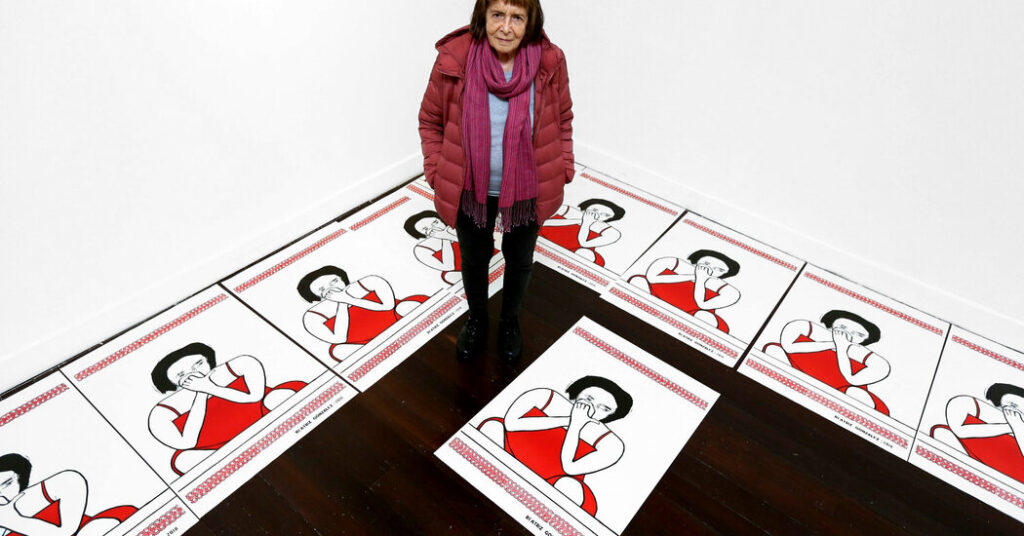
Beatriz González, a Colombian artist who transformed mass-produced images into quietly subversive paintings that called into question her country’s social and political order, died on Jan. 9 at her home in Bogotá, the capital of Colombia. She was 93.
Her death was announced in a statement by the office of the mayor of Bogotá and the Colombian culture ministry, which said that her work “revolutionized the relationship between art, politics, memory and the city.”
Ms. González was one of Latin America’s foremost late-20th-century artists. Her work was exhibited throughout the world, including at Tate Modern in London; CAPC, the contemporary art museum in Bordeaux, France; the Museum of Modern Art and Museo del Barrio in New York; and the Museum of Fine Arts, Houston.
But her subject matter, style and vision remained intensely local, reflecting her preoccupations with the violence that permeated life in Colombia; the European “high culture” that filtered its way across the Atlantic in cheap reproductions; and the in-your-face commercial aesthetic of pervasive urban advertising.
Her middle-period paintings are splashes of vibrant, violent colors, like “Los Papagayos” (“The Parrots,” 1987), in which Belisario Betancur, then the Colombian president, and his generals are flattened into a row and depicted with aggressive reds, oranges and greens.
She was sometimes compared to Andy Warhol in her willful distortions of commonplace images, but Ms. González insisted she was not making Pop Art.
“No, I considered my work a provincial type of painting,” she said in a 2015 interview with Tate Modern, adding that she “painted the joy of the underdeveloped.”
“Mine was a provincial type of art,” she repeated, “without horizons, confronting the everyday.”
By “provincial,” she was nodding to the freedom she felt starting out as an artist in a country with no real art market, no patrons and “more importantly, no critics and no art publications,” she said in an interview for the catalog of a 1973 exhibition at the Museo de Arte Moderno in Bogotá.
Ms. González took what was available to her in a place cut off from cutting-edge artistic currents — cheap reproductions of fine art, poorly reproduced newspaper photographs illustrating sensational crime stories, bargain furniture from Bogotá’s flea markets — and made it into work that reflected the reality of the society in which she lived.
The painting that established her reputation, “Los Suicidas del Sisga” (“The Suicides of the Sisga,” 1965), was based on a grainy photograph of a young couple clasping hands. Ms. González had found the photo in a newspaper, where it accompanied a story about how the couple had committed suicide together in the Sisga River to preserve the purity of their union.
Here, as elsewhere, Ms. González was “attracted to the image’s reductive qualities, the way the poor printing abstracted its details,” the curator and critic Tobias Ostrander wrote in the catalog for a 2019 retrospective of her work at the Pérez Art Museum in Miami.
Ms. González made three versions of the painting. In all of them, the image is almost banal, the couple’s smiles vague and vacant.
“With its simplified forms and eye-catching colors, it could be a folk painting: a shop sign, say, sentimentally promoting the rewards of married life,” the New York Times critic Holland Cotter wrote in a review of a 1998 González retrospective at the Museo del Barrio.
But the sentimentality is an illusion; these are people, after all, who are about to kill themselves. As she does throughout her body of work, Ms. González subverts expectations and calls into question received ideas — in this case, popular notions of romantic love.
That will to subvert is a theme running through her career. “Los Reveses de la Realeza” (“The Backside of Royalty,” 1974), shows Princess Anne on a royal visit to Bogotá, her behind visible as the wind catches the back of her dress. A seemingly banal 1968 portrait of a smug, arms-folded Simón Bolívar, painted in bold greens and yellows, caused a scandal, with a conservative journalist accusing Ms. González of disrespecting national history and the great Latin American liberator.
“These were the colors that I saw in shop windows,” Ms. González told the Tate interviewer, “in reinterpretations of universal images that were made in the Third World.”
Her rendering of contemporary Colombian reality reached its culmination in a series of paintings she did in response to a government-launched massacre in November 1985, when Mr. Betancur’s military attacked the leftist guerrilla group M-19, which had occupied Bogotá’s Palace of Justice. The assault killed at least 98, including guerrillas, civilians and 11 judges.
“After the palace,” Ms. González later said, “I could not be the same. I could not continue producing pictorial games.”
In 1986 she made three large-scale paintings in oils and pastels, collectively titled “Sr. Presidente Qué Honor Estar Con Usted En Este Momento Histórico” (“Mr. President What an Honor It Is to Be With You in This Historic Moment”).
In one painting, Mr. Betancur, surrounded by his cabinet and henchmen, looks down at a piece of paper while a charred corpse lies on the table in front of him. In another, the president, smiling and wearing sunglasses, contemplates a bouquet placed in the same spot on the table. The figures are simultaneously sinister and banal.
“The flowers transform into a symbol of hypocrisy,” Mr. Ostrander wrote, “a vulgar veneer of normalcy or even elegance that covers cruelty and injustice.”
Beatriz González Aranda was born on Nov. 16, 1932, in Bucaramanga, a city 250 miles north of Bogotá, the youngest of three children of Valentine González Rangel, a coffee planter who served as the city’s mayor, and Clementina Aranda Mantilla.
Her father “taught me to look at the landscape, from the mountain ranges to the streams flowing from the Magdalena River,” Ms. González said in a 1994 interview, while her mother “helped to train my eye.”
“But they were unable to drill a bourgeois sensibility into me,” she added.
She attended the Santísima Trinidad School in Bucaramanga, founded by Franciscan nuns, and in 1951 entered the Universidad Nacional in Bogotá to study architecture.
She left the school two years later, took art courses and in 1959 enrolled at the Escuela de Arte at the Universidad de los Andes, also in Bogotá, where she continued to paint, graduating with a degree in art history in 1962. Her mentor was the Argentine art critic Marta Traba.
In 1964 she exhibited her work for the first time, at the Museo de Arte Moderno in Bogotá, and married an architect, Urbano Ripoll.
Among her notable later works are “Los Delicios” (“The Delights,” 1997), drawings of anguished Indigenous people; and “Auras Anónimas” (“Anonymous Auras,” 2007-09), an installation in Bogotá’s Central Cemetery consisting of 8,957 silhouettes of people carrying bodies, printed on structures slated for demolition.
Her inspiration was a newspaper photograph of two men carrying a corpse wrapped in a black plastic bag. The figures were, Ms. González said, “the victims, the result of war, drug trafficking, paramilitarism, and violence.”
Ms. Gonzàlez’s husband died in 2024. She is survived by her son, Daniel.
Over the years she resisted interviewers’ attempts to draw her and her career into broader trends in the art world.
“Above all I was focusing on a provincial everyday reality,” she said in the Tate interview. “Universal symbols that underwent a process of transformation through their relocalization in the Third World.”
Adam Nossiter has been bureau chief in Kabul, Paris, West Africa and New Orleans and is now a writer on the Obituaries desk.
The post Beatriz González, Who Chronicled Colombia’s Turmoil in Paint, Dies at 93 appeared first on New York Times.