This is an edition of Time-Travel Thursdays, a journey through The Atlantic’s archives to contextualize the present. Sign up here.
Even before the legendary gunslinger Wild Bill Hickok was shot dead holding aces and eights at a Deadwood poker table, the practice of gambling—as a pastime and an enterprise—has been bound up in American identity.
But for as long as some Americans have loved gambling, others have judged it. All of the cockfighters, lottery participants, and sailors throwing scrimshaw dice had to work around the ethical code imposed by Quakers, Shakers, and Puritans who vehemently opposed these games of chance. Gambling has been intermittently banned throughout this country’s history. (By the 1830s, lotteries were banned outright in most states.) The result was a certain cultural ambivalence: Gambling was widespread despite being morally out-of-bounds. It was even once a part of American politics—in the 19th century, before the advent of reliable polling, people would place public bets on electoral outcomes as a form of electioneering.
The critics took a variety of approaches. In the December 1907 issue of The Atlantic, the Unitarian minister Charles F. Dole argued that “the long and costly experience of mankind bears uniform testimony against gambling, till at last the verdict of civilization has become as nearly unanimous as human judgment can be that it is an intolerable nuisance.” Even the humble church raffle, he proposed, flirts with an inherent moral danger: “We have no right to expect to receive when we give no equivalent return.”
In the April 1962 issue, Robert F. Kennedy condemned gambling not for its moral valence but for its inevitable connection to organized crime. His view was that the factory worker filling out a basketball parlay card at a local lunch counter was in some sense complicit. “Once the housewife, the factory worker, or the business executive gives money to a local bookie or policy writer, it disappears into the pocket of the underworld figure, who is in business to cheat the government—and his customer, if he can,” wrote Kennedy. In a 2010 story, Thomas Sugrue framed gambling as an engine of social inequity, taking aim at the ubiquity of contemporary state-sponsored lotteries. (Most states now run their own lotteries, which send revenues back to local government budgets.) Sugrue saw them as preying on a “great American pathological co-dependency, namely the desperation of tens of millions of mostly working-class folks to escape their financial insecurity.”
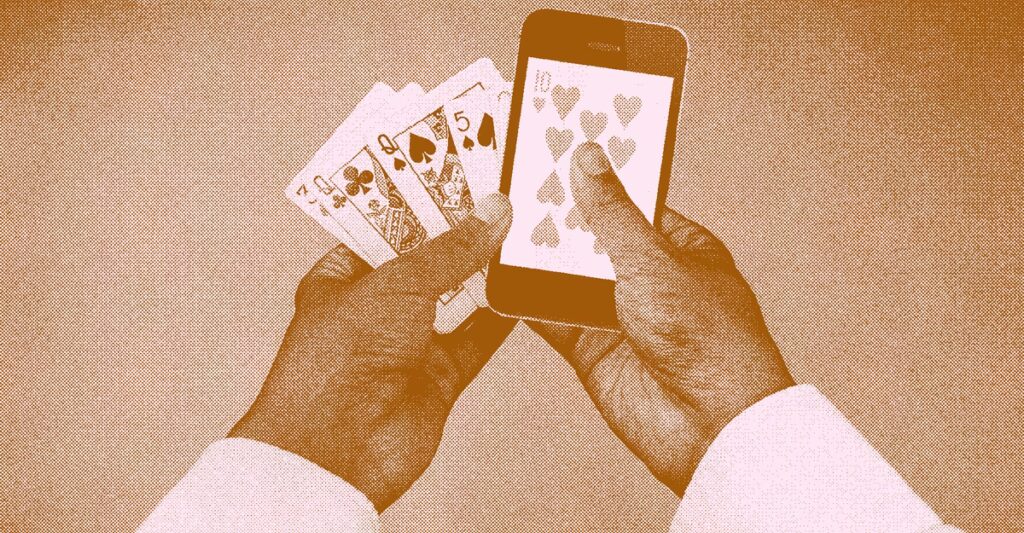
Since the emergence of COVID, gambling has only become more accessible. Mobile sports betting took off in 2020; research from last year suggested that nearly half of men under 50 have an account with an online sports book. And prediction markets now enable bets on almost anything. Will Donald Trump acquire Greenland? Will Paul Thomas Anderson finally win the Academy Award for Best Director? Will Jesus return? If it can be formulated as a yes-or-no question, you can probably bet on it. And the fact that it’s all available on demand only makes it easier to lose your shirt.
Gambling is no longer confined to casinos, horse tracks, or backroom card games. It’s everywhere—in restaurant chains and gas stations, Super Bowl ads and video games. This has created new temptations, particularly for the young people now being coaxed into putting their weekly allowance toward randomized Call of Duty loot boxes and Polymarket wagers. To be sure, there is something predatory about the ways in which companies are now “working really hard to separate young guys from their money,” as the writer Max Read put it on the Galaxy Brain podcast. But the integration of online gambling into daily life also builds on a push-pull that has existed for centuries: the rush of risking it all, and the nagging intuition that it might be better not to.
The post Your Phone Is a Slot Machine appeared first on The Atlantic.