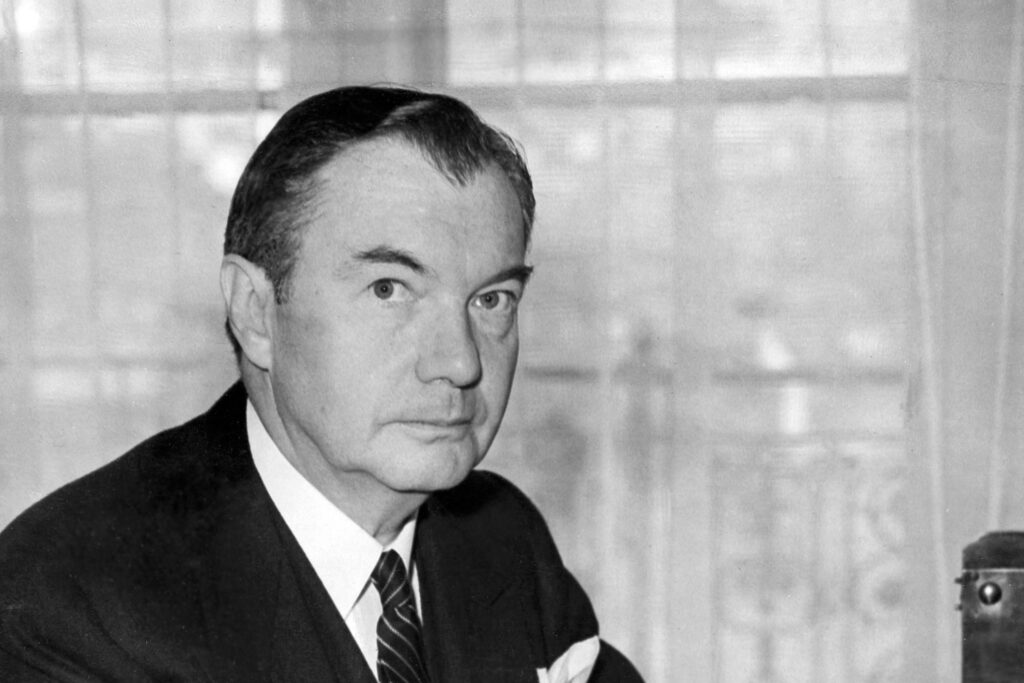
The nation has long needed, but never more than now, what it now has. The new biography of a Supreme Court justice, “Robert H. Jackson: A Life in Judgment,” by University of Virginia law professor G. Edward White, arrives amid disputes involving judicial review of governmental, and especially presidential, actions presented as urgent for national security. Concerning this, Jackson believed judicial deference should be high, but not unlimited.
In 1940, before Jackson joined the court, it ruled, 8-1, that a Pennsylvania school district could make saluting the flag mandatory. Some Jehovah’s Witnesses objected to this as idolatry. The court’s opinion was written by Justice Felix Frankfurter. He thought coercing the Jehovah’s Witnesses was mistaken, but he generally favored judicial restraint, and considered the school district’s objective had a rational basis: “National unity is the basis of national security.”
In 1943, Jackson’s second year as a justice, the court repudiated this, 6-3, in an identical case involving Jehovah’s Witnesses. Writing for the majority, Jackson said:
It is doubtful “that the strength of government to maintain itself would be impressively vindicated by our confirming power of the state to expel a handful of children from school.” So, national security does not justify “officially disciplined uniformity.” And: “The very purpose of a Bill of Rights was to withdraw certain subjects from the vicissitudes of political controversy, to place them beyond the reach of majorities and officials,” as “legal principles to be applied by the courts.” And: “Authority here is to be controlled by public opinion, not public opinion by authority.”
Biographer White considers Jackson’s language “overbroad,” given what wartime exigencies sometimes require governments to do. But in what White calls 1943’s “atmosphere of enhanced patriotism,” Jackson’s words were apposite. A year later, Jackson was wary about bending constitutional principles to accommodate claimed national security imperatives.
During World War II, the existence of large West Coast populations with “Japanese ancestry” prompted the government to require people like Fred Korematsu, a U.S. citizen, to leave the area and submit to relocation in concentration camps. The military report justifying this was, as White says, saturated with racist suppositions, such as: All persons of Japanese ancestry are “subversive” and belong to “an enemy race” whose “racial strands are undiluted.”
In 1944, the court ruled 6-3 against Korematsu’s challenge. Dissenting, Jackson held that courts should not review military officials’ wartime decisions. The internment policy, although “very bad as constitutional law,” was, Jackson wrote, promulgated by a military commander implementing a military program, “not making law in the sense the courts know the term.”
Jackson saw imprudence in the court evaluating the order’s constitutionality: “Once a judicial opinion rationalizes such an order to show that it conforms to the Constitution … the court for all time has validated the principle of racial discrimination in criminal procedure and of transplanting American citizens.” Then: “The principle … lies about like a loaded weapon ready for the hand of any authority that can bring forward a plausible claim of an urgent need.”
In 1952, the court and Jackson again confronted the task of reconciling constitutional principles and a president’s claim of urgency. With the Korean War raging, Harry Truman said an impending nationwide steelworkers strike would “jeopardize national defense,” so he issued an executive order for government to seize and operate most mills. The companies sued, arguing that no act of Congress or constitutional provision validated Truman’s action.
Truman’s lawyers argued that his authorization “could be implied from the aggregate of his powers under the Constitution,” especially as commander in chief. The court disagreed, 6-3.
Concurring, Jackson said that Truman’s action flowed from neither an express nor implied authorization by Congress, and was against Congress’s will as expressed in a 1947 labor relations law that made no provision for such presidential action. It would be “sinister and alarming” to say that the president, enjoying vast discretion regarding foreign affairs, can by “his own” foreign commitment “vastly enlarge his mastery over” the nation’s internal affairs. This way, the president “of his own volition” can give himself “undefined emergency powers.” Truman’s seizure of the mills originates in his “individual will” and “represents an exercise of authority without law.”
Today, the nation is inured to presidential claims of urgent needs — “emergencies,” “existential” dangers — being used for evasions of the Constitution. Said Jackson, our institutions for keeping the executive under the law might be “destined to pass away,” but “it is the duty of the Court to be last, not first, to give them up.”
The post With executive power rampant, exactly the right book has arrived appeared first on Washington Post.