Even by President Trump’s own mercurial standards, his whipsawing over the past few weeks on Greenland — insisting on the largest land acquisition in American history and then dropping it without explanation, threatening allies and then reversing himself — was a remarkable and revealing exercise in a new era of American coercive diplomacy.
Mr. Trump began, as always, with a maximalist demand. This time, it was that a small European power, an ally that had shed blood for the United States in Afghanistan and beyond, turn over a vast and icy territory for the sake of U.S. national security. The president was clearly testing the boundaries of the Atlantic alliance, arguing that handing over the land was a small price for lesser powers to pay for continued American protection.
It was a formula familiar to anyone who has tracked the approach to power that Mr. Trump honed in the New York real estate world and brought with him to the White House, one that leans heavily on bullying and an ability to keep opponents off-balance.
“We want a piece of ice for world protection, and they won’t give it,” the president complained about Denmark in a speech to the world’s elite in Davos, Switzerland, adding with a hint of menace: “You can say yes, and we will be very appreciative. Or you can say no, and we will remember.”
But this week Mr. Trump also discovered the limits of his coercive powers. After he threatened a wave of new tariffs, markets fell abruptly, which always seizes his attention. Allies objected, this time openly. And by the time the president returned to Washington on Thursday night, it was clear that he had left considerable damage to the Western alliance in his wake.
When the climb-down came, it was with only the vaguest explanation from the president.
Mr. Trump said a “framework of a future deal” had been reached, one that did not resemble full American ownership. Instead, he floated the idea of what sounded like a lease for expanded military bases in Greenland in which “the time limit is infinity” and “we can do anything we want,” including to support the Golden Dome, his ambitious missile defense plan.
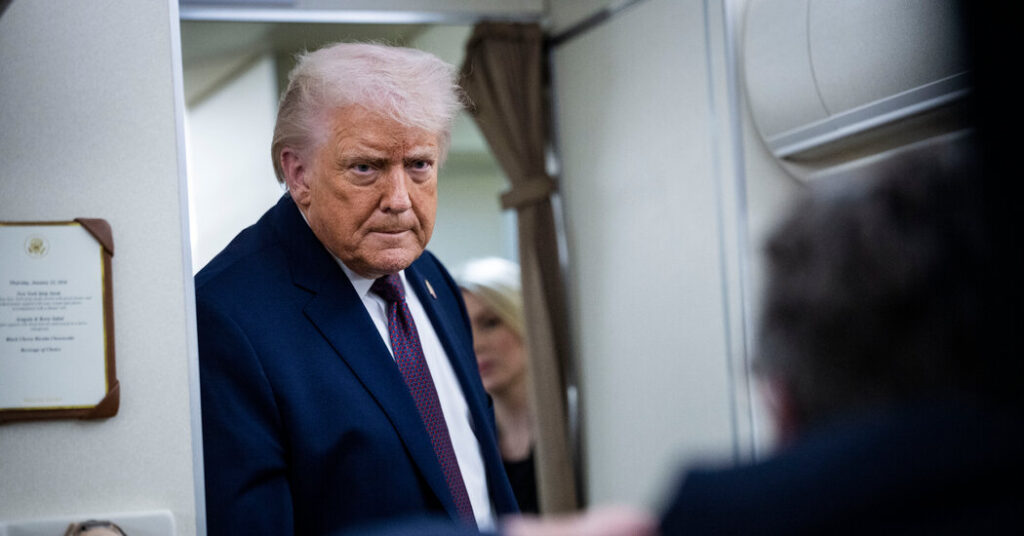
When pressed on Air Force One on Thursday about how the new arrangement would expand America’s right beyond an existing 1951 treaty — which gives the United States almost unlimited rights to base troops, missiles, aircraft and the U.S. Navy on Greenland — he described it as “a much more generous deal.”
Of course, there is the possibility that Mr. Trump’s retreat from a demand for ownership is just temporary, until he finds another reason to revive what has been a yearslong ambition, to pull off an American land acquisition slightly larger than the Louisiana Purchase. (Historians note that Napoleon Bonaparte willingly sold the French territory to Thomas Jefferson for $15 million to raise funds; Denmark has consistently said it has no interest in a deal for Greenland, at any price.)
For now, though, Mr. Trump has retreated from his declaration to The New York Times two weeks ago that ownership is key because “that’s what I feel is psychologically needed for success.” It is unclear what that means about other places where he has threatened action, from Mexico to Cuba to Iran.
But there was a longer-term price, harder to measure.
Even as Mr. Trump backed off, he clearly did damage to a post-World War II system that Washington itself had designed. It is a system that, for all its many flaws, helped prevent direct superpower conflict for three-quarters of a century. Along the way it brought huge advantages to the United States, extending its reach and amplifying its power.
After Greenland, nothing will be quite the same in the Atlantic alliance. The perception of how America envisions using its military and economic power has shifted, perhaps permanently.
For the first time since the end of World War II, the country that created the modern system of how civilized nations interact spent several weeks threatening to turn its military and economic power toward the cause of expanding American borders. To the Europeans, Washington suddenly appeared to be the enemy within.
“The principle behind the threats is disturbing,” Richard Fontaine, the chief executive of the Center for a New American Security and a former aide to the late Senator John McCain. “The prohibition against conquest is a key feature of the post-1945 world, and one that has helped keep the peace among great powers. Coveting Greenland and threatening to acquire it, possibly by force, upends that.”
By the end of the week, Mr. Trump’s European allies were all asking versions of the same questions: Why did Mr. Trump create so much drama, only to back away? In the end, was the possible reward worth the risks?
And in an era of so many urgent threats, from China’s menacing of Taiwan to Russia’s appetite for European territory beyond Ukraine — how did Greenland emerge as Washington’s most urgent security concern?
Trump Administration: Live Updates
Updated
- Under U.S. pressure, Venezuela agrees to take more deportees.
- The U.S. once had more than a dozen bases in Greenland. Now it has one, and Trump wants more.
- Federal vaccine panel leader says polio and other shots should be optional.
“Estranging allies is the cost,” Mr. Fontaine noted, while the benefit of gaining ownership of Greenland “seems minimal.”
The estrangement is real. Allies began to talk about their survival strategies in a world where Washington could no longer be trusted. “We’ve now de-escalated,” Alexander Stubb, the president of Finland and a friend and golfing partner of Mr. Trump, told CNN’s Christiane Amanpour. “But obviously, it’s not over yet.”
Some spoke obliquely about preserving the “rules-based system,” not wanting to directly challenge Mr. Trump. But one leader was astoundingly direct: Mark Carney, the prime minister of Canada, a former central banker who took on Mr. Trump with a bluntness that shocked many in the audience at Davos and generated sustained applause.
“Every day we’re reminded that we live in an era of great-power rivalry,” Mr. Carney told the crowd early in the week, before Mr. Trump reversed course. “That the rules-based order is fading. That the strong can do what they can, and the weak must suffer what they must.”
That last line draws from Thucydides, the ancient Greek historian and military strategist whose “History of the Peloponnesian War” has, for hundreds of years, served as the fundamental text on how to manage raw power.
“This aphorism of Thucydides is presented as inevitable, the natural logic of international relations reasserting itself,” Mr. Carney said. “And faced with this logic, there is a strong tendency for countries to go along to get along. To accommodate. To avoid trouble. To hope that compliance will buy safety.
“Well, it won’t,” he concluded.
But that leaves America’s allies with uncomfortable choices. It is one thing to declare that the United States can no longer be trusted. Some will hedge; Mr. Carney was just back from a trip to Beijing, where he agreed to open Canada to Chinese electric vehicles, which the U.S. has banned.
But it is a stretch to say that any of America’s biggest allies — including Britain, France and Germany — can truly afford to go their own way. They simply have no replacement for a system where the United States stands at the center of their defensive strategy, bolstered by the American nuclear arsenal. They cannot pretend to have the kind of exquisite military reach that Mr. Trump has showcased, from the strike on Iran’s nuclear sites to the dark-of-night rendition of Nicolás Maduro, the former Venezuelan leader.
It would take decades, and hundreds of billions of dollars, to replicate what the Pentagon has built up over generations. Few countries in Europe have the stomach for that. Nor do they possess the budget or the technology.
Mr. Trump rarely misses a moment to remind them of this reality. NATO, he has said repeatedly, is “nothing” without American power at its core.
Of course, that looks different to the Ukrainians, who now get their Western weaponry from the European NATO allies, not from the United States. (Mr. Trump frequently notes that the United States is now “making money” from the Russia-Ukraine war, selling arms to Europe that get passed on to the Ukrainians.)
And in Davos, he was repeatedly dismissive of Europe’s willingness to fight. He questioned whether Europe would “be there” if the United States “ever needed them.’’ He acknowledged that NATO had sent troops to Afghanistan, but insisted “they stayed a little back, a little off the front lines.”
That was too much for Mark Rutte, the secretary general of NATO, who usually flatters Mr. Trump in public and thanks him for forcing European nations to spend far more on defense. But this time he pushed back hard.
“For every two Americans who paid the ultimate price” in Afghanistan, he reminded Mr. Trump as the two men sat onstage, “there was one soldier from another NATO country who did not come back to his family.”
Mr. Rutte bolstered his reputation as a Trump whisperer by quietly negotiating the “framework” that alleviated the immediate crisis over Greenland. He said that in his private meeting with the president, American ownership of Greenland never came up and that the president was “really focusing NATO again on how can we collectively save the Arctic from the Russians and the Chinese.”
Perhaps Mr. Rutte’s agile diplomacy will hold. But after Greenland, European leaders have good reason to wonder where Mr. Trump’s demands will next fall. Last spring, he was claiming that Canada had to become America’s 51st state, and that if it did, it would get the protection of the Golden Dome for free.
He has not revived that demand. But he did take on Mr. Carney, whose critique clearly stung. And he did so with a not-very-veiled threat, one that sounded a lot like the way he was talking about Denmark until Wednesday.
“Canada lives because of the United States,” Mr. Trump said. “Remember that, Mark, the next time you make your statements.”
David E. Sanger covers the Trump administration and a range of national security issues. He has been a Times journalist for more than four decades and has written four books on foreign policy and national security challenges.
The post Trump’s Turnabout on Greenland Shows the Limits of His Coercive Powers appeared first on New York Times.