This is an edition of The Atlantic Daily, a newsletter that guides you through the biggest stories of the day, helps you discover new ideas, and recommends the best in culture. Sign up for it here.
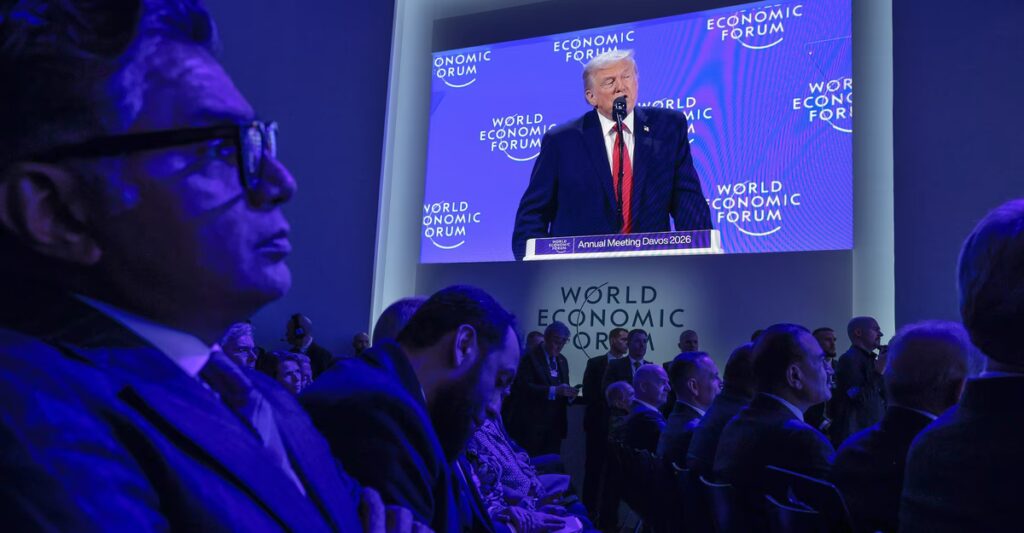
At a rally in Detroit earlier this month, Donald Trump told the crowd that his upcoming speech at the World Economic Forum would tackle one of his core issues: affordability. But the address he delivered in Davos yesterday was not quite what he’d telegraphed.
In what my colleague David A. Graham described as a “stump speech,” the president strayed from that focus, roaming from Arctic defense to the Minnesota fraud scandal to the policies of “Sleepy” Joe Biden. When he returned to the topic of affordability, he claimed that grocery prices are “going down” (they’re not) and that drug prices have declined by “2,000 percent” (they haven’t). Although Trump campaigned on the economy, weak polling has recently spurred new plans to make life in America more affordable.
At one point, Trump plugged a plan to curb predatory lending practices by capping credit-card interest rates at 10 percent—but the deadline (proposed on Truth Social) for the policy to go into effect had passed the day before. Trump also used his speech to promote his plan to lower housing costs, which he recently unveiled in an executive order. The policy is aimed at preventing corporations from buying up single-family homes, and has bipartisan support. These proposals were a blip in his 80-minute speech before he quickly pivoted.
Trump has lately been laser-focused on foreign policy. Nearly three weeks ago, U.S. troops captured Venezuelan President Nicolás Maduro and brought him to New York for trial. Since then, Trump has flirted with military action in Iran and attempted to bully Denmark into giving up Greenland, threatening a sweeping new tariff strategy that—had Trump not reneged yesterday—could have raised costs for Americans.
When Trump and his officials have talked about the economy, their comments have been confusing. The White House’s insistence that consumer goods are, in fact, affordable has so far not connected with many Americans, for whom high prices are still top of mind. In an attempt to underscore how cheap supermarkets have supposedly become, Agriculture Secretary Brooke Rollins said last week that “it can cost around $3 a meal for a piece of chicken, a piece of broccoli, you know, a corn tortilla, and one other thing.” After being criticized online for appearing out of touch, she clarified that $15.64 was the more accurate figure, based on “almost 1,000 simulations,” for “three full square meals and a snack.” (I have some follow-up questions: What’s that “other thing”? And what constitutes a “square” meal?)
Treasury Secretary Scott Bessent also faced blowback from observers and Democratic politicians this week after suggesting in an interview that “mom and pop” homebuyers are snapping up “five, 10, 12 homes” for retirement. And at a rally in Ohio earlier today, Vice President Vance compared the American economy to a doomed enterprise: “You don’t turn the Titanic around overnight,” he said. Trump has blamed “bad public-relations people” for failing to sell his affordability message—but the problem could also have to do with these sorts of gaffes.
The president’s inconsistent messaging may play a role too. Before the holidays, he held a rally in Pennsylvania as part of his “affordability tour”—an effort to shift Americans’ perspectives on the economy. His address included a digression about why the Democrats’ emphasis on affordability was a “hoax,” how Representative Ilhan Omar “does nothing but bitch,” and why Americans don’t need so many pencils. His speech at the Detroit Economic Club included a few diversions but was overall more targeted. “The Trump economic boom has officially begun,” he said.
Trump is right that the economy is showing signs of health. Unemployment is low, and the stock market is on a tear. But these metrics don’t reveal the whole picture. The economy is adding fewer jobs even as inflation remains under control. The Atlantic contributing writer John Dickerson recently pointed out that “aggregate gains mask uneven distribution, and many workers really are seeing their purchasing power erode.” If Trump’s attempts to interfere with the Federal Reserve’s independence prove successful, they could unleash even more economic uncertainty. “Trump is hardly the first president to cherry-pick numbers and accentuate the positive,” Dickerson wrote. “But his argument is weak because he has to overcome people’s lived experience.”
Despite his constant jabs at his predecessor, Trump is in some sense following in Biden’s footsteps. “Bidenomics” fell flat as a slogan in part because Biden’s rosy view of the economy didn’t connect with voters facing ever-higher inflation. When Trump and his team aren’t shutting down criticism of the economy, they’re simply distracted. Neither communicates to Americans that their struggles are understood.
Related:
Here are three new stories from The Atlantic:
- Trump casually denigrates NATO’s war dead.
- Gavin Newsom’s record is a problem.
- Doomsday-prepping for Trump’s third term
Today’s News
- Negotiations over Greenland are centering on expanding NATO’s Arctic presence, restricting Russian and Chinese access to the territory’s resources, and possibly allowing the United States to build and operate military bases on parts of the island. Denmark has rejected any transfer of sovereignty, maintaining that Greenland is not for sale.
- The Trump administration ordered federal agencies to review funding to 14 Democratic-controlled states and Washington, D.C., as it moves to cut off resources to “sanctuary cities” that limit cooperation with immigration enforcement. The president has said that federal payments to such states and cities will end starting February 1; courts have repeatedly stopped similar efforts in the past.
- Donald Trump sued JPMorgan Chase and its CEO, Jamie Dimon, for at least $5 billion, alleging that the bank improperly closed his and his businesses’ accounts for political reasons after the January 6 insurrection. JPMorgan called the suit meritless, saying that the bank does not close accounts for political or religious reasons.
Dispatches
- Time-Travel Thursdays: Gambling is no longer confined to casinos, horse tracks, or backroom card games—it’s everywhere, Will Gottsegen writes.
Explore all of our newsletters here.
Evening Read

The Sciencewashing of Everyday Life
By Ellen Cushing
There’s a double helix in my local Sephora. It’s roughly the size and shape of a soda can, and it is accompanied by a placard referencing patents and peptides, as if in a science fair. It’s trying to sell me a hair mask.
Online, the company responsible for this display describes itself as a “biology-first haircare brand, powered by biotech.” It practices “biomimetic hairscience,” and, thanks to “a decade of complex research into the bioscience of hair,” has patented a peptide that repairs hair “at a molecular level across multiple types of bonds including polypeptide chains and disulfide bonds.” I have no idea what any of this means. The mask costs $75.
In 2026, it is possible to cover your body in science.
More From The Atlantic
- The upside of professional rejection
- Why conservatives defend ICE
- Europe’s red lines worked.
- Science is drowning in AI slop.
- The real fight for the Smithsonian
- The Trump administration is publishing a stream of Nazi propaganda.
Culture Break

Explore. This year’s Oscar nominations may resonate with the average moviegoer more than usual, David Sims writes.
Read. George Saunders discusses his new novel, Vigil, with Adrienne LaFrance.
Rafaela Jinich contributed to this newsletter.
When you buy a book using a link in this newsletter, we receive a commission. Thank you for supporting The Atlantic.
The post The Trump Administration’s Affordability Messaging Is Confusing Americans appeared first on The Atlantic.