This is an edition of The Atlantic Daily, a newsletter that guides you through the biggest stories of the day, helps you discover new ideas, and recommends the best in culture. Sign up for it here.
Earlier this month, Representative Blake Moore of Utah, a Republican, signed a bipartisan statement about Donald Trump’s aggressive pursuit of Greenland that, by the standards of the Trump-loving GOP, amounted to a rare and sharp rebuke of the president. “Sabre-rattling about annexing Greenland is needlessly dangerous,” Moore and Representative Steny Hoyer of Maryland, a Democrat, said in the statement.
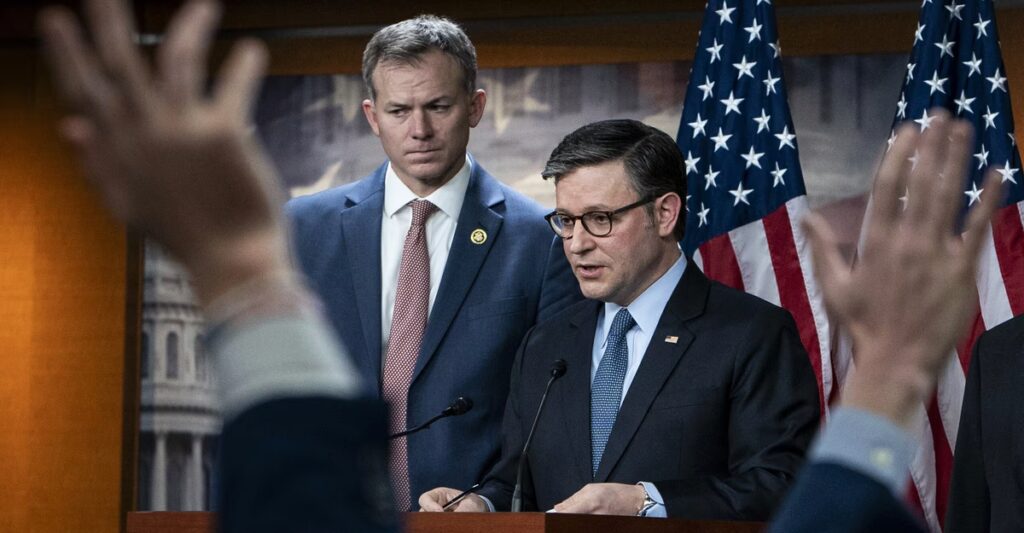
The 45-year-old Moore is in just his third House term, but he’s no rank-and-file member of Congress. For the past two years, he has served as the vice chair of the Republican Conference—the same leadership perch from which Mike Johnson leapt to the House speakership after the mid-session ouster of Kevin McCarthy. Moore also happens to be, with Hoyer, the co-chair of the Congressional Friends of Denmark Caucus, and it was in that capacity that he delivered his warning to Trump. “The last thing America needs,” Moore and Hoyer said, “is a civil war among NATO that endangers our security and our way of life.”
When I spoke with him yesterday, Moore seemed relieved to see that, at least for the moment, the president’s sabers had calmed down. “I think we’ve landed in a really good spot relatively quickly,” Moore told me by phone the morning after Trump announced that he had reached “the framework of a future deal” with NATO Secretary-General Mark Rutte. Moore had yet to be briefed on the developments in Davos, but he said he was happy that the administration had backed off its threat of slapping tariffs on European allies that had opposed Trump’s Greenland endeavor.
Trump’s obsession with acquiring the territory of a long-standing NATO ally has posed yet another test for Republican leaders who have allowed him to largely ignore Congress on both foreign and domestic policy. “I have no intention of getting in the way of President Trump and his administration,” Johnson told reporters Wednesday. He was speaking about the president’s tariff authority, but he could have been referring to any number of issues on which the administration has stretched or entirely obliterated the normal bounds of executive power—including unilaterally dismantling congressionally authorized federal agencies and capturing Venezuelan President Nicolás Maduro in a military raid without even notifying lawmakers. Johnson might still be in lockstep with Trump, but some congressional Republicans have shown signs of wavering. GOP lawmakers joined Democrats to force a vote first on releasing the Epstein files and then on extending expiring health-insurance subsidies.
A few Republicans on Capitol Hill, such as Senator Thom Tillis of North Carolina, had taken a much stronger stand in opposition to Trump’s move on Greenland than their colleagues usually would have. One House Republican, Representative Don Bacon of Nebraska, had suggested that an unauthorized military attack on the island could lead to the president’s impeachment—with GOP support. (Whether Bacon’s prediction is correct is another matter.)
Perhaps it’s no coincidence that Tillis and Bacon are planning on leaving Congress at the end of this year, unlike Moore. The most recent member of the Republican leadership to openly defy Trump, former Representative Liz Cheney of Wyoming, lost her job as House Republican Conference chair and then her seat in relatively quick succession.
Yet Moore’s close ties to Denmark—his family has roots there dating back to the 16th century, a spokesperson told me—and his leadership post make this a tricky moment for him. “Folks don’t recognize how long-standing our ally relation with Denmark is. It’s one of our longest ever,” Moore said. During our conversation, he mixed in praise for the administration’s renewed focus on Arctic security while making clear that, unlike Trump, he does not think that the United States needs to possess Greenland. “There is already so much we can accomplish without having to purchase, acquire, own that land to achieve the outcome that we want,” Moore said.
Moore told me that Congress would need to approve any “sustained military presence” or “trillion-dollar acquisition of Greenland.” And breaking with Johnson, he said that Congress should take a more active role in tariff policy. “I believe we need to be far more involved in all trade discussions,” Moore said.
In his and Hoyer’s statement, they warn that “an attack on Greenland” would “tragically be an attack on NATO.” But when I asked Moore if he agreed with Bacon that a military incursion could lead to Trump’s impeachment, he dismissed the possibility altogether. “There was no potential of an attack on Greenland or military operation there,” he said. “It’s not even in the realm of possibility.”
So, I asked Moore, did Trump back down on Greenland, or did his heavy-handed pressure successfully force NATO to make concessions they would not otherwise have made? Despite his earlier condemnation of “sabre-rattling,” Moore adopted the more charitable view of Trump’s approach. He compared Trump’s pursuit of Greenland to the president’s aggressive first-term push for NATO countries to boost their contributions to the alliance. “President Trump’s a tough negotiator, and people know that,” Moore said. “Denmark is going to stand firm, too, and they should be able to because” they bring a lot to this table, Moore continued. He noted that “if we come to an agreement, I only think it’s going to be a net positive for everybody.”
Moore’s optimistic response struck a familiar note. His brief break with the president was more a hairline fracture than a full rupture. And it still doesn’t take much—in this case, the barest outlines of a diplomatic agreement—for Trump to bring a jittery congressional Republican back into the fold. But as global crises mount and the midterm elections near, the president is discovering that his party is not quite as sanguine as it once was.
Related:
Here are three new stories from The Atlantic:
- America’s real “secretary of war”
- Lessons from the extremists who hijacked the 1970s
- Autocracy in America: Defund science, distort culture, mock education
Today’s News
- Ukraine, Russia, and the United States are holding negotiations in the United Arab Emirates, the first known trilateral discussions about Russia’s war in Ukraine since the conflict started.
- A major winter storm forecasted to last through Monday is expected to hit 34 states starting today.
- Hundreds of businesses across Minnesota closed today during an “economic blackout” to protest the presence of ICE in the state.
Dispatches
- The Books Briefing: Boris Kachka on a biography to read that doesn’t have “the boring bits.”
Explore all of our newsletters here.
More From The Atlantic
- Teenagers are pushing Himmler’s favorite myth.
- Galaxy Brain: ICE is turning real conflict into viral content.
- The firewall against Chinese cars is cracking
Evening Read

The Sports Conspiracy That’s Too Easy to Believe
By Kaitlyn Tiffany
The San Francisco 49ers will not be playing in the Super Bowl, because they lost to the Seattle Seahawks by a disgraceful score of 41 to 6 over the weekend. But of course, “someone wins, someone loses” is never the whole story in sports.
Some fans are now buying into the narrative that the team had no chance because it suffered a suspicious number of devastating injuries over the course of the season (as well as in recent past seasons) … To explain this, some fans pointed to the fact that the team’s practice field and stadium are near an electrical substation and suggested that the electromagnetic waves emanating from it could be weakening players’ bodies, making them especially susceptible to soft-tissue injuries such as tendon tears and muscle strains.
Culture Break

Learn to handle “no.” Rejection doesn’t have to be ego-shattering—and the people most likely to push through it tend to share a specific quality, Anna Holmes writes.
Debate. The Smithsonian’s reputation as the “nation’s attic” belies its unique ability to shape the country’s narrative, Lily Meyer argues.
Stephanie Bai contributed to this newsletter.
When you buy a book using a link in this newsletter, we receive a commission. Thank you for supporting The Atlantic.
The post The Rumbles Within Trump’s GOP appeared first on The Atlantic.