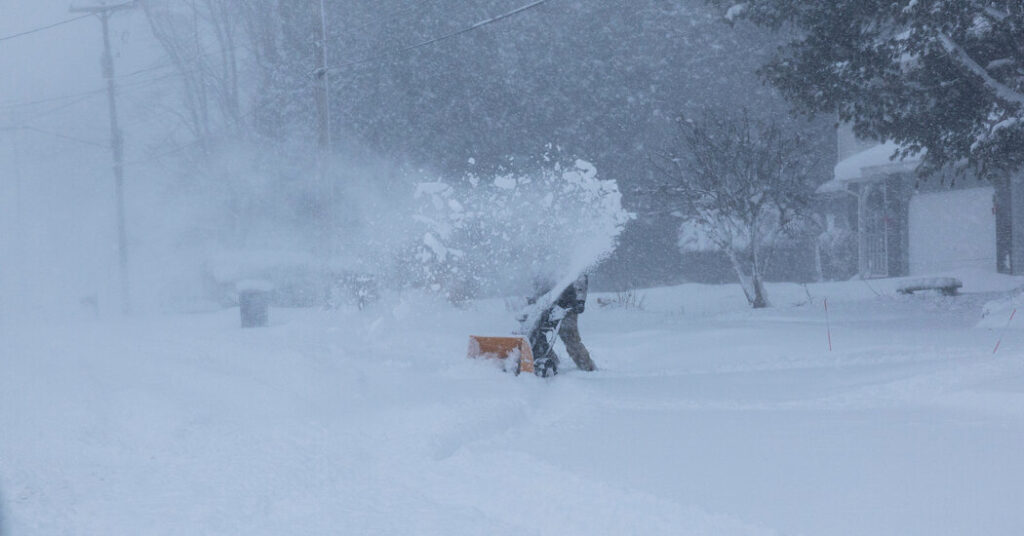
As arctic cold and snow squalls threaten much of the United States this weekend, managers of electric grids from the Midwest to the East Coast have issued warnings that many homes and businesses could lose power.
Grid managers have instructed the country’s largest electricity providers to postpone routine maintenance on power plants and lines to ensure that those resources are available during and after the storm. Heavy snow and freezing rain weigh down tree branches and power lines, causing failures that can cripple energy systems.
Frigid cold also drives up electricity demand as heating appliances require more energy and run longer. Extreme winter weather has expanded utility peak demand in the United States beyond summer to include winter. As a result, utilities have less time to maintain and upgrade equipment, making the grid less reliable and raising energy costs for consumers.
“When you get one day of cold weather, it’s not as significant. But we’re talking about three or four days here of very low temperatures,” said Douglas Giuffre, who leads U.S. power and renewables research for S&P Global Energy.
The utility industry has been preparing for extreme weather by, among other things, upgrading equipment and trimming trees around power lines. Ahead of the storm, power companies said they had activated line crews to help restore power when equipment was damaged.
Exelon, a utility with customers from Illinois to New Jersey, said it was prepared. “Exelon is currently investing $38 billion to modernize and harden our transmission and distribution systems to make the grid more resilient, flexible and better able to withstand increasingly severe storms,” said Mike Innocenzo, executive vice president and chief operating officer at Exelon.
The energy secretary, Chris Wright, said on Thursday that the federal government had ordered that unused backup generators at data centers and “other major facilities” be made available to grids to help prevent blackouts.
The coming storm will arrive about five years after a massive winter storm caused extensive blackouts across much of Texas.
The state’s electric grid, which is largely isolated from grids in the rest of the country, was ill prepared for that storm, according to a report published by the University of Texas at Austin. Grid managers did not anticipate the severity of the storm and underestimated how much demand for electricity would rise when the weather turned bad.
All kinds of power sources failed during that storm, but the state’s natural gas power plants and pipelines played a central role. A lot of pipelines and power plant equipment froze or malfunctioned, forcing generators offline and leaving many residents shivering in their homes for days. The state has estimated that more than 200 people died because of that storm.
“We’re better prepared in some respects, but we still could be better prepared in others,” said Joshua Rhodes, a research scientist at the University of Texas at Austin.
Dr. Rhodes remains concerned about the system for transporting natural gas from production sites in West Texas and elsewhere to the power plants that burn the gas to generate electricity. Much like household pipes, natural gas pipelines and other equipment that is not properly insulated can freeze, interrupting the supply of fuel to power plants.
Up to two-thirds of natural gas processing plants in the Permian Basin, which lies in Texas and New Mexico, experienced an outage during the winter storm five years ago, the University of Texas report found.
“When it happens to the big guys, that’s when there’s a noticeable loss of gas going to the power plants and people’s houses,” said Suzie Boyd, whose company, Caballo Loco Midstream, operates networks of small natural gas pipelines in West Texas and New Mexico.
Caballo Loco was injecting antifreeze into its systems, wrapping equipment with tarps and preparing to heat pipes if needed to keep them warm through the freezing rain forecast for its area beginning on Friday. Ms. Boyd’s son even planned to sleep on a cot in a field office, she said. “We’re bracing ourselves.”
The potent winter storm that has meteorologists and residents on edge is expected to begin on Friday in the Rocky Mountains and make its way across the country through the weekend, bringing wintry precipitation to more than 160 million people from the Southwest into New England.
Officials in Texas and neighboring states were especially concerned by a forecast for a dangerous combination of freezing rain, sleet and snow that could coat trees, power lines and roads.
Even if electric grids can withstand the bad weather, consumers are likely to feel the impact for weeks to come.
Natural gas prices have already begun to rise. Production often falls during storms like this, sometimes considerably.
“It’s not necessarily the temperature itself, it’s the rate of change of temperature that’s important, and then being able to respond to that,” said Sarah Fenton, an executive vice president at Pittsburgh-based EQT, one of the country’s largest natural gas producers.
The dangerous conditions are likely to take a bigger toll on lower-income Americans, many of whom live in poorly insulated homes and have struggled with rising energy costs. Losing power during a storm could make them even more vulnerable.
“A major storm isn’t just a reliability event — it’s an affordability shock,” said Mark Wolfe, an economist and executive director of the National Energy Assistance Directors Association, an organization of state officials who administer the federal Low Income Home Energy Assistance Program. “Vulnerable families are more likely to face outages, lost wages, spoiled food and higher bills in the weeks that follow, making shut-off protections and bill-payment relief critical to recovery.”
Ivan Penn is a reporter based in Los Angeles and covers the energy industry. His work has included reporting on clean energy, failures in the electric grid and the economics of utility services.
The post Storm Poses Big Threats to Power Grids Across U.S. appeared first on New York Times.