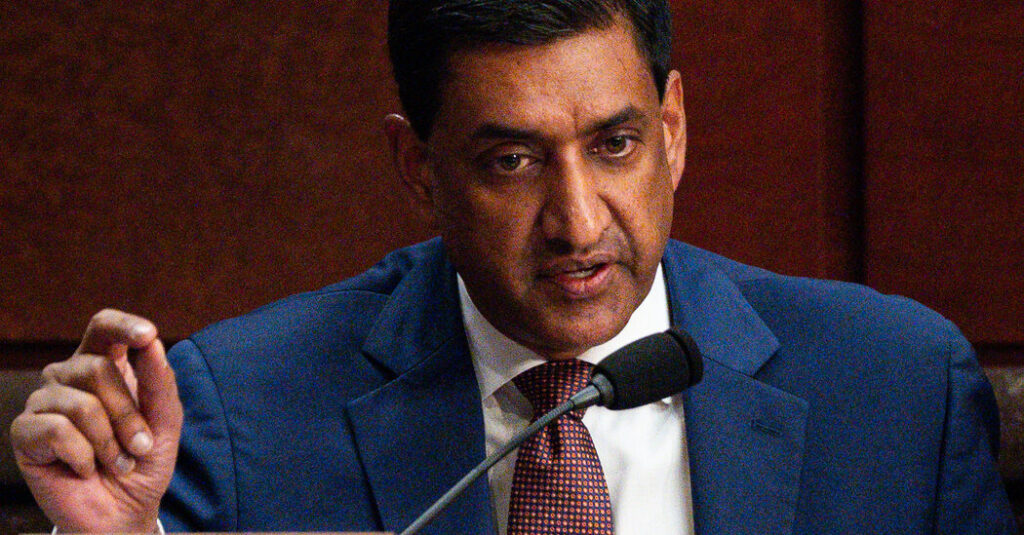
A proposed wealth tax has pitted Democrat against Democrat in California. The initiative, which a health care worker union wants to place on California’s November ballot, would apply a one-time 5 percent tax on the fortune of any Californian worth more than $1 billion. Gov. Gavin Newsom opposes it, while Ro Khanna, who represents Silicon Valley in the U.S. House, favors it. Some prominent billionaires have already exited the state, and others are staying put.
Stephen Stromberg, an editor in Opinion, convened a written discussion with Steven Rattner, a contributing Opinion writer; Catherine Rampell, economics editor of The Bulwark; and Emmanuel Saez, a U.C. Berkeley economist, to discuss the California plan, wealth taxes and economic inequality.
The conversation has been edited for clarity.
Stephen Stromberg: Emmanuel, you helped design the California proposal. Why do you think it makes sense, and how do you respond to worries that it will drive high-net-worth taxpayers out of the state and harm its start-up ecosystem?
Emmanuel Saez: California faces significant defunding from the federal government, especially for Medicaid, hence the urgent need for more revenue to preserve those programs. Billionaires are the socioeconomic group that has done best in recent years, seeing a 158 percent increase in their wealth between 2022 and 2025. Hence, it makes sense to ask them to contribute. A 5 percent tax on their wealth is modest relative to their gains yet can raise substantial revenue. The tax is based on residence as of Jan. 1, 2026, sharply limiting their ability to flee the state to avoid paying. Despite billionaires’ threats to leave, I think extremely few will have been able to change residence by Jan. 1, given the complexity of doing so.
Stromberg: Google founders Larry Page and Sergey Brin have moved assets out of California to states such as Nevada. On the other hand, as Emmanuel says, many billionaires have remained in the state. Catherine, how do you see it, and what reaction do you predict if the initiative passes?
Catherine Rampell: California definitely has long-term structural deficit issues, not only related to federal funding. It needs revenue, and there’s little appetite for cutting spending. (The same is true for the United States overall, by the way.) Raising taxes on rich people is probably part of the solution. But a wealth tax seems like more of a gimmick than a way of actually raising revenue in the long run and may well lead to less revenue.
I feel like I’ve seen a lot of commentary of the “good riddance!” variety about tech billionaires moving, or moving assets. Ro Khanna tweeted a version of this. But losing your tax base is bad if you’re trying to raise revenue — and you don’t need a lot of people to leave to blow a big hole in your state budget. Just ask New Jersey, when hedge fund manager David Tepper left for a while.
Steven Rattner: In addition to Catherine’s good point about the ability of the wealthy to move states, wealth taxes are very difficult to administer. It is not a coincidence that a dozen European countries had wealth taxes at one time or another and only three still do.
I am all in favor of taxing the wealthy more substantially, but there are better ways to do it. We need to change inheritance taxes and raise the capital gains tax, which people pay when they sell an asset such as a share of stock, on the value it has gained since they acquired it.
And we can close other loopholes. Here’s a question for you: If I proposed a government program in which every dollar of charitable contribution was matched by 75 cents of a government grant to the same charity, would you say that’s a good idea or a bad idea? That’s exactly what we have in the federal tax deduction for charitable giving.
Rampell: There are serious proposals to tax billionaires’ wealth in ways that are not strictly a wealth tax, through the existing income tax system. This would pose fewer constitutional problems. Raising capital gains tax rates, as Steve proposes, is one way. So is taxing rich people when they borrow against their assets — without ever selling them — to pay for their living expenses. Also, closing loopholes like the step-up basis (which allows people to die and pass on their capital gains effectively untaxed).
Saez: When we have reached such high levels of wealth concentration, wealth taxation is no gimmick. The revenue at stake is substantial. California billionaires own about $2 trillion in wealth, so a 5 percent tax on them can raise about $100 billion. I estimate that they pay only $3 to $4 billion in California income tax each year.
California already taxes capital gains realizations with a top rate of 13.3 percent, but this does not result in much revenue from the billionaire class, because billionaires do not realize gains. Changing inheritance laws would not help much, because billionaires have found ways to transfer wealth to their heirs before they die.
I am all in favor of closing loopholes, but those measures cannot raise nearly as much as a direct wealth tax when we are talking about the billionaire class.
Rattner: But, again, trying to do this at the state level risks the loss of the very individuals who pay most of the taxes. Applying it retroactively doesn’t necessarily solve the problem — people will think: They did it once; they can do it again.
Saez: The California wealth tax is designed to raise substantial revenue for the state for a duration of five years. If it passes, we can all analyze and revisit the issue in five years! You have to start somewhere, and California’s modest, one-time wealth tax proposal, which will go directly to voters, is probably the best opportunity to demonstrate how this can work.
Rampell: My question for Emmanuel is: If this is such a great, workable idea, and no risk of capital flight or other distortions or administrability problems, why not expand it to people with $5 million in wealth? Surely this would hit a lot of wealthy doctors, lawyers — and maybe Berkeley professors!
One of my big objections to these kinds of proposals is that Democrats keep redefining upward who is “wealthy” in our country. The goal posts have moved a lot in the past decade or so — from no new taxes on people making under $250,000 (President Obama) to no new taxes on people making under $400,000 (President Biden) to only new taxes on millionaires and billionaires (Bernie Sanders) to now just billionaires. I’m all for raising taxes on billionaires, but there’s not enough money on that money tree. Even if you taxed billionaires at 100 percent and assumed no avoidance or exodus, that’s a one-time $2 trillion; California spends about $350 billion a year.
In the long run, if you want a Scandinavian-style welfare state, you need Scandinavian-style taxes. That would mean raising taxes somewhat on the top but a lot on pretty much everyone else, too, which no one has the political appetite for.
Saez: Millionaires do pay a substantial amount of taxes, and that’s a good thing. The group that underpays relative to their ability to pay is the billionaire class. That’s why the wealth tax should specifically target them. They own very large businesses that are either publicly traded (such as Alphabet and Meta), for which valuation is straightforward, or very successful start-ups that have gone through rounds of venture capitalist funding that provide a good sense of their value. Millionaire businesses, such as lawyers’ and doctors’ offices, are much harder to value, and that’s why wealth taxes on millionaires do not work well.
I agree with Catherine that, in the long term, successful welfare states such as those in Scandinavia are based on broad taxes; everybody contributes, and benefits are universal. However, it is hard to get there when you start from a very unequal society, such as the United States, or just California. In the mid-20th century, countries typically addressed extreme income or wealth concentration first through progressive taxation and then developed their large welfare states.
Rampell: The big risk is that California’s wealth tax doesn’t pass and people still leave the state, pre-emptively reducing income tax revenue. Or it does pass and the courts strike it down, but people leave in the meantime, again reducing income tax revenue. Maybe it passes, nobody moves because California is such a fantastic environment that can’t be replicated elsewhere, and the courts don’t strike it down. But this seems Pollyannish.
Stromberg: As this discussion shows, tax policy often revolves around questions of avoidance — how might those targeted for taxation avoid paying it — and administrability — how hard it is for the government to assess and collect what people owe. How would a national wealth tax play out? Billionaires couldn’t avoid that by moving out of state.
Rampell: I’m more skeptical that people will leave the United States; it’s easier to move to Nevada than to Singapore. But even if there isn’t a mass exodus, I think a wealth tax will be harder to administer than people think. A wealth tax would be a huge windfall for accountants and tax attorneys. Ask people who assess assets for estate taxes: The current value of things that don’t sell often or easily — rare works of art, closely held businesses — is manipulated easily.
Saez: Large private firms owned by billionaires are always organized in shares — that is, ownership is divisible. And such shares generally have an active market of venture capitalists and private equity funds. That’s why the wealth tax that takes a fraction of a person’s ownership is straightforward in principle. Meta C.E.O. Mark Zuckerberg sells 5 percent of his stock to pay the wealth tax; it does not matter whether Meta stock goes up or down. Start-up funders sell 5 percent of their stock to pay the wealth tax; it does not matter when the start-up explodes in value or fails. Obviously, tax accountants will try to find tax avoidance opportunities, but when the underlying principle is simple and clear, you can defend the spirit of the tax law.
Rattner: While there are often markets in shares of nonpublic companies, I think asking a founder to sell shares simply to pay a wealth tax is misguided. The tax should be accrued and paid, with interest, when the founder sells the shares. We want founders and early employees to be invested in their businesses, not to become forced sellers at big discounts to true value because their companies are private.
Rampell: Valuations are very volatile from one year to another. They go way up and way down. Does this mean we would give a huge tax refund to start-up founders if they have a down funding round? Valuation is very easily manipulated; you can sell a tiny share of a company in complicated, structured venture capital arrangements to make it look like the shares aren’t worth very much. I say this as the daughter of a long line of accountants.
Stromberg: We’ve discussed wealth concentration. If a billionaire or two were in this conversation, they might argue that inequality is necessary. People need to accumulate lots of private capital to grow the economy, by investing in artificial intelligence and other expensive next-generation technologies. What’s your response?
Rattner: Of course, some level of income and wealth inequality is appropriate. But inequality is unacceptably high. History provides many examples when it reached extreme levels — the Gilded Age, the Roaring Twenties — and many of those eras ended badly, politically, economically or both.
The California proposal reflects a broad belief that the ultrawealthy are not paying their fair share. That perception exists because it is true. Many of the household names — Jeff Bezos and the Google guys — almost certainly pay a tiny fraction of the annual increase in their net worths because that increase comes from the rising value of the shares they own in their companies, creating unrealized capital gains. Under the current system, those gains are taxed only when the shares are sold — and, if held at death, they aren’t taxed at all.
The public is understandably sympathetic to the idea that the ultrarich don’t pay enough because they hold assets that are only taxed when they are sold. If rational minds don’t find a way to address this problem, there could be a popular reaction that would result in something poorly designed and destructive being put in place — like the California proposal.
Saez: A successful capitalist system needs to encourage innovation and the creation of new businesses. Some businesses will be successful, creating billionaires. After the business is successful, it no longer needs a founder who controls it fully. This is why a wealth tax on billionaires, even a recurrent one, that essentially dilutes slightly founders’ ownership is not going to harm business dynamism.
Rampell: I’m skeptical that high taxes on rich people are going to kill innovation meaningfully, but I do think having stable, predictable tax and regulatory policy is good for long-run investments. Even if California’s wealth tax is only a one-time thing, a lot of founders are likely to pick another state. If the wealth tax actually works at raising revenue — and I’m skeptical it will — it’s going to be hard to commit to “we’re only going to do this one time!”
My bigger question is: Are we trying to solve wealth inequality (and punish the rich) or are we trying to raise revenue?
Stromberg: Boosters of wealth taxes would surely say, “Why not do both?”
Rampell: Because you probably wouldn’t design the solution for either this way.
Stromberg: Emmanuel, part of your argument appears to be that the California measure is about momentum-building: Voter approval would show that wealth taxes are politically viable (though a voter rejection might suggest the opposite). What’s your read on the politics of wealth taxes?
Saez: Wealth taxes on the ultrarich are very popular among voters. We’ll see how this initiative goes, as billionaires might be able to influence public opinion. But billionaires have even more sway with elected officials, so a direct vote is the most promising route. Absent the wealth tax, I don’t see California plugging the revenue hole federal defunding has created.
Rampell: Everyone’s favorite tax is one that someone else pays. But a one-time tax that will be hard to collect and might drive away the tax base without increasing long-run revenue is the definition of “slopulism.” It’s designed to fire up the base. In general, I think Democrats need to focus more on policies that will invest in the future and improve the living standards of the bottom half of the population, not just on who they want to punish.
A wealth tax is an easy-sounding solution to a complicated problem — California spends a lot more money than it brings in — and real solutions to that problem likely involve dealing with much touchier state issues.
Stromberg: Thank you, Catherine, Steve and Emmanuel. I hope we get to chat again — in less than five years.
Catherine Rampell is economics editor of The Bulwark and an anchor at MS NOW. Steven Rattner is a contributing Opinion writer. Emmanuel Saez is the director of the James M. and Cathleen D. Stone Center on Wealth and Income Inequality at the University of California at Berkeley. Stephen Stromberg is an Opinion editor for politics and economics.
The Times is committed to publishing a diversity of letters to the editor. We’d like to hear what you think about this or any of our articles. Here are some tips. And here’s our email: [email protected].
Follow the New York Times Opinion section on Facebook, Instagram, TikTok, Bluesky, WhatsApp and Threads.
The post Simple or Simplistic? Three Experts Spar Over a California Billionaire Tax. appeared first on New York Times.


