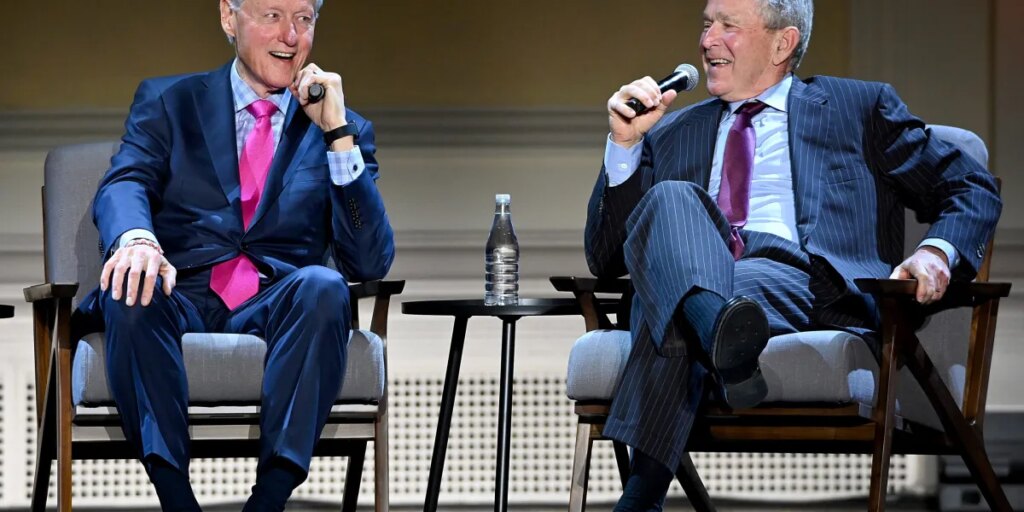
After George W. Bush succeeded Bill Clinton in the White House, the two didn’t drift into political distance. In fact, during Bush’s second term, he called his rival about twice a year to talk through the challenges he was facing.
“He asked my opinion,” Clinton recalled in a video that’s recirculated on social media. “Half the time he disagreed with it, but I felt good about that. I thought that was a really healthy thing.”
For Clinton, the exchange reflected a broader principle that applies far beyond politics: success often comes down to learning from people who think differently—and getting out of your own way.
“You’ve got to cultivate people who know things you don’t and have skills you don’t—and yes, that can be taught,” Clinton added.
“If nothing else, we can help people get out of their own way. Everybody’s got a story and a dream and they can bring it to bear if we can just help people get out of their own way sometimes.”
Even in an era when careers seem more competitive and polarized than ever, climbing to the top can feel like a solo sport. However, Bush and Clinton’s relationship make it clear that there is true benefit to seeking out new perspectives, even if it’s from your staunchest critics.
Presidents Bush and Clinton agree: success is never a straight line
While both Bush and Clinton are now remembered as two-term presidents, neither mapped out a straight line to the Oval Office in their youth. Like most careers, theirs were shaped as much by setbacks and detours as by ambition
According to Bush, rigid life plans can actually do more harm than good.
“People who plan their life when they’re 18 years old and say, ‘This is my life plan,’ would generally be surprised and maybe disappointed,” Bush said in a 2011 interview with AARP.
“I think you ought to be open-minded as to where life takes you. One of the things I learned as president is that your life is just not going to unfold the way you want it to. There will be surprises, challenges, and therefore the question is how you deal with the unexpected.”
Clinton’s own path tells a similar story. Before the White House, he lost his first ever political race when he ran for Congress in the 1970s. Instead of letting the defeat define him, he regrouped—later winning elections as Arkansas’ attorney general, then governor, and eventually president.
“If you’re broken by defeat, you’re giving someone else the permission to define your life. And your worth. And your tomorrows,” Clinton told college students in 2013. “You know, if you’ve lost a lot of yesterdays – welcome to the human race. But you don’t have to give anybody your tomorrows. I think that’s the most important thing to remember.”
Your competitor might be your best career asset—just look at Steve Jobs’ relationship with Larry Ellison and Bill Gates
The same dynamic plays out far beyond politics. The idea of learning from rivals—and keeping strong relationships even in competitive environments—is just as common in the business world.
Steve Jobs, for all his reputation as an intense competitor, maintained close ties with fellow tech titans, including people whose companies were directly competing with Apple. Oracle founder Larry Ellison often described Jobs as his best friend.
“Apple became the most valuable company on Earth, and it wasn’t even one of Steve’s goals,” Ellison said. “He wasn’t trying to be rich. He wasn’t trying to be famous. He wasn’t trying to be powerful. He was obsessed with the creative process and building something that was beautiful.”
Jobs’ relationship with Microsoft cofounder Bill Gates proved even more consequential. In 1997, when Apple was struggling, Gates made a $150 million investment in the company—a move credited with helping stabilize the business at a critical moment.
“Bill, thank you,” Jobs told Gates at the time. “The world’s a better place.”
Gates has long embraced a leadership truth that mirrors the Bush–Clinton dynamic: progress often depends on being open to perspectives outside your own camp.
“We all need people who will give us feedback,” Gates said at a TED talk in 2013. “That’s how we improve.”
The post President George W. Bush used to call Bill Clinton for advice—and his message was consistently to get out of your own way appeared first on Fortune.