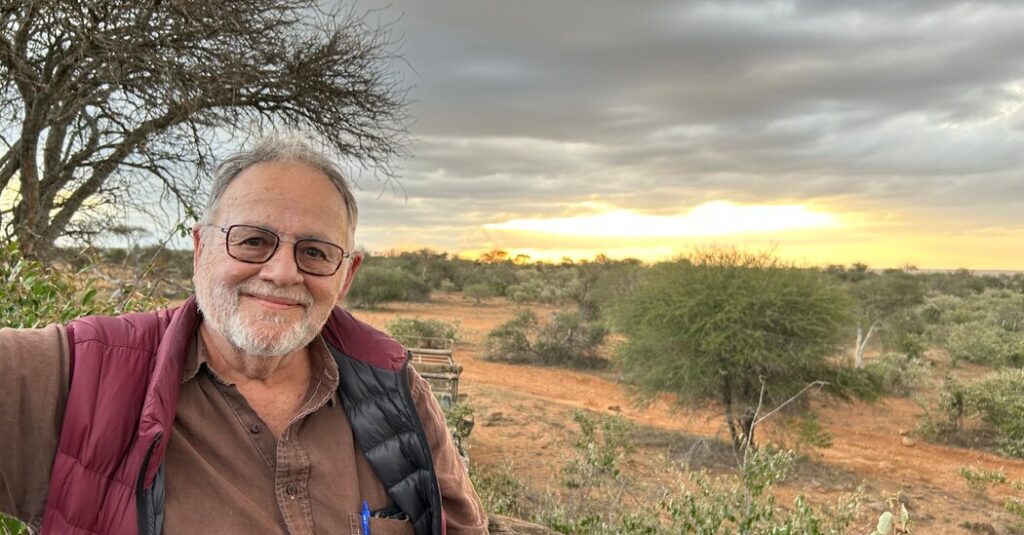
Pedro A. Sanchez, a soil scientist who helped increase crop yields in poor countries where subsistence farmers saw their children go to bed hungry, especially in sub-Saharan Africa, died on Jan. 12 at his home in Falmouth, Mass. He was 85.
The cause was end-stage dementia, his daughter Jennifer Goebel said.
Born in Cuba, where his father sold fertilizer to farmers, Dr. Sanchez studied agronomy at Cornell University and became a leading expert in how to improve the productivity of poor soils in tropical regions. He worked to extend to Africa the breakthroughs of the Green Revolution, a movement that began in the 1960s and tripled food productivity in Asia and Latin America.
In 2002, Dr. Sanchez was awarded the World Food Prize — often likened to the Nobel Prize for those working in food security and agriculture — for helping Peru become self-sufficient in rice growing; opening to farming an arid region of Brazil the size of Western Europe; and developing programs in Africa adopted by more than 250,000 subsistence farmers that increased crop yields up to fourfold.
“By pioneering ways to restore fertility to some of the world’s poorest and most degraded soils,” the prize citation read, Dr. Sanchez “has made a major contribution to preserving our delicate ecosystem, while at the same time offering great hope to all those struggling to survive on marginal lands around the world.”
In the early 2000s, as co-chair of the United Nations Task Force on Hunger, Dr. Sanchez helped persuade Kofi Annan, the U.N. secretary-general, to call for a new Green Revolution focused on Africa.
The original Green Revolution, which lifted hundreds of millions of people out of extreme hunger in Asia and Latin America, was sparked by the American agronomist Norman E. Borlaug, who developed higher-yield, disease-resistant wheat — a breakthrough that his colleagues later extended to rice.
The Green Revolution bypassed Africa for a number of reasons. Its village farmers — largely women deprived of rights, including the right to own land — grew a wider range of crops than other regions, depended on fickle rainfall rather than irrigation, and cultivated soils that were severely deprived of nutrients for want of fertilizer.
The first country to take up Mr. Annan’s challenge for an African Green Revolution was landlocked Malawi, where nearly half the population depended on donated food aid.
Dr. Sanchez, who became an adviser to the country, told its president in 2005 that small farmers needed subsidized seeds and fertilizer to replenish the nitrogen-starved soils. The government embraced the policy over the objections of the World Bank and foreign donor nations, which claimed that subsidizing poor African farmers violated free-market principles.
In response, Dr. Sanchez pointed out that Europe, Japan and the United States subsidized their farmers.
Malawi, though one of the poorest nations on Earth, paid for the initial subsidies itself. It offered farmers hybrid seeds and two bags of fertilizer apiece at a 75 percent discount. Production of corn increased fourfold in two years, and Malawi even became a food donor to neighboring countries.
Dr. Sanchez went on to promote similar ideas as a leader of the Millennium Villages Project, an ambitious demonstration effort in some 80 African villages. The project was started in 2005 by the economist Jeffrey D. Sachs of Columbia University, whose aim was to offer a model for ending extreme poverty in Africa.
“It was quite an experience to get out of academia and really do development,” Dr. Sanchez recalled.
As in Malawi, he offered subsidized fertilizer and seeds for the smallhold farmers in the villages. The Millennium Villages Project ran for a decade, gaining wide attention for funneling hundreds of millions of dollars from donors including George Soros into rural health clinics and schools as well as agriculture.
The project was criticized for its expense and for falling short of its goal to cut poverty dramatically. Bill Gates, whose foundation declined to support the project, called it “a cautionary tale.”
But Dr. Sanchez was proud of his contribution to improving crop yields, which grew to 1.5 from 1.1 tons per hectare, he said in 2016. Those are “miserable” yields compared with farmers in the West, he said, “but it’s a 50 percent increase, so it’s beginning to happen.”
Pedro Antonio Sanchez San Martín was born on Oct. 7, 1940, in Havana, the oldest of four children of Pedro and Georgina (San Martín) Sanchez. Besides owning a fertilizer business, his father farmed 50 acres of avocados and mangoes for export.
In 1958, Pedro entered Cornell, his father’s alma mater. The Cuban Revolution the next year forced his parents to flee to Florida. Unable to pay college fees, Pedro took a job as a dishwasher at his fraternity house.
He received a bachelor’s degree in 1962 and remained at Cornell for a master’s in 1965 and a Ph.D. in 1968, both in soil science.
Starting in 1968, he spent 23 years on the faculty of North Carolina State University and balanced teaching with extensive research abroad. Early in his career, he led a team in Peru that produced some of the highest rice yields in the world.
Beginning in 1972, he worked with the Brazilian government to reduce soil acidity in the Cerrado, a tropical savanna that occupies one-fifth of the country. By pouring millions of tons of lime into fields, among other measures, the Cerrado was opened to large-scale production of cereal crops.
“The result was the single largest increase in arable land anywhere in the world in over 50 years,” according to the World Food Prize. (The prize was established by Mr. Borlaug, the father of the Green Revolution, who in 1970 won the Nobel Peace Prize for his work.)
In 2003, Dr. Sanchez received a MacArthur Foundation fellowship, widely known as a “genius grant,” for his “practical and economical solutions to problems of land productivity in developing countries.”
Dr. Sanchez’s first marriage, to Wendy Levin, ended in divorce. In 1990, he married Cheryl Palm, a fellow soil scientist, and the two taught at universities including the University of California, Berkeley; Columbia; and the University of Florida, which recruited them in 2016.
They retired in 2023 to Falmouth, on Cape Cod, and Dr. Palm died in 2024.
Besides Ms. Goebel, from his first marriage, Dr. Sanchez is survived by two other children from his first marriage, Evan Sanchez and Juliana Sanchez Bloom; a sister, Georgina Sanchez Maher; a brother, Jorge Sanchez; and six grandchildren.
The original Green Revolution used technologies and practices that sometimes harmed the environment, including raising carbon emissions. Dr. Sanchez said Africa should learn from those past mistakes and, from 1991 to 2001, he implemented that view as head of the International Center for Research in Agroforestry (now known as World Agroforestry) in Nairobi, Kenya.
He promoted planting trees next to crops to add nitrogen naturally to poor soils. Supplemented with phosphate from local rocks, the need for expensive imported fertilizers was eliminated. More than 400,000 farmers who adopted the technique in some 20 countries saw their crop yields increase dramatically.
In 2001, a leader of the Luo people in western Kenya named Dr. Sanchez an elder of the community — because, for the first time, villagers were not going to bed hungry.
Trip Gabriel is a Times reporter on the Obituaries desk.
The post Pedro Sanchez, Who Helped Feed the Developing World, Dies at 85 appeared first on New York Times.