BRUSSELS — After President Donald Trump used his bully pulpit in Davos, Switzerland, to demand “the acquisition of Greenland by the United States — just as we have acquired many other territories throughout our history” — and then backed down on the same day, many officials here see a lesson for the European Union: Pushing back works.
The brazen ultimatum — give up Greenland or face tariffs — elicited a level of unity that largely had eluded the leaders of the 27-nation E.U. in the year since Trump’s second inauguration.
Trump’s gambit for Greenland, an autonomous territory of NATO ally Denmark, bonded some unlikely partners in opposition: Europe’s mainstream political establishment with populist and nationalist parties; Republicans and Democrats in the deeply partisan U.S. Congress; the mostly Indigenous people of Greenland with their Danish former colonizers; and the E.U. and Britain, the only country ever to quit the bloc.
For advocates of taking a tougher line with Trump, the president’s climbdown regarding the strategic Arctic territory was proof that retaliation — not conciliation — is the answer to his hardball tactics. After accommodating Trump on trade and on arming Ukraine, the Europeans finally stood up to him. Even more significantly, Trump backed down.
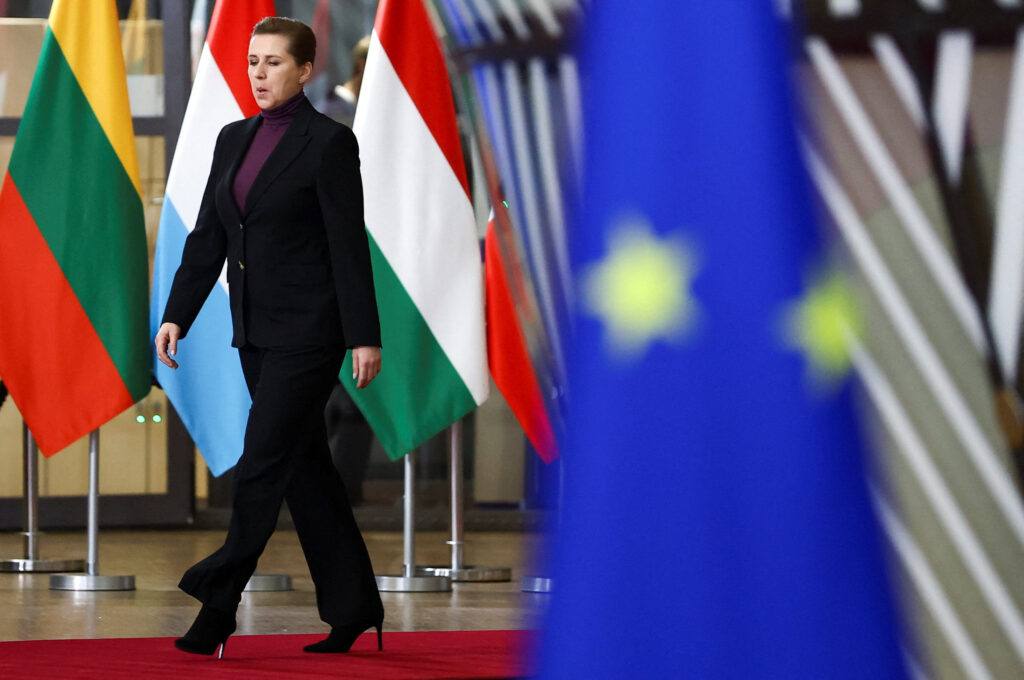
“When we stand together, and when we are clear and strong, also in our willingness to stand up for ourselves, then the results will show,” Danish Prime Minister Mette Frederiksen told reporters in Brussels on Thursday night. “I think we have learned something during the last couple of days and weeks, and now we, of course, want to find a solution.”
A chorus of European leaders insisted they would not be blackmailed. They blasted Trump’s crusade to grab land from a NATO ally as “unacceptable” and “inexplicable.” The E.U. threatened its own tariffs on American goods. And resolve grew within the bloc to unleash a trade retaliation tool it had long hesitated to use, which could target U.S. services in Europe — a profit center for American companies in which they benefit from a big surplus.
The solidarity from across Europe, Frederiksen said, “was extremely important in this very difficult situation.”
The White House maintains that Trump did not blink but actually got everything he wanted, including full access to Greenland for the U.S. military, without having to pay a dime through a deal brokered with NATO Secretary General Mark Rutte.
“President Trump was preparing for a Feb. 1 tariff and that has only been removed from the table for one reason: he and the NATO Secretary General agreed upon a framework for a deal on Greenland,” Anna Kelly, a White House spokeswoman, said in a written response to a question.
Trump’s true motive for compromising may never be known. He arrived in the Swiss resort of Davos for the World Economic Forum planning to emphasize his efforts to address concern over an affordability crisis in America, which Trump has denied. The prospect of E.U. tariffs further raising costs for U.S. consumers may have moved him. Or perhaps it was a sharp sell-off in U.S. stock and bond markets, or the bipartisan opposition in Congress during a midterm election year.
Whatever the reason, Trump suspended his tariff threats against European nations, proclaiming he had reached the “framework” of a deal.
Points under negotiation include greater American access to military bases and minerals extraction in Greenland, European operations in the Arctic, and oversight over investments to prevent Russia or China from gaining a foothold, according to two European officials, who spoke on the condition of anonymity to discuss sensitive diplomacy.
Trump had been clear about wanting to “own” Greenland either by buying or otherwise acquiring the territory, even hinting at military action. In a speech in Davos on Wednesday, Trump ruled out the use of force. And within hours he declared victory and backed down.
Danish leaders said ceding sovereign territory is a red line and that they requested a NATO mission in the Arctic. The Danes also had insisted that Trump could achieve his goals through an existing 1951 defense pact — a position the White House previously dismissed.
Now, the Trump administration will pursue negotiations with Denmark on updating that defense treaty, as well as with European nations over expanding NATO military presence in the Arctic, they said.
European officials said they believed his U-turn came from a change of heart, rather than a change in substance. Danish and other NATO leaders made such overtures for weeks before Trump escalated the standoff.
Officials said Trump appeared to shift after realizing that E.U. retaliatory tariffs could take effect in February, and that his bid for Greenland was unpopular back home, including with American businesses.
“Who knows what really goes on in his mind,” one official quipped.
Ursula von der Leyen, the president of the European Commission, the E.U.’s executive body, said many elements “may also have played a role … but without firmness, non-escalatory responses, and unity in the European Union, they would not have worked.”
“We are here in a better position than we were 24 hours ago, and tonight we drew the lessons of our collective strategy,” von der Leyen said. “It was effective,” she added, “so going forward we should maintain this very approach.”
Von der Leyen spoke to reporters overnight following a summit of all 27 of the E.U.’s heads of state and government in Brussels. Beyond Greenland, they discussed how to prepare for a volatile world in which Washington, at any moment, might turn the threat of its military or economic power on longtime European allies.
Even as Europeans pushed back, leaders dispatched Rutte, a former Dutch prime minister often dubbed their “Trump whisperer.” Rutte’s job at NATO has been consumed by papering over rifts with Trump.
Publicly, the NATO chief said little about the Greenland crisis, refusing to deviate from praising Trump or agreeing with his grievances about Arctic security.
A few leaders attributed Trump’s reversal to patience and an extended olive branch. Italian Prime Minister Giorgia Meloni, an ally of Trump on the hard right, pointed to “fostering dialogue between allied nations.”
French President Emmanuel Macron, however, said tough resolve was the trick. “What we should conclude is that when Europe reacts with a united front, using the instruments at our disposal while it is under threat, it can command respect,” Macron said. “And we remain extremely vigilant.”
Even Polish Prime Minister Donald Tusk, still one of the most ardent champions of preserving the transatlantic relationship, said it was important “for our partners in Washington to understand the difference between domination and leadership.”
That said, the standoff has dramatically darkened the mood within the E.U. regarding relations with Washington — a bond that has insured economic stability and security on the continent for 80 years.
European lawmakers voiced a sense that the E.U. had to push back or there would be no end to Trump’s breaching of red lines. Playing nice only goes so far in shielding them from confrontation, officials conceded, and many warned that the Greenland matter was not yet settled.
“When we genuflect, Trump weighs in, when we keep our back straight he tacoes out,” Nathalie Tocci, director of the Rome-based Institute for International Affairs, wrote on X in reference to “Trump Always Chickens Out” — a favorite phrase of Trump critics. It’s not because “he’s scared of Europe but of the markets,” Tocci said. “Lesson learned hopefully.”
Lucky for E.U. leaders, they did not actually have to hit back — at least not yet — because the mercurial president stood down. That would have proved a bigger test of the cohesion between countries favoring a harder line, like France, and those more cautious, like Italy.
For all the declarations of E.U. unity, the standoff caused a serious and potentially enduring split in the NATO alliance.
Trump’s comments in Davos went to the heart of the European dilemma of how to navigate a world in which their most powerful ally is defining its positions. Trump cast the dispute as the U.S. vs. NATO, saying that Rutte was “representing the other side” while adding, “which is really us too, because, you know, we’re a very important member of NATO.”
In his pursuit of Greenland, Trump also suggested in his speech that the U.S. was not inclined to defend territory it does not own. The core pillar of NATO is its Article 5 collective defense clause — that an attack against one is an attack against all. For smaller nations such as the Baltics, near Russia, the key to this idea is that the U.S. would come to their defense.
Whatever moved Trump, everyone wants to claim the success.
In London, Prime Minister Keir Starmer had been facing pressure within his own Labour Party for a tougher response. Starmer delivered his sharpest rebuke yet hours before Trump’s pivot, promising he “would not yield” on his defense of Greenland.
The timing allowed officials to say Starmer’s government had stood up to Trump and even to claim some credit for deterring the president. British Foreign Secretary Yvette Cooper told Sky News it was a “a reflection of the strength of our connections in Washington.”
Still, European officials spoke of a deep breach of trust across the Atlantic. In Brussels, some diplomats from countries that have been the loudest cheerleaders of the U.S. now refer to America as “our former ally.”
Asked if she can still trust the U.S., Frederiksen, the Danish prime minister, hesitated. “I mean, we have been working very closely with the U.S. for many years,” she said, “but we have to work together respectfully, without threatening each other.”
Beatriz Rios in Brussels, Steve Hendrix in London, and Emily Davies and Cat Zakrzewski in Davos, Switzerland, contributed to this report.
The post On Greenland, Europe stood up, Trump blinked, and the E.U. learned a lesson appeared first on Washington Post.