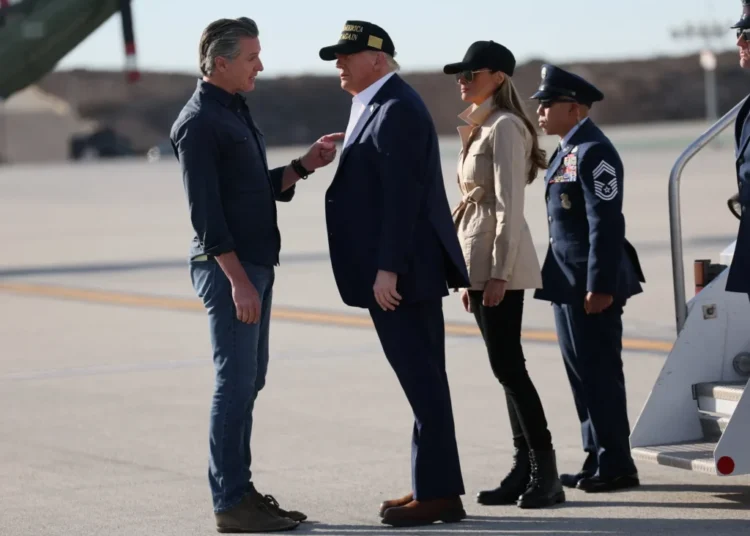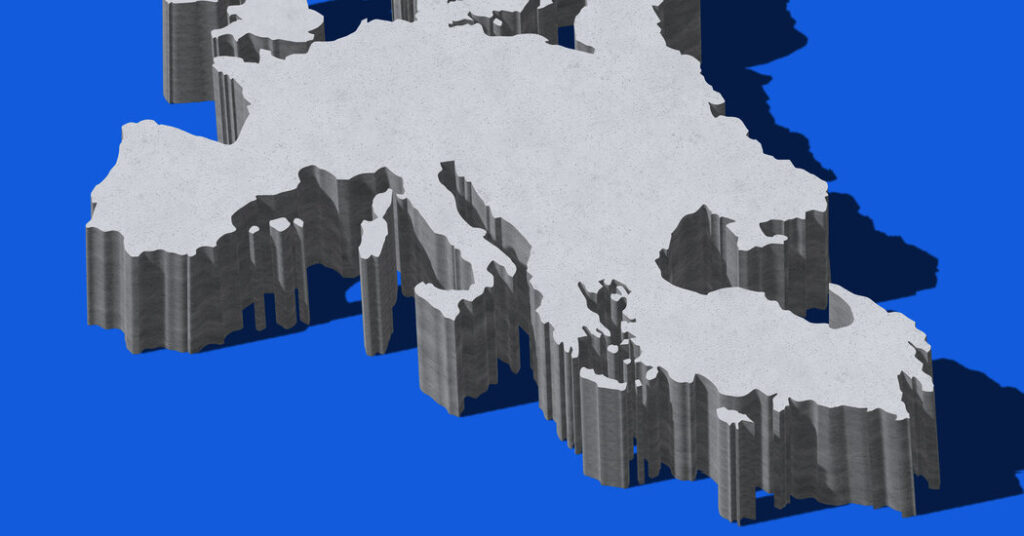
President Trump’s hopes to annex Greenland appear to be at an end. On Wednesday, he pulled back from the prospect of military invasion and abandoned the threat of tariffs to secure the territory. Instead, he wrote on Truth Social, there is a “framework” agreement in place, the details of which are still to come to light. The crisis, for now, seems to be averted.
That is a relief. But the aggression cannot be forgotten. In an extraordinary conceit, Mr. Trump said he’d like to buy the island, an autonomous territory of Denmark, and could take it by force if necessary. No one imagined that the United States, NATO’s founder and prime protector, would threaten to invade one of its members. Yet that’s where we got to.
What happens next? To judge by the comments of those gathered this week in Davos, Switzerland — where Prime Minister Mark Carney of Canada announced a “rupture” in the world order — nobody really knows. Europeans are surely scrabbling to make good on Mr. Trump’s climb-down. But after the shock of recent weeks, nobody should be in any doubt: NATO as we know it, the alliance that has been the bedrock of trans-Atlantic security for over 75 years, is coming to an end.
To be sure, its unraveling won’t be immediate and will entail all manner of disruption. But it will be no disaster. For Europe, which has long subcontracted its security to Washington, possesses both the motive and the means to protect itself. Indeed, this week showed how effective it can be when its leaders work in concert with one another. Amid Trumpian turbulence, Europe has a chance to step out of America’s shadow.
Mr. Trump has consistently claimed that owning Greenland is vital for American national security. For one thing, he believes that China and Russia are eyeing it, in part for its untapped store of minerals. For another, he wants to build his “Golden Dome” missile defense system on its territory. The United States currently deploys around 200 military personnel at Greenland’s Pituffik Space Base, and a 1951 treaty with Denmark enables the United States to increase that number and build additional installations on the island. But Mr. Trump insists that to protect something, you must possess it.
The United States, of course, doesn’t own any of its fellow NATO members. By Mr. Trump’s logic, their protection therefore can’t be assured: It’s not clear that he would honor the alliance’s self-defense clause, Article 5. In fact, Mr. Trump has previously suggested that he might not defend NATO allies under threat and recently, when pressed, wouldn’t rule out exiting NATO over the Greenland controversy. In a peevish speech in Davos, he struck a plangent note. “We give so much,” he said, “and get so little in return.”
No president has created so much doubt about America’s commitment to trans-Atlantic security. That seems to stem from Mr. Trump’s disdain for Europe, a sentiment expressed unsparingly in his administration’s National Security Strategy. Released late last year, the document paints Europe as economically declining, at risk of “civilizational erasure” and less important than other regions, not least Latin America and East Asia. It even questions whether some European countries will have the muscle required to “remain reliable allies.”
Europe, having courted Mr. Trump with gifts, flattery and talk of “misunderstandings,” has finally begun to show some resolve. In response to his Greenland threats, the European Parliament suspended ratification of the bloc’s trade agreement with the United States. European leaders mulled counter-tariffs and, at the urging of President Emmanuel Macron of France, considered invoking the European Union’s anti-coercion instrument, which enables the bloc to retaliate against economic pressure. More immediately, a Danish pension fund said it would offload $100 million in U.S. Treasuries.
Europeans are doubtless relieved that the dispute over Greenland didn’t boil over. But they are wrong if they think that Mr. Trump alone is the problem. Even if he doesn’t seek an unconstitutional third term, his “America first” worldview and antipathy toward Europe resonate within MAGA’s ranks, one of whose leaders could well succeed him. And if a Democrat wins the next presidential election, the United States is likely to be increasingly focused on China, the only plausible challenger to its global dominance. Either way, Washington’s strategic priorities will continue to shift elsewhere.
For European leaders, infantilized by decades of reliance on American protection, a world without NATO is all but unimaginable. But they must open their minds. Only by jettisoning their supine attitude and committing to military autonomy can Europe, along with Britain and Canada, free itself from dependence on a country that, more and more, views its traditional allies with scorn and condescension.
The continent certainly has the wherewithal to do so. Standard measures of military power — population, gross domestic product, technological advancement and the caliber of defense industries — show that Europe can attain security on its own. What it lacks is the political will. Because Europe consists of many sovereign states, acting in unison is inherently difficult. And some, particularly Poland and the Baltic trio, remain wedded to American protection for deeply rooted historical reasons.
Yet these obstacles, while undeniable, aren’t insuperable. The European Union, itself an ensemble of states, has achieved astonishing economic and political integration, including supranational institutions with substantial power. Back in the 1950s, when European integration began, the federation of today was unthinkable. Europe’s own history shows what can be done.
In any case, its leaders don’t really have a choice. They can either retreat into fatalism or opt for political agency. The latter will require rethinking their America-centered security strategy and making changes to modernize and improve the continent’s military hardware and infrastructure. It will also require revising their defense industries’ habit of duplicating production, instead dividing up tasks based on whose is best placed to do them.
There’s much work to be done, including increasing investment in rapid-maneuver armored formations, air power, integrated air defenses, drones, and command and control systems. Change, at least, is afoot. NATO countries, America aside, have significantly increased defense spending. Only two allocated 2 percent of G.D.P. to defense in 2014; by 2025, all had reached that threshold and six were spending 3 percent or more. Their combined military spending totaled $608 billion — more than four times Russia’s expenditure.
For all its hybrid high jinks and bluster, Russia doesn’t pose an unmanageable military threat. Just look at President Vladimir Putin’s shambolic invasion of Ukraine. Nearly four years into a war against a far weaker country, Russia’s armed forces have suffered staggering losses in troops and materiel, for meager gains, and are in no condition to march on the rest of Europe. The war’s direct and indirect economic costs, an estimated $2.4 trillion so far, mean that Russia will spend many years in recovery.
“Tell that to the Poles and Balts,” a skeptic might counter. It’s a fair point. But there’s no reason that Europe cannot come up with a strategy to protect its eastern flank, especially if it forges a long-term defense partnership with Ukraine by training Kyiv’s troops, selling it weaponry and helping to modernize its defense industries.
Mountain air can be clarifying. In Davos, European leaders have been able to breathe in the fact that America is no longer interested in European security and may even be a threat to it. The choice is clear. Europe can remain a vassal of the United States, without being able to count on its protection. Or, by coming together, it can take control of its own destiny.
Rajan Menon is a professor emeritus of international relations at the Colin Powell School for Civic and Global Leadership at the City College of New York and a senior research fellow at the Saltzman Institute of War and Peace Studies at Columbia University.
The Times is committed to publishing a diversity of letters to the editor. We’d like to hear what you think about this or any of our articles. Here are some tips. And here’s our email: [email protected].
Follow the New York Times Opinion section on Facebook, Instagram, TikTok, Bluesky, WhatsApp and Threads.
The post NATO as We Know It Is Coming to an End, and That’s OK appeared first on New York Times.