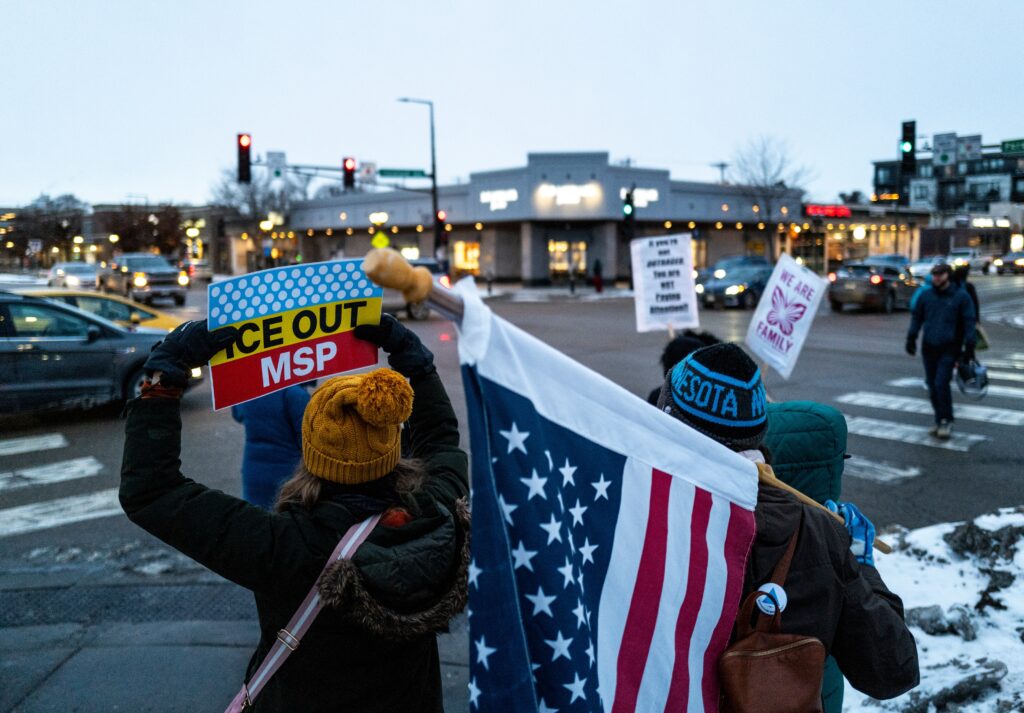
MINNEAPOLIS — Businesses planned to close, union members to skip work and residents to forgo shopping in favor of marching downtown here on Friday, aiming to mount a significant economic protest against the Trump administration’s deployment of federal agents in Minnesota.
Organizers of the action, dubbed ICE Out of Minnesota: Day of Truth and Freedom, have called for residents to boycott work, school and shopping. Faith leaders, labor unions and business leaders have joined to promote the general strike, which calls for an immediate stop to U.S. Immigration and Customs Enforcement actions in the state, charges for the ICE officer who killed Renée Good and no additional funding for the agency from Congress in the next federal budget.
They are aiming for a statewide pause in “daily economic activity” to call attention to the tactics of federal agents and “show Minnesota’s moral heart and collective economic power,” organizers wrote online. A march is planned for 2 p.m. in Minneapolis.
The strike and march come during the third week of tension in Minneapolis since Jan. 7, when Good was shot. In recent days, federal prosecutors subpoenaed the Minnesota governor and other officials, all Democrats; a 5-year-old was detained with his father in their driveway in a Minneapolis suburb; and the federal government arrested three activists in connection with a protest that disrupted a Sunday morning church service.
During a visit to the city Thursday, Vice President JD Vance — who had previously accused local leaders of stonewalling the federal deployment — said President Donald Trump had urged him to work with local leaders to “turn down the chaos a little bit, at least.”
Thousands of Minnesota residents, including many who do not normally identify as activists, have protested the federal government’s actions in the weeks since the Department of Homeland Security sent agents into the Twin Cities area with the stated mission of removing undocumented immigrants.
Residents and officials in Minnesota say federal agents have gone far beyond that brief, detaining U.S. citizens, pulling people from their cars, appearing to stop people on the basis of race, and using chemical irritants on people demonstrating against or monitoring their work.
Kimberly Case, 64, a Minneapolis native and retiree, braved the 4-degree snowstorm to protest outside the Vance event Thursday. Chase said she had been unable to stomach the fact that her niece and her classmates had been talking about digging a hole in their schoolyard to hide from ICE agents who might come to their school.
“We’re being invaded at all levels of society from kids to old people,” said Chase, who wore a battery-heated vest to fight the chill. “But it’s not working. If anything it’s making our community tighter.”
Court challenges to the Trump administration’s actions are now before federal judges. The state of Minnesota and the cities of Minneapolis and St. Paul have sued to stop ICE’s deployment in the state, and civil liberties groups are representing Minnesota residents who say federal agents have violated their constitutional rights. A federal judge in one of the citizen suits last week barred DHS agents from arresting peaceful protesters, but this week an appeals court temporarily lifted that restriction while the litigation continues.
After the ICE officer killed Good this month, angry residents began protesting and the administration sent more federal agents to Minnesota, escalating tensions. A week later, on Jan. 14, an ICE officer shot 24-year-old Julio Cesar Sosa-Celis in the leg before arresting him and two other undocumented men at their home.
“What we have experienced and are experiencing in the state of Minnesota is not normal,” said JaNaé Bates Imari, auxiliary minister at Camphor Memorial United Methodist Church in St. Paul, at a Jan. 13 news conference announcing Friday’s action. “We have witnessed violence over and over again, families being ripped apart, loved ones being torn from their hospital beds, from their workplaces, from their homes.”
The Trump administration has defended its work as arresting criminals it calls dangerous and has characterized opposed residents as agitators getting in the way of the work of law enforcement.
The White House did not respond to a request for comment on the strike from The Washington Post.
On X this week, Homeland Security Secretary Kristi L. Noem claimed without providing evidence that the agency had arrested more than 10,000 undocumented immigrants in Minneapolis. The Post was unable to verify Noem’s number.
“Over the weekend in Minneapolis, the heroes of @ICEgov arrested more murderers, rapists, gang members, and perpetrators of fraud. A huge victory for public safety,” Noem posted Tuesday.
Bates Imari said that the way federal agents have operated has been dangerous and harmful to residents. She said the goal of Friday’s action is for Minnesotans to come together in opposition to the administration’s “swarm” of armed, masked agents in the state.
“We cannot allow this to continue,” she said. “If you ever wondered for yourself, when is the time that we do something different, when is the time that we stand up … the time is now.”
Prayer vigils were planned across the state for Friday morning. Some coffee shops planned to open without doing business to provide spaces for march attendees and ICE observers to warm up, offering free coffee and sign-making materials. One brewery planned to provide free hot dogs all day.
Other businesses said on social media that they would stay open out of consideration for employees’ wages but would donate a portion of their revenue to community nonprofits.
The high in Minneapolis on Friday was forecast to be minus-10 degrees. The National Weather Service issued an extreme cold warning for Thursday evening until noon Friday, saying wind chills as low as minus-45 degrees were expected.
This article will be updated.
The post Minnesota residents plan general strike Friday to protest ICE appeared first on Washington Post.


