Jacqueline Smith was more than 300 miles from the Pentagon when she learned that the Trump administration planned to overhaul Stars and Stripes, the military newspaper where she has served as ombudsman since 2023.
Since President Donald Trump returned to the White House last year, Smith had feared that the administration would interfere with the military newspaper, where she is charged with defending the publication’s editorial independence and addressing reader concerns. Stars and Stripes occupies an unusual position: Its staffers are Defense Department employees and it is partly funded by taxpayers, but it has long reported independently on the military.
President Donald Trump has taken aim at other media organizations that receive federal funding. Over the past year, Smith watched as the administration dismantled the U.S. Agency for Global Media, which oversees the international broadcaster Voice of America; persuaded Congress to strip funding from NPR and the Public Broadcasting Service and their member stations; and curtailed access for reporters covering the Pentagon. “I was hopeful that Stripes would not be affected, but not naive,” Smith said.
Last week, Pentagon chief spokesman Sean Parnell wrote in a post on X that the department planned to bring Stars and Stripes “into the 21st century.”
“We will modernize its operations, refocus its content away from woke distractions that syphon morale, and adapt it to serve a new generation of service members,” Parnell wrote. The note came one day after The Post reported that applicants to Stars and Stripes were being asked how they would support the president’s policies.
Parnell said the newspaper “will focus on warfighting, weapons systems, fitness, lethality, survivability, and ALL THINGS MILITARY,” adding that the publication will cease publishing “repurposed DC gossip columns” and “Associated Press reprints.”
The Pentagon’s statement quickly raised alarm among some of the newspaper’s staff and experts in media freedom that the publication is at risk of being turned into a de facto publicity arm for the Defense Department, which would run contrary to the newspaper’s long-standing history of reporting independently on issues affecting American service members and veterans.
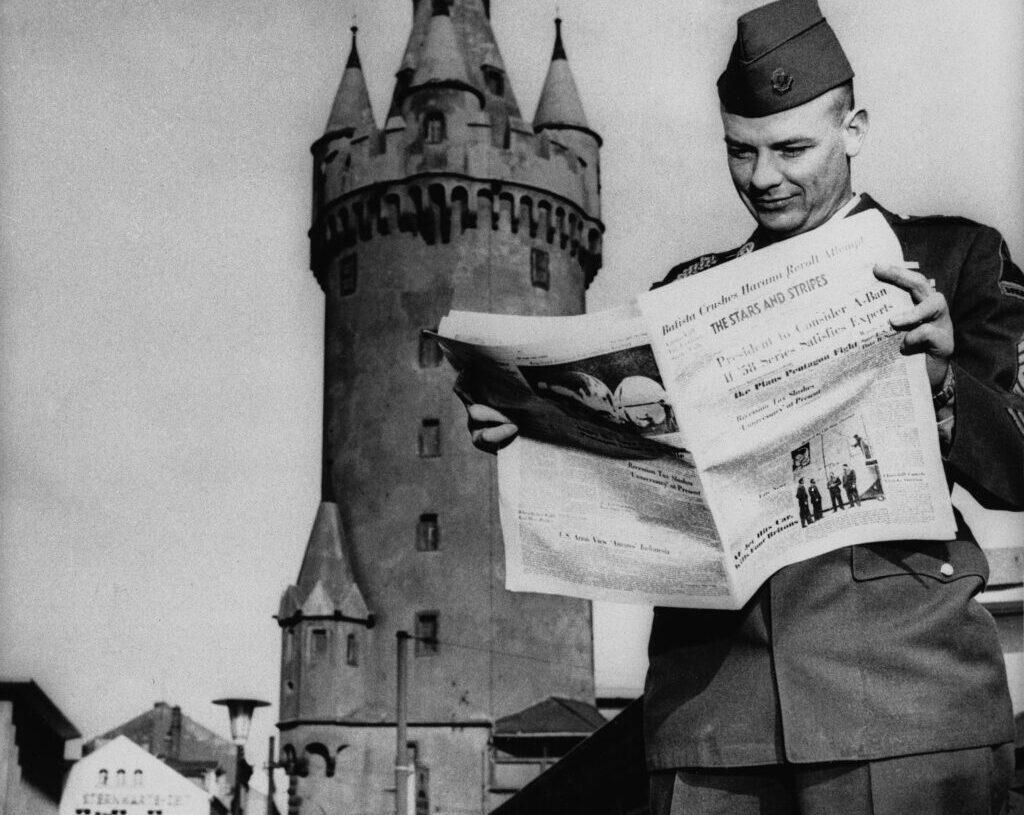
First published during the Civil War and continually published since World War II, Stars and Stripes reports on and for the U.S. military community. With about 60 newsroom staffers spread across eight countries, the paper estimates that it reaches about 1.4 million people a day across its platforms. Even though the newspaper receives some of its funding — about 35 percent to 45 percent — from the Pentagon, Congress has long affirmed the newspaper’s editorial independence.
Smith, who works from her home in western Connecticut, said there had been “no previous word or inkling” that any changes were on the horizon. “I was quite alarmed, like, ‘Oh no, here it is,’” she said. “Then, of course, you spring into action.” She said she’s focused on planning briefings with the House and Senate Armed Services committees as soon as possible.
In response to questions about what changes are planned for the newspaper, the Pentagon referred The Post to Parnell’s statement.
Trump officials have targeted the outlet before. In 2020 the Pentagon planned to shut Stars and Stripes down by eliminating its funding. At the time, Defense Secretary Mark T. Esper said funds devoted to the publication would be used for “higher priority issues,” such as weapons purchases.
Ernie Gates, who served as the newspaper’s ombudsman from 2019 to 2023, lobbied lawmakers on the House and Senate Armed Services Committees, as well as lawmakers who were veterans, in an effort to restore the newspaper’s funding. Republican senators like John Boozman (R-Arkansas) and Shelley Moore Capito (R-West Virginia) joined Democrats in pressing Esper on the matter. Sen. Lindsey Graham (R-South Carolina) also urged Esper to continue Stars and Stripes’ funding until Congress completed a spending bill.
Their support proved pivotal. “It was everything,” Gates said. After a bipartisan outcry from lawmakers and veterans, Trump eventually said he would spare the publication. “It will continue to be a wonderful source of information to our Great Military!” he said in a 2020 social media post.
Gates said the current situation is even worse. “Nobody’s talking about taking the money away. They’re talking about taking the credibility,” he said. “It’s harder to get a grip on, but the consequences are just as dire.”
Like Smith, the paper’s editor in chief, Erik Slavin, was surprised when he read Parnell’s statement about overhauling the newspaper. “I believe with all my soul in what we do,” he wrote that morning in an email to Stripes staffers obtained by The Washington Post. “I will work with our leadership to preserve Stars and Stripes as an independent news source for the military community.”
“The people who risk their lives in defense of the constitution have earned the right to the press freedoms of the First Amendment,” Slavin, added.
Smith hopes to replicate Gates’s strategy by marshaling support on Capitol Hill and arousing the interest of the public and military community. When it comes to members of the House and Senate Armed Services committees, Smith said, “They’re always very, very interested in the operation of Stars and Stripes, and its editorial independence.”
Beyond last week’s social media post, the Pentagon has not communicated directly with the newspaper about what the new standards will mean in practice, according to Smith and Slavin.
“It’s been silence,” Slavin said in an interview.
That uncertainty has left staffers — some of whom spoke on the condition of anonymity because their employer did not authorize them to comment — feeling as if they’re in the dark. “Speaking for myself, I’m definitely job hunting,” one Stripes reporter said.
But the situation has also reaffirmed some staffers’ commitment to the work. “Our leadership is prepared to and willing to fight back. The editorial independence of this paper is its bread and butter,” another reporter said.
Since last week’s Pentagon announcement, the days have been a blur for Smith as she tries to galvanize support among lawmakers. Smith, whose position was created by Congress and reports to the House Armed Services Committee, is the only staffer who can lobby lawmakers to defend the paper. Weighing on her are decades of reporting that the newspaper has undertaken on the U.S. military. “I don’t want that to be eroded on my watch,” she said. “It is our obligation to defend the newspaper’s editorial independence.”
Stripes has a record of reporting unflattering stories about the Pentagon. In 2010, the paper won a George Polk Award for exposing the Defense Department’s use of a public relations firm that profiled reporters and guided them toward favorable coverage of the war in Afghanistan. In 2020, the newspaper reported that schools on American military bases in Japan planned to remain open during the covid-19 pandemic. More recently, it has covered housing issues affecting service members, how the Trump administration’s campaign against diversity, equity and inclusion is playing out in the military, and how the president’s One Big Beautiful Bill could negatively impact veterans. The newspaper also reported on its own potential demise, as it did in 2020.
Kathy Kiely, a professor at the University of Missouri School of Journalism, said Stripes functions like a local newspaper for service members. “When there are no more watchdogs, people get slovenly about how they operate, so it’s important that Stripes is independent for the troops it serves,” Kiely said.
Ten Democratic senators, including the Senate Veterans’ Affairs Committee’s ranking Democrat Richard Blumenthal (Connecticut), wrote on Jan. 16 to Defense Secretary Pete Hegseth to express their “strong and unwavering” support for the newspaper’s editorial independence.
“Any diminishing independence of Stars and Stripes is a blow to the public’s legitimate need for information and disrespectful to our military,” they wrote. “Congress has been clear for decades that Stars and Stripes must be governed by First Amendment principles and insulated from political influence, regardless of which administration is in power.”
Blumenthal said in a statement Thursday that he’s planning to take action to further codify Stars and Stripes’s editorial independence by introducing legislation ensuring the outlet is “safeguarded from political influence and interference.”
“Servicemembers, veterans, and their families across the globe have relied on Stars and Stripes to provide honest, credible reporting on the issues facing them without ideological or political narratives,” Blumenthal said. “At a time when Secretary Hegseth has continuously infringed on the First Amendment rights of the Pentagon press corps, the Administration’s interference constitutes unacceptable censorship.”
The House Armed Services Committee has sent the Pentagon a bipartisan request for information about its plans for Stripes, according to two people familiar with the matter, who spoke on the condition of anonymity to discuss an ongoing inquiry.
Despite the concerns and uncertainty, Slavin said the newspaper will keep reporting the news as it usually does.
“We’re going to continue to do our jobs,” he said. “What else can we do?”
The post Inside the effort to shield Stars and Stripes from Pentagon control appeared first on Washington Post.