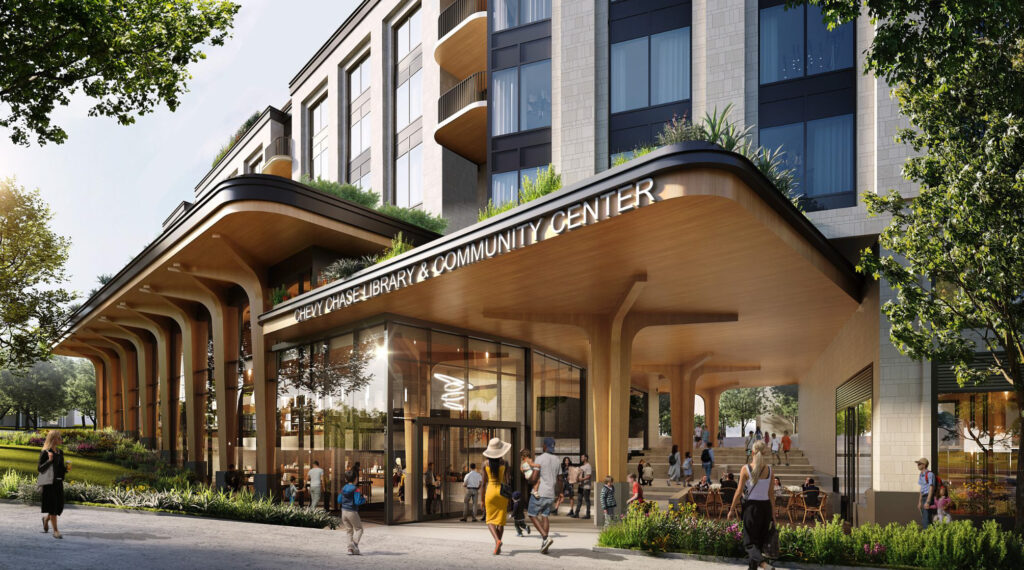
In D.C.’s wealthiest neighborhood, residents have long clamored for an upgrade to their brutalist library and rec center — blocky, brown-brick and concrete buildings that haven’t been renovated in over 50 years. Outside, the slide on the playground is broken and blocked off.
“It’s depressing,” said Karrenthya Simmons, an advisory neighborhood commissioner whose 6-year-old son isn’t too interested in playing there.
Last Friday, the D.C. government released a proposal from a local developer selected to transform the Chevy Chase community commons, making the facility the last of the city’s 26 library campuses slated for a massive renovation plan — a milestone Mayor Muriel E. Bowser celebrated.
But neighborhood division continues to reign over one key element: The development plan puts 177 units of mixed-income housing on top of the library.
That friction point has turned the development project into fodder for a heated debate about the evolving role of the public library in the 21st century — and what responsibility an affluent community has to help expand affordable housing in a city rife with wealth inequality. Those debates have bubbled up at libraries nationwide, and at several locations in D.C. in the past, but have taken on new life in a leafy neighborhood more known for million-dollar single-family homes than urban development.
“I just don’t want to continue seeing affordable housing only built in certain areas — every part of our city should help with affordability,” said Simmons, who greeted the new development proposal with enthusiasm.
“The idea that a space like this, a public commons, has a compatible use with housing, with private housing, is just wrong,” said Sheryl Barnes, leader of Chevy Chase Voice, which is among the most vocal opponents of the library-housing combo and has sued the city, arguing that the plan violates zoning regulations.
Housing has been combined with library renovations in cities around the country and the world as high costs of living have forced government to seek out new strategies to add homes. Nearly two dozen library-housing projects have been completed in the United States and Canada this century, according to the Urban Institute — including one in D.C.’s West End neighborhood.
The plan for D.C.’s Chevy Chase library and community center calls for 54 units to be set aside as affordable to those making less than 50 percent of the area median income — though both supporters and opponents had expected more affordable units than that. There are also 123 market-rate units planned, ranging in size from studio to three-bedroom.
The developer, Rift Valley Capital, envisions amenities including an amphitheater, rooftop terrace, outdoor classroom, new play park, public plaza and native plant garden. The library and rec center would be divided by a large walkway beneath a wood-ceilinged awning leading to greenspace and recreation courts in the back.
“The challenge was to create a library and civic component that was iconic,” said Bereket Selassie, managing partner at Rift Valley Capital, “but at the same time, we wanted to propose a residential design that wouldn’t overshadow that,” that would function as “more of a backdrop.”
The library and community center are expected to cost $43 million overall, while D.C. would also provide a housing subsidy, according to Albert’s office. The project, which now enters a more robust planning stage, is expected to open by 2030 if all goes as planned.
The local advisory neighborhood commission passed a resolution in July by a vote of 4-2-1 urging the city to reconsider housing at the site, citing community surveys that showed more residents were concerned about the concept than supportive.
But the D.C. government stood by the housing idea.
“We were very sensitive to what the community conversation’s been,” said Nina Albert, deputy mayor of planning and economic development “But at the end of the day, we know it’s important to produce more housing. It’s important for the community to have a variety of housing at different income levels.”
Laura Phinizy, chair of the advisory neighborhood commission, said that while the upgrades to the library and community center are “very welcome,” she wants to see officials address neighbors’ concerns about how increasing housing density could affect infrastructure, such as by crowding schools. They also do not want neighbors to feel like “interlopers” in the public space as if it belonged to the on-site residents, she said.
“I’m concerned that the scale of the project is really going to be detrimental to our character and our public needs,” she said, adding that she was disappointed D.C. government ignored pleas to look at other potential sites for the housing.
Richard Reyes-Gavilan, director of the D.C. Public Library system, said that as a library lover he is sympathetic to some of the feedback that the buildings should remain civic spaces “devoid of any exterior noise.” But “I’m much more pragmatic about the whole thing,” he said. “I think that we will have the same degree of rigor around the architecture of the space so that people still feel that same level of dignity.”
The Chevy Chase redevelopment project is part of much broader citywide vision — spanning four mayoral administrations — to transform public libraries to better adapt to a changing world.
The transformation effort dates to the early 2000s during the Tony Williams mayoral administration, when D.C.’s libraries were in varying states of disrepair. The administration embarked on a grand mission to invest in an overhaul, seeking to turn the outdated, neglected public libraries into inviting architectural marvels. “It was a big plan — a bold plan,” said Robin Diener, director of the Library Renaissance Plan, which advocated for library upgrades.
Since the initial batch of renovations around 2010, the role of libraries has further evolved due to the explosion of technology, Reyes-Gavilan said. “Our goal is to move away from libraries being these transactional spaces, right?” he said. “We know that the use of print material is decreasing year over year, especially among adults … and especially during the pandemic, we’ve seen a remarkable a push towards electronic resources,” like e-books.
With less space needed for bookshelves, he said, that has allowed the city to redesign libraries with more flexible spaces for amenities and activities. That could mean a recording studio, food pantry and “library of things” at the forthcoming Congress Heights library, he said. Or more community event space, co-working space for remote workers and children’s play space, as at the flagship MLK Library and others.
But whether housing should be among the modern library features hits a nerve with some residents — a debate present in some of the earliest projects, such as the initial Benning and Tenleytown library redevelopments, where housing didn’t move forward.
Diener, whose group battled in court unsuccessfully against the West End library-housing project, holds the view that a civic space should be off-limits to private uses. And the library, she said, is “the foremost, maybe best and highest use of public land.” She accused the D.C. government of essentially giving that land away to the developer with a 99-year lease for a nominal fee.
Chevy Chase was facing “undue pressure,” Diener argued, to cede part of the civic property to housing development as a kind of “restitution” for its past, which included exclusionary housing policies such as redlining and racial covenants in the 20th century.
“To take it out on this land here in this public space, they’re irrelevant to each other — they are not connected,” she said, “but I think they’ve been connected in the minds of the people who are pushing for giving up the public land.”
For proponents of the housing addition to the Chevy Chase library, however, the past was a big part of why the neighborhood should be on board with expanding affordable housing now.
The Ward 3 chapter of the Washington Interfaith Network (WIN) pushed hard for the housing component, believing the neighborhood had to do its part in expanding affordable housing. The area west of Rock Creek Park, including Chevy Chase, failed miserably compared to other areas in the city at meeting Bowser’s affordable housing targets by 2025 — largely because it mostly consists of privately owned land and single-family homes, Albert said. That was why the public site was so opportune for new housing, she said.
But that was also why supporters of the housing project were surprised last week’s proposal was not more ambitious in its affordable housing offerings, with only 54 units. WIN had called for at least 100 units. Rift Valley Capital’s original submission had included 137 affordable units: 70 deeply affordable and 67 workforce housing units, which are no longer part of the selected proposal.
“We are disappointed. The mayor has chosen to deliver half a loaf,” Elizabeth Vaden, a member of the WIN Ward 3 Steering Group, said in a statement. “We continue to support the addition of dedicated affordable housing to upper Connecticut Avenue, and urge the mayor to make fuller use of this site for that purpose.”
Barnes, with Chevy Chase Voice, said the lower-than-anticipated affordable housing served to confirm her group’s fears that the project was more about “luxury housing at the Chevy Chase Commons for private developer profit.”
Albert did not answer a follow-up question about why fewer affordable housing units were selected than the community anticipated, other than to say the ratio of affordable to market-rate units “struck the right balance.” She noted the city had to weigh many competing interests and perspectives about desired housing and density.
Cheryl Cort, executive director of the Coalition for Smarter Growth, said she suspected that financing challenges may have affected how many affordable units were included — but saw 54 as much better than none. The city has experienced serious challenges with affordable housing investment in recent years, due to a combination of rising construction costs and inflation, and housing policies that investors opposed and have since been changed.
Cort said her group has long advocated for the use of public land for affordable housing, since it eliminates land-acquisition costs for developers — one factor Selassie said was helpful in this case.
“Our understanding is, when we talk to developers, that sort of nothing is moving forward whatsoever,” Cort said, “so we’re eager to make sure that this project can get financed and be built.”
Officials committed to continuing to collect residents’ input on the development as the planning stage kicks off. Phinizy said she’d want to renegotiate the housing plan if it is still on the table.
As for Simmons, who was already pleased with the concept, said she’d push for a gym and space for activities like fencing or ballet — and a play space her 6-year-old, and all kids, would actually like to visit.
The post In wealthy Chevy Chase, divisive plan advances to add housing to library appeared first on Washington Post.


