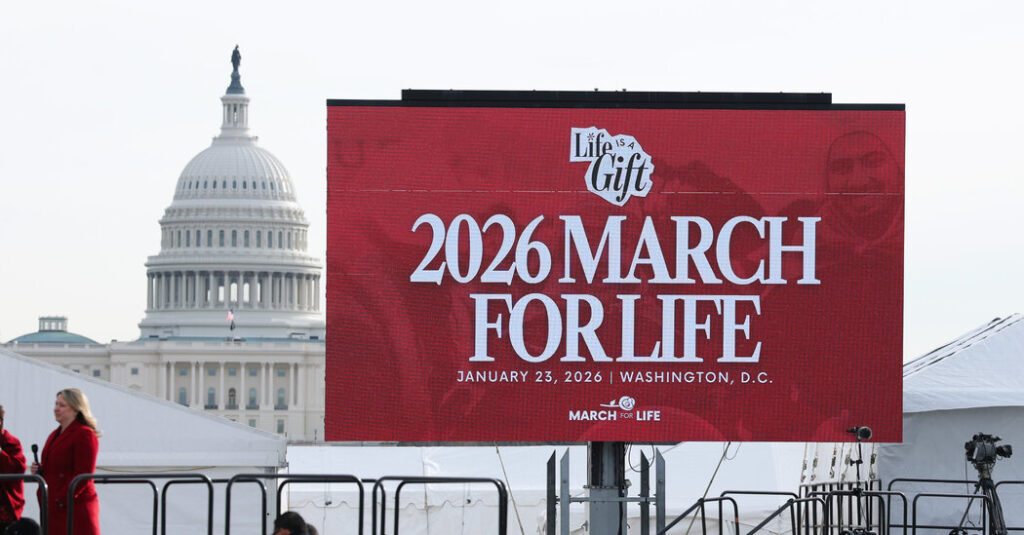
Last year thousands of anti-abortion activists descended on Washington for their annual March for Life, eagerly hoping that President Trump’s second term would accelerate aggressive actions to end remaining abortion access in the United States.
This year, they arrived on the National Mall with their usual upbeat signs and prayers — but many were also carrying a gnawing sense of frustration.
Even as abortion opponents have gained ground and put allies in key policymaking positions, Mr. Trump has at times also infuriated them, exposing fractures among a group whose support has been critical to his success for the past decade.
Last fall, the Food and Drug Administration approved a generic version of the abortion pill mifepristone, which abortion opponents want banned. This month, as Congress debated health care subsidies, Mr. Trump said that Republicans would “have to be a little flexible” on the Hyde Amendment, a provision that says federal funds cannot be used for abortion.
“This administration has not moved when it absolutely could move,” Marjorie Dannenfelser, president of Susan B. Anthony Pro-Life America, a leading anti-abortion group, said in a news conference on Thursday. “So this is not the direction that we were hoping for.”
On Friday, abortion opponents showed up hoping to hear something that would revive their spirits. Like at last year’s rally, the three most powerful political figures in the country delivered remarks: President Trump via recorded message, and Vice President JD Vance and Speaker Mike Johnson onstage.
Last year, Mr. Vance received enormous cheers as he urged Americans to have more babies, and this week, he announced that he and the second lady, Usha Vance, were expecting their fourth child.
At the end of his remarks on Friday, Mr. Vance directly addressed “the elephant in the room,” he said, referring to “a fear that some of you have that not enough progress has been made.”
“I hear you and I understand,” he said, adding, “We are going to continue to make strides over the next three years to come.”
As important as the politics are, the stakes are existential, he said. “It is about whether we remain a civilization under God, or whether we will ultimately return to the paganism that has dominated the past,” he said.
Activists still champion Mr. Trump as the president who helped them achieve their decades-long goal of ending federal abortion rights, by filling the Supreme Court in his first term with justices who were willing to overturn Roe v. Wade.
Now, while Mr. Trump has routinely elevated the place of Christianity in America, he has also consistently prioritized issues like immigration and trade. As the midterm elections approach, anti-abortion political leaders are still smarting from how he pushed them to the outskirts of the Republican Party in his 2024 campaign.
On Thursday, before the march, Trump administration officials invited leading anti-abortion activists to the White House for a briefing announcing several changes in their favor, including that the National Institutes of Health would reinstate a ban from Mr. Trump’s first term that ended research using human fetal tissue.
Officials also told guests that they would be expanding a policy that prevents federal funding from going to international nongovernmental organizations that promote or perform abortions, and that they would investigate Planned Parenthood’s use of $88 million in pandemic-era loans.
Leaders of several groups in attendance were pleased with the announcements but also saw them as incremental.
Jennie Bradley Lichter, the president of the March for Life, is one of many in the anti-abortion movement who want the Trump administration to restrict access to medication abortion.
Trump Administration: Live Updates
Updated
- The U.S. once had more than a dozen bases in Greenland. Now it has one, and Trump wants more.
- Federal vaccine panel leader says polio and other shots should be optional.
- Democrats seek a visit to Ghislaine Maxwell’s prison, citing preferential treatment.
Ms. Lichter, a former deputy director of the Domestic Policy Council at the White House during Mr. Trump’s first term, noted that effective policymaking could take time, particularly to craft policies that are harder to challenge in court.
She believes the Trump administration and her movement are “on the same page in terms of our general orientation and our first principles, namely that abortion should be limited for a whole host of reasons.”
“We are one year into a four-year term,” she said. “We’ve seen a lot of great pro-life policymaking activity so far.”
Reproductive rights activists worry that the Trump administration’s actions to limit abortion are having far-reaching effects.
“Anti-abortion extremists are weaponizing every lever of power and level of government to restrict medication abortion through the courts, Congress and federal agencies like the F.D.A.,” said Mini Timmaraju, the president and chief executive of Reproductive Freedom for All, an abortion rights group.
“If these efforts succeed, it will devastate abortion access in all 50 states, including those that have already protected and codified abortion rights,” she said. “That’s why this November, we must flip the House and Senate and elect governors, attorneys general and lawmakers in the states to enforce the public will.”
For some anti-abortion activists who flew in for the march, the national dynamic is a contrast to advances in their Republican-led states.
John Seago, the president of Texas Right to Life, said his home had a “phenomenal” year advancing anti-abortion policy. Texas, which already bans abortion in nearly every circumstance, enacted a new law last month that aims to stop doctors in other states from mailing abortion pills into its borders.
By contrast, the dynamic in Washington feels “dire,” Mr. Seago said. His organization typically focuses on pressuring state lawmakers, but has made it a 2026 goal to focus on federal leaders like Representative Monica De La Cruz, Republican of Texas, who he noted voted to advance the health care subsidies without the Hyde provision.
During his 2024 re-election campaign, Mr. Trump’s allies pushed a plan to enforce the Comstock Act, a 150-year-old law that Mr. Seago and others hoped would be used to prevent the mailing of abortion pills.
So far in his second term, that feels like a reach. Mr. Seago printed 1,500 postcards for March for Life attendees in Washington and Texas to write to the Department of Justice to demand change.
“It is worse than just missed opportunities, he said. “It is actually losing ground.”
Speaking with a Domestic Policy Council staff member before the White House meeting on Thursday, Kristan Hawkins, president of Students for Life of America, noted that the administration had invoked 18th-century laws to support its agenda on other issues, like immigration.
By comparison, the Comstock Act “is a fairly modern and new law,” Ms. Hawkins said. “What is delaying the progress on that?”
The marchers, including many Roman Catholic church groups, received support on Friday from Pope Leo XIV, who sent a written message for the event.
“Please know that you are fulfilling the Lord’s command to serve him in the least of our brothers and sisters,” he said.
The note also cited Pope Leo’s recent diplomatic message, in which he condemned a “zeal for war” that he saw as spreading globally.
Garrett Riley, executive director of the Arizona Life Coalition, attended the March for Life again for the first time since 2020, the year Mr. Trump became the first sitting president to speak in person at the event.
This time, he’s watching the administration closely but focusing his attention on expanding anti-abortion pregnancy centers in Arizona.
“Things seem to be, from the outside, stuck or going slow,” he said. “We are not going away.”
Elizabeth Dias is The Times’s national religion correspondent, covering faith, politics and values.
The post Hoping for More From Trump, Abortion Opponents Gather in Washington appeared first on New York Times.