PARK CITY, Utah — It started with a birthday invitation. In the summer of 2015, filmmaker Sam Green, who’d just finished a documentary on Guinness World Records, read in the newspaper that the then-oldest person in the world, Susannah Mushatt Jones, was living a few subway stops away from him in Brooklyn. When he called up her family, they told him to come to a big celebration in honor of her 116th birthday.
He brought a camera, not knowing it would become “The Oldest Person in the World,” which premiered Friday at the Sundance Film Festival. Green was fascinated by how everyone giving speeches simply ignored the fact that Miss Susie slept through the whole thing.
Then he arranged with Miss Susie’s 86-year-old niece Lavilla (who looks like she’s 40) to visit them at home. Miss Susie slept through the whole thing again, as Lavilla gently stroked her head and told Green she’d become like a baby and thrived on touch.
He learned that Miss Susie was known as a giant of her apartment complex, the daughter of sharecroppers and the granddaughter of enslaved people who’d moved to Brooklyn from Montgomery, Ala., in the 1920s and worked for White families as a nanny. She never had children but was able to put many of her more than 100 nieces and nephews through college on her salary.
Rather than finding the afternoon boring, he says in the film, “it was transcendently human, not painful or sad — one of the most inspiring experiences I’ve had.”
We live in an age when Kris Jenner, 70, can go dark for a few weeks and come back looking as if she’s 30, or tech entrepreneur Bryan Johnson, 48, who once took over 100 supplements a day and infused himself with his son’s plasma, can confidently declare on a podcast that he won’t die.
Longevity and biohacking have become a global obsession, which explains why Guinness World Records religiously tracks the world’s oldest person and why Green felt compelled to meet as many of them as possible. The media scrums that would follow around Jeanne Louise Calment, the Frenchwoman still considered the oldest (verified) person in history, who died in 1997 at 122, are something to behold in the film.
“I think part of it is our general freaked-out feelings about death,” Green told The Washington Post. “I think the oldest person in the world becomes a kind of symbol of the mysteries of life that we all wrestle with. … No matter how many episodes of ‘The Blue Zone’ you watch, your days are numbered.”
The movie is a lot like Miss Susie’s birthday party. It isn’t so much about how to live longer but a contemplation of mortality spurred by Green discovering he’s ill just as he’s about to have his first son, and while he’s processing his brother’s death by suicide. And the act of filming these supercentenarians becomes an exercise in confronting death and being okay with it — because what happens when you’re tracking the oldest person in the world is that your subject keeps dying. Over and over.
Here are five lessons from a filmmaker who’s probably spent time with more supercentenarians than anyone else on the planet.
Healthy choices get you only so far
The most-asked question of every oldest person in the world is, “What’s your secret?” Everyone wants to know what it was that made them live so long. As Green says in the film, “It’s as if this one person has outsmarted time and death and fate.”
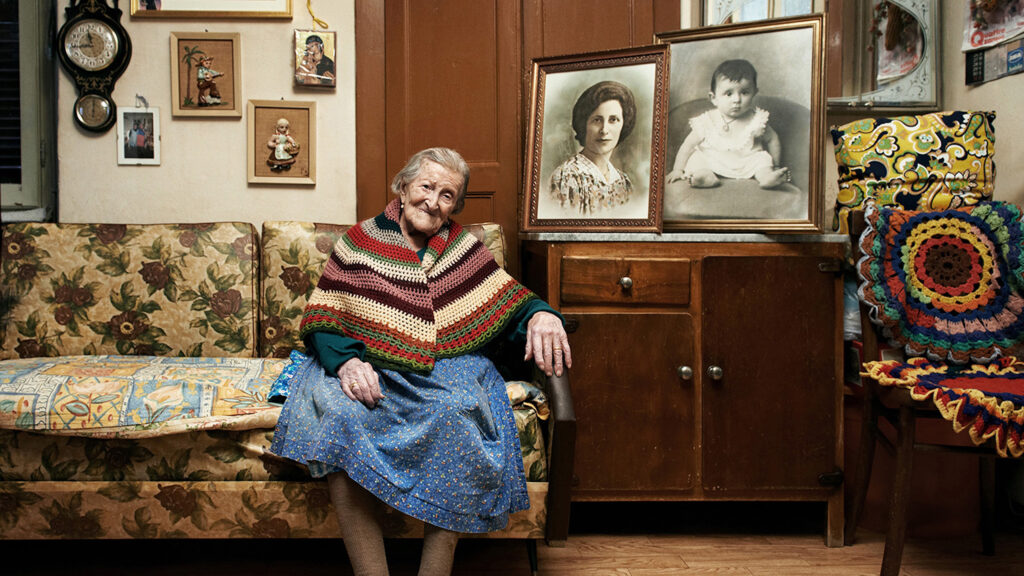
Calment, shown in archival footage, said her secret to a long life was “a couldn’t-care-less attitude and damn good willpower.” She was, as Green said, “so perfectly French.” She drank wine every day and smoked until she was 117, stopping only because she couldn’t see well enough to light cigarettes anymore. Miss Susie loved bacon so much that at her 116th birthday, the cake was decorated with a rendering of bacon in frosting. Emma Morano, a 116-year-old woman he visits in Italy and the last person alive born in the 19th century, ate three raw eggs a day.
“All that stuff probably matters less,” Green said. Still, he added, “I do think most of the people who lived that long may have lived a life of moderation. I bet Jeanne Calment was not smoking a pack a day; she probably smoked, like, two cigarettes a day.”
A leading gerontologist told him there is no secret: “He said, ‘The only secret is choose your parents and your grandparents wisely.”
It helps to be a woman — and possibly to avoid husbands
One thing you’ll quickly notice watching the film is that every oldest person in the world is a woman. The gerontologist told Green no one knows exactly why this is, but it might be because women are smaller. All Green knows, he said, is that he’ll never get to be the oldest person because he’s a man and the average male lifespan in the United States is 76.
It’s not enough to just be a woman, though. Many of the movie’s subjects never married. Morano was forced to wed a neighbor who abused her, had a baby who died as an infant, and then kicked her abusive husband to the curb. Two are nuns. When he asked Miss Susie’s niece what she did to live that long, “She said, ‘Miss Susie didn’t have the two things that’ll kill you: a husband and kids.’ And I just thought, ‘I guess I can see that.’” (Miss Susie was briefly married.)
But community is paramount
Miss Susie didn’t have kids, but she had a huge, loving family who looked after her every day. Being a nun, Green said, is the “perfect” scenario for getting really old. “They’re married to God and they’ve got a bunch of community around them. So nuns are kind of the sweet spot.”
When Green visits soon-to-be 117-year-old Violet Brown in Jamaica, she’s living with her son Harold, 96. They’d sit together every night and watch the sun go down.
Money also doesn’t seem to matter much
This is probably a corollary to having a great community, but what Green loves about this world is that it’s totally diverse and international. The film takes him to Italy, France, Spain, Jamaica, Japan. “You know, it doesn’t discriminate. There’s no class bias,” he said. “A lot of these people were poor people. So in this weird world there’s some sort of strange equality.”
The record, though, is biased toward the Western world. It’s awarded only to people who can prove their age, which rules out people who were born in countries with poor recordkeeping or whose records were destroyed by war. Last year was the first year the oldest person came from South America: Sister Inah Canabarro Lucas, a soccer-loving nun from Brazil, who died in April 2025 at 116.
That’s only because Brazil started keeping good birth records in the early 1900s, Green said. “But when will there be somebody from Africa? Hopefully soon.”
Have a great attitude and try to keep sharp
Green said he wanted to know what it felt like to be in a body that old, but no one seemed to really think about it. Perhaps they were beyond complaining. He also asked about regrets and ambitions, then realized that these were questions he cared about as a 50-year-old man. “I was asking about death and belief and all these big things and it’s like, they just want to think about flowers and nice memories.”
When Green visits Brown in Jamaica, she recites a poem, Lord Byron’s “Vision of Belshazzar,” about an Aryan king who is struck down after flouting the rule of God, that she learned as a schoolgirl 110 years ago. “What I catch, I hold,” Brown said, meaning, she remembers everything important. Her secret, she says, is “love, love, love.”
A woman in Spain, Maria Branyas, had a popular Twitter presence until her death at 117.
Kane Tanaka, a 119-year-old woman he visits in Japan, does math exercises every day and is spry with a walker despite a Coca-Cola (full sugar!) habit. Her secret to longevity? “Don’t dwell too much on negative things, regret isn’t helpful, worrying doesn’t solve a thing.” She goes on: “I just live happily, enjoying everything.”
Being around these women boosted Green’s outlook, too. “It sounds corny,” he said. “But it’s made me appreciate the wonder and the marvel and the beauty of [life]. Every day we’re walking around, it’s full of miracles … There’s bad stuff and good stuff, but it’s great to be alive.”
The post Five longevity lessons from ‘The Oldest Person in the World’ appeared first on Washington Post.