Following an emergency summit on the state of the trans-Atlantic relationship, European leaders announced that they would soon propose an investment package for Greenland and would direct part of a surge in security spending toward the Arctic.
Ursula von der Leyen, the president of the European Union’s executive arm, unveiled the moves at a news conference early on Friday morning in Brussels — part of a plan to smooth over relations with the United States, even as Europe works to make itself more independent of its increasingly volatile partner.
“The commission will soon put forward a substantive package of investments,” Ms. von der Leyen said, without offering many details. “Beyond investment, we also intend to deepen cooperation with the United States and all partners on the important topic of Arctic security.”
The détente comes after one of the tensest weeks the trans-Atlantic alliance has seen in decades. President Trump had made it clear for years that he wanted the United States to take over Greenland, but he shocked his European allies on Saturday when he threatened to place tariffs on several European nations if they stood between him and ownership of the large Arctic island.
To Europe’s relief, Mr. Trump backed away from that tariff threat on Wednesday and ruled out military action in Greenland, which he had also threatened. Still, his attempt to force Europeans to let the United States have Greenland — a semiautonomous territory of Denmark, which is part of both the European Union and NATO — sent shock waves across the continent that are still reverberating.
“The word for this year has been unpredictability,” Kaja Kallas, the E.U.’s top diplomat, said on Thursday night, adding that “trans-Atlantic relations have definitely taken a big blow over the last week.”
Mr. Trump’s administration had already spent months menacing Europe. The White House imposed 15 percent across-the-board tariffs on E.U. nations last year, after threatening even higher ones. It released a national security strategy in December that said Europe was facing “civilizational erasure” and endorsed efforts to sway its elections toward nationalist parties.
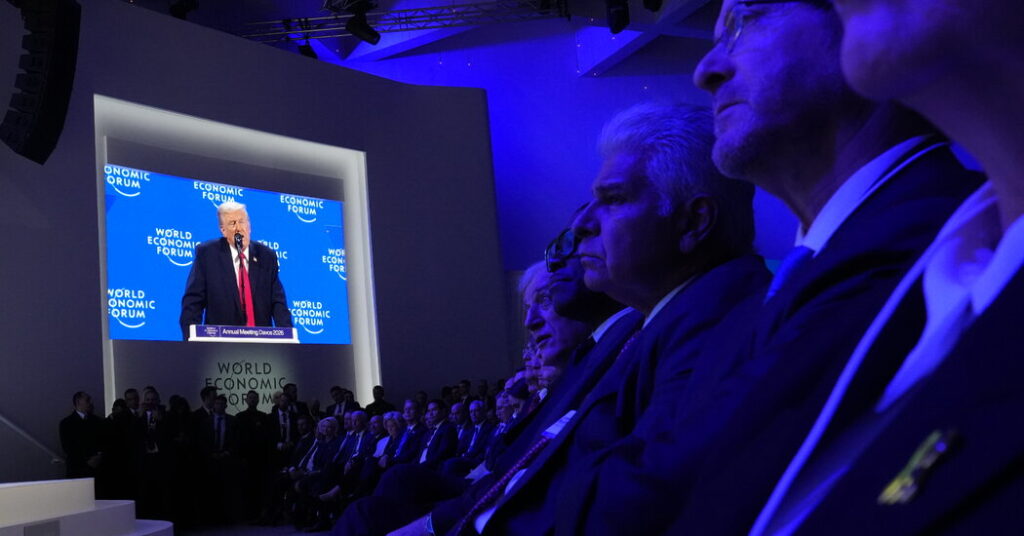
And on Wednesday, Mr. Trump made clear in his rambling speech at the World Economic Forum in Davos that he disdains the direction the continent has taken, criticizing its regulations and immigration policies.
Up to this point, Europe has approached the situation — a constant cycle of high drama and partial resolution — by trying to act like the adult in a chaotic room. Its leaders have avoided escalation, flattered Mr. Trump and hoped that his worst threats would never materialize.
But officials around the world, and across the European Union, increasingly say they may need a stronger strategy — and more ability to stand on their own militarily and economically.
“We know that we have to work more and more for an independent Europe,” Ms. von der Leyen said at the post-summit news conference.
Thursday’s gathering, which brought together prime ministers and presidents from across the European Union’s 27 nations, was called in response to Mr. Trump’s tariff threats over Greenland, but it was framed more broadly, as an assessment of the European Union’s relationship with the United States.
There is much to lose if the rift with Washington lasts, several European leaders said as they entered the meeting.
“If you look at the interdependence, economically, it’s so strong and so vast that any undermining of that would have — very seriously — repercussions for European citizens and for American citizens,” said Ireland’s leader, Micheál Martin.
Yet there is almost no area of European policy that Mr. Trump’s second term — just a year old — is not reshaping.
Thursday’s meeting ended with a few takeaways about how to approach the turbulence.
Ms. von der Leyen said that the latest tariff threats offered a tactical lesson for dealing with the United States: “firmness, outreach, preparedness and unity” had been effective.
“We are clearly in a better position than we were 24 hours ago,” she said.
But now that the situation has improved, both Ms. von der Leyen and António Costa, the head of the European Council, said that the European Union should pivot to implementing its trade deal with the United States. That agreement was struck last year, but members of European Parliament had announced that they would halt its progress amid the Greenland tensions.
Still, the Greenland dispute is not definitively solved. The Danish prime minister, Mette Frederiksen, has said no deal can be reached about the future of Greenland without the participation of Danish and Greenlandic officials.
After Mr. Trump announced a “framework” of a possible deal on Wednesday night, European leaders and officials said on Thursday that Denmark, Greenland and the United States would discuss updates to their defense agreement, and that NATO would work toward fortifying its military presence in the Arctic. The European Union will take part, its leaders suggested: Ms. von der Leyen said the bloc would direct resources toward both Greenland and Arctic security, pledging a “defense surge on Arctic-ready equipment — a European icebreaker, for example.”
But even as Europe steps up, it remains unclear how political negotiations toward finalizing a Greenland plan will go. It is not yet clear to what extent Mr. Trump has abandoned his hopes of owning Greenland, and European officials still insist that its sovereignty must be protected.
Jeanna Smialek is the Brussels bureau chief for The Times.
The post European Leaders to Propose Greenland Investment and Arctic Security Plans appeared first on New York Times.


