The night his wife and a stranger were killed in the bedroom of a Northern Virginia home, Brendan Banfield stayed in a hotel with the family’s au pair and his 4-year-old daughter. In court Thursday, a police victim advocate testified that an officer at the hotel that night overheard the little girl, who had lost her mother just hours earlier, asking the au pair a question about the future: “Are you going to marry my daddy?”
“I wish,” she said the au pair replied. The advocate saw the scene as the earliest evidence Banfield might have something to hide.
Investigators would soon discover that Brendan Banfield and his family’s Brazilian au pair, Juliana Peres Magalhães had been having an affair for months. Police would come to believe the two had orchestrated the 2023 killings in an elaborate catfishing scheme involving a sexual fetish website. Brendan Banfield’s trial began last week, and the 40-year-old is charged with aggravated murder in the deaths of Christine Banfield, 37, and Joseph Ryan, 39.
His defense attorneys spent much of their time this week trying to convince jurors that police jumped to conclusions and set out in search of evidence that would fit the story they believed.
Brendan Banfield and Magalhães initially told police they had walked in on Joseph Ryan holding a knife to Christine Banfield’s throat and shot him, but they were too late to save her.
But the theory that Brendan Banfield was the mastermind behind a scheme to kill his wife emerged just days after the deaths, Detective Leah Smith said Thursday in court. Supervisors told detectives early in the investigation that there “were two theories in the case” and that they “needed to get behind the right one.” One of those theories involved “catfishing” — that the victims had been tricked by someone posing as Christine Banfield online.
Smith pushed back against her bosses in that meeting, she testified. “I told the room that at this point in time nobody should have a theory of a case,” Smith told jurors. “We were still at the very beginning. We should just be gathering facts and information.”
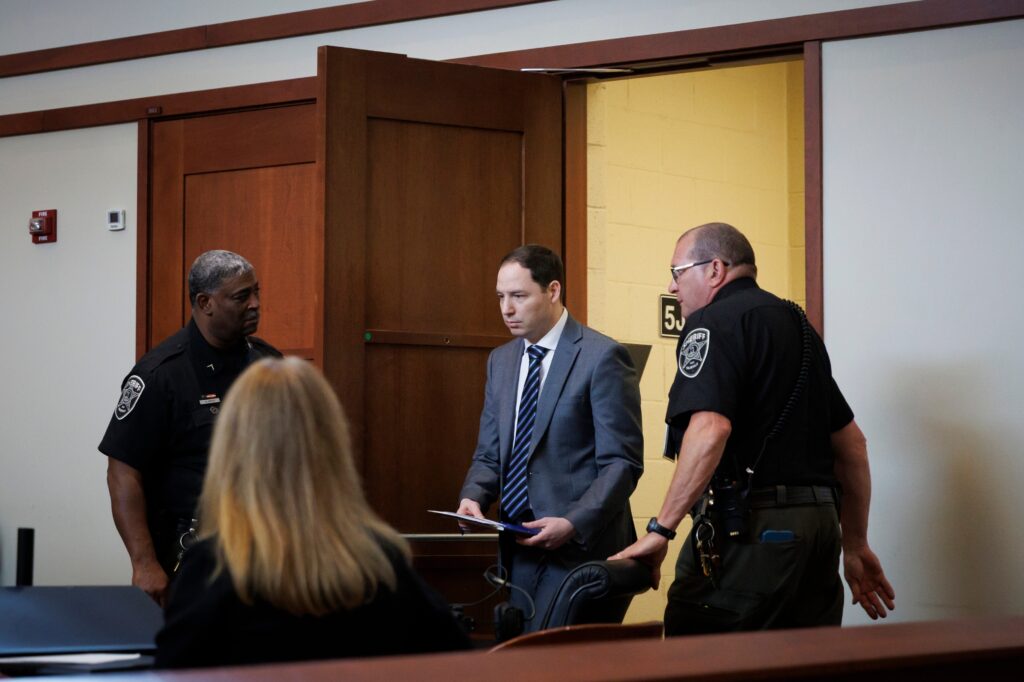
Defense attorney John Carroll argued this week department leaders prematurely decided what they thought happened on Feb. 24, 2023, inside the Banfield bedroom in suburban Virginia, then retaliated against detectives who challenged it. At least two detectives on the case were transferred from the homicide unit because of their work on the investigation. And detectives said leadership at the department were regularly monitoring progress in the high-profile case that garnered international attention.
But the witnesses Banfield’s attorneys called to the stand didn’t always agree with how Carroll characterized the probe. Despite the pressure, Smith told jurors, she and the other investigators continued to follow where facts led them: Brendan Banfield and Magalhães.
“I would say investigators on this case knew to investigate with an open mind even if that might not be along the lines of what supervisors wanted us to investigate,” Smith said Thursday.
Au pair’s tale
Magalhães corroborated the catfishing theory earlier in the trial, telling jurors that she and her employer turned lover had plotted to kill his wife by impersonating her on a BDSM website, luring a stranger to the Banfields’ home under the promise of a sexual encounter, then killing them both and framing the stranger as a violent intruder.
She said Banfield wielded the knife himself, and stabbed his wife repeatedly in the neck after shooting the man he planned to frame for the killing.
Magalhães maintained their innocence for more than a year, even as she was arrested and charged with murder. Then, in October 2024, she struck a plea deal that could see her freed and deported to Brazil after the trial as long as she cooperates in the case against her former paramour.
Magalhães, speaking publicly for the first time during the trial, described how she arrived in the United States from Brazil as a 21-year-old offered $200 a week and a room in the Banfields’ home to care for their toddler, then how her relationship with Brendan Banfield turned sexual.
He first mentioned a plan to “get rid of” his wife while on vacation in New York in October 2022 with Magalhães, she said. She said he took precautions to avoid being caught, installing soundproof windows at his home and checking to make sure neighbors didn’t have security cameras.
Brendan Banfield’s lawyers say her story has changed because she’s lying to save herself.
‘Unsubstantiated deductions’
The defense has repeatedly pointed to a report from a Fairfax County digital forensic examiner to sow doubt in the catfishing theory.
Brendan Miller, a digital forensic examiner with the Fairfax County Police Department, wrote in a summary of the case that “there is no indication that Christine lost control of her devices” in the six weeks before the slayings.
The records show Christine Banfield’s laptop and phone were used to contact Ryan and that one of Brendan Banfield’s phones had no such contact; his work phone could not be opened. An evidence analysis team at the University of Alabama peer-reviewed and affirmed Miller’s digital forensic findings, according to court records.
Magalhães testified she and Brendan Banfield only impersonated Christine Banfield on her computer while she was at home so there wouldn’t be digital footprints leading back to either of them.
Miller told jurors Wednesday that although he was the only digital forensics expert working the case, he was not invited to question Magalhães during the hours-long interview with detectives and prosecutors during which she confessed her involvement in a plan she said was hatched by Brendan Banfield.
He also testified that a superior asked him to review his findings after Magalhães accepted the plea deal, but his findings did not change. He was then removed from the homicide unit and reassigned, a move he said he was told was related to his work on the Banfield case.
“Additional evidence came to light,” Miller said of Magalhães’s confession. “But the data remains the same.”
A supervisor with a master’s degree in computer forensics told jurors he was not pushing Miller to draw conclusions to fit with a theory. Miller, he said, was simply wrong.
Patrick Brusch, a former Fairfax police deputy chief involved in the investigation, told jurors he disagreed with Miller’s “unsubstantiated deductions” and “wrongful analysis” on the investigation about whether Christine Banfield had access to her accounts. Brusch pointed to the fact that no messages were sent on the FetLife account purportedly belonging to Christine Banfield when Brendan Banfield and Magalhães went out of town.
Brusch said in his testimony he told other supervisors Miller would never work on the digital forensics of a major crimes investigation again.
“It’s not a survivable injury”
Carroll this week tried to puncture the prosecution’s portrayal of Brendan Banfield as a man who so wanted his wife dead that he plotted for months and killed another man in an attempt to get away with it. He played body-camera footage for jurors showing Brendan Banfield appearing distraught at the news his wife hadn’t survived.
Christine Banfield’s family wept in court Wednesday as the jurors watched more than an hour of video from the morning after the slayings, the audio loud enough to be heard throughout the courtroom.
“He’s having a breakdown,” one police officer says to another in the video, before advising Brendan Banfield to take deep breaths.
Brendan Banfield can be heard breathing heavily and asking about his daughter as officers walk him to the ambulance. Once inside the ambulance, first responders note the blood covering Brendan Banfield and ask, “That’s not your blood, right?”
“I — I think it’s—” he can be heard saying, before breaking off with a gasp. Minutes later, an officer tries again: “Where’d all this blood come from?”
“I was holding her neck,” Brendan Banfield responds. “Is there a way to get an update on her?”
He repeatedly asks to be with his wife in the footage, and between sobs questions officers about his daughter. “What’s going to happen with my daughter?” he can be heard asking. Then later, “Are they going to tell her? She’s only 4.”
Brendan Banfield also faces child abuse and child endangerment charges related to his daughter, who was in the basement of the home when the killings occurred.
Upon arriving at the hospital, Brendan Banfield continues to plead to see his wife, the video shows. A doctor eventually tells Brendan Banfield his wife has died of blood loss. Brendan Banfield says he had tried to apply pressure, which a 911 dispatcher had instructed him to do to stifle the bleeding.
“You did a wonder— you did what was possible,” the doctor can be heard saying over Brendan Banfield’s cries. “It’s not a survivable injury.”
In cross-examination, prosecutors asked the police officer who recorded the body-camera footage whether when he arrived he saw Brendan Banfield using the blankets or towels found on the floor of the bedroom to attempt to stop Christine Banfield’s bleeding. The officer said no.
Later in the footage, Brendan Banfield tearfully asks a hospital chaplain to pray for his wife. He can be heard reciting the Lord’s Prayer between choked sobs.
“Forgive us our trespasses, as we forgive those who trespass against us,” Brendan Banfield and the chaplain recite in unison. “Lead us not into temptation but deliver us from evil.”
The post Defense in au pair murder plot case says police rushed to judgment appeared first on Washington Post.