It has been more than 30 years since a botched standoff in Idaho and a conflagration at a cult compound in Texas sparked enduring hostility toward federal law enforcement by activists on the right — including some of the anti-government conservatives who propelled President Donald Trump to the White House.
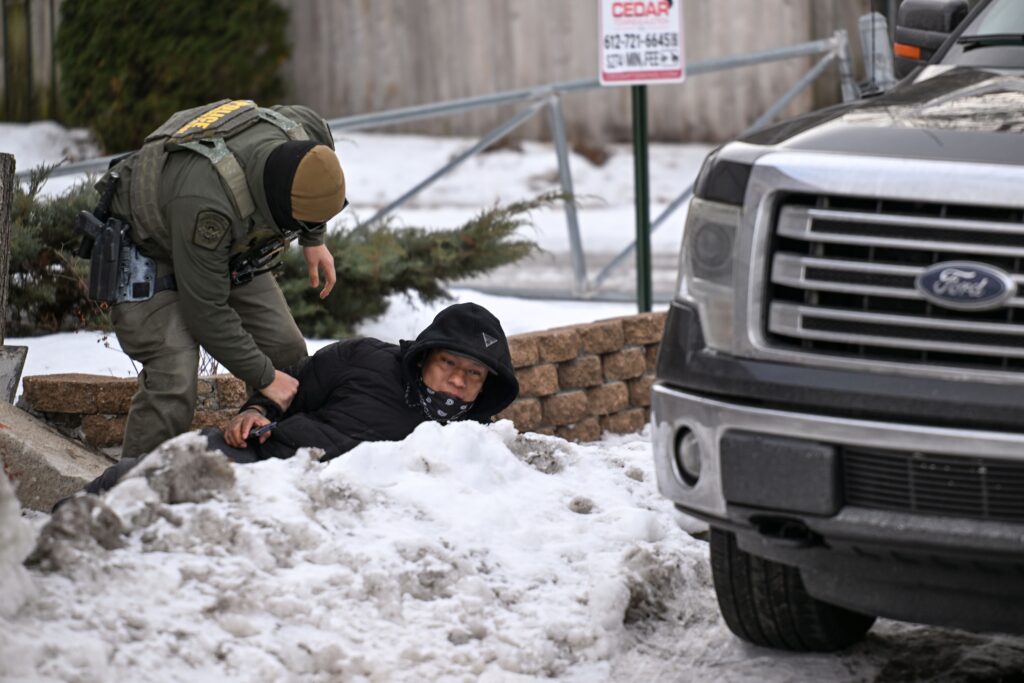
Now Trump himself is deploying some of the government’s policing agencies as an armed presidential force of sorts — sending Immigration and Customs Enforcement, the Border Patrol, the National Guard, and others into areas he considers in need of pacification, from Los Angeles to Portland, Oregon, to Minneapolis. Many on the right are applauding the crackdown.
The turnabout highlights Americans’ complex relationship with armed federal power, which erupted anew with the recent killing of Renée Good in Minneapolis and Trump’s warning that he maysend the U.S. military to quell unrest there. Americans are often upset about police action against people they see as sympathetic, while supporting similar actions against perceived adversaries.
In this moment, many conservative activists who long derided federal agents are embracing the armed crackdown.
“All people engage in what psychiatrists call motivated reasoning — we adjust the facts to suit our arguments,” said Georgetown law professor Rosa Brooks, an expert in national security law who has served as a reserve Washington, D.C., police officer. “It’s not surprising that we see people saying, ‘It’s fine for police to crack the heads of people I don’t like, but not okay when it’s people for whom I feel sympathy.’”
The debate has been heightened by Thursday’s disclosure of a memo, allegedly signed by ICE’s acting director, telling agents and officers that they can enter a person’s home to arrest them without a judicial warrant, a directive that appears to violate the Fourth Amendment.
“What is striking to me right now is that while the Fourth Amendment and civil liberties concerns about federal government overreach have brought the left and right together at different times in our history, right now there has been a pretty muted response among conservatives about the types of tactics ICE is using,” said Vanita Gupta, who served as associate attorney general in the Biden administration.
Department of Homeland Security spokeswoman Tricia McLaughlin, asked whether Trump’s supporters are applauding the ICE crackdown only because they are happy to see immigrants and minorities targeted, responded, “No. That’s stupid.”
Americans across the political spectrum are broadly supportive of the police, including in liberal and minority communities. A 2024 Gallup poll showed that 51 percent of Americans have “a great deal” or “quite a lot” of confidence in the police, with an additional 32 percent expressing at least some confidence. That makes police among the most trusted institutions in the country.
Still, Americans’ views of the police can be multifaceted and sometimes situation-based.
Liberals have traditionally been harsher critics of tough policing tactics, most recently during the Black Lives Matter protests that followed the killing of George Floyd in Minneapolis in 2020. Yet in the highest-profile assault against police in recent memory — the Jan. 6, 2021, attack on the U.S. Capitol — an array of conservative, pro-Trump populists engaged in hours of violent combat with U.S. Capitol police officers.
Trump’s ascent to the presidency in 2017 changed the views of many right-leaning populists about the government in general, and federal agents in particular, since they now felt that one of their own was in charge, experts say.
Rachel Carroll Rivas, interim director of the intelligence project at the Southern Poverty Law Center, said anti-government or “patriot” movements wax or wane depending who controls Washington. “It is a very clear trend that when there is a Democratic administration in power at the federal level, those movements grow,” Carroll Rivas said. “When there is a federal administration they are in agreement with — on issues like race, gender, social programs, etcetera — they shrink and pull back.”
One landmark event was a standoff that unfolded in 2014, when Nevada rancher Cliven Bundy refused to pay the fees for grazing his cattle on public lands. Hundreds of Bundy’s conservative, anti-government backers faced off against federal of agents, who ultimately backed down.
“I’m just afraid of what this government is capable of doing. I mean, we saw what happened in Waco,” media host Sean Hannity, a strong Bundy supporter, said at the time. “The government needs to stand down.”
In the current crisis, Hannity has portrayed federal agents as professionals carrying out the necessary task of pursuing criminals. “Democrats wax poetic about criminals while vilifying ICE agents, professionals, for upholding the law,” Hannity said on a recent program. “The supremacy clause of the Constitution establishes federal law as the supreme law of the land.”
Conservative commentator Laura Ingraham called IRS agents under President Joe Biden a “new Gestapo” that would be deployed “in the same abusive, corrupt manner as the FBI and the DOJ have been used,” according to a report by the liberal group Media Matters for America. But when it comes to Minneapolis, Ingraham has called it “borderline illegal” for Democratic lawmakers to disparage ICE agents and floated the notion that Trump should invoke the Insurrection Act to send the U.S. military into the city.
Mike German, a former FBI agent who has worked undercover in white supremacist groups, said “far-right” was once considered almost synonymous with “anti-government.” Once Trump became president, German said, all that changed.
“In the late ’80s and ’90s and early 2000s, when I was in the FBI, we referenced ‘far-right militants’ as ‘anti-government militants,’” German said. “Sometime around the first Trump administration, I came to believe that was not an accurate description; they were Trump supporters. They clearly presented a pro-police, pro-state viewpoint.”
Senior Border Patrol official Greg Bovino rejected criticism of the federal agents carrying out the current immigration crackdown, saying the raids in Minneapolis and elsewhere have been professional and well-executed.
“Our operations are lawful. They’re targeted. And they’re focused on individuals who pose a threat to this community,” Bovino said at a Tuesday news conference in Minneapolis. “They are not random, and they are not political. They are about removing criminals who are actively harming Minneapolis neighborhoods.”
Trump’s supporters and the MAGA movement are coalitions, and they clearly include strong law-and-order conservatives as well as activists deeply suspicious of federal law enforcement. The people cheering on ICE’s operation in Minneapolis may not be the same ones who for years have decried the behavior of government agents, Brooks said.
“Are these in fact the same actors who 10 minutes ago were warning us about jackbooted federal thugs, and today are saying ‘Yay, jackbooted federal thugs, crack some more heads?’ “ Brooks said. “I do wonder about that.”
Either way, the Ruby Ridge and Waco incidents serve as notable reference points for the clashes unfolding today. Their drama and bloodshed 30 years ago ingrained a hostility toward government policing in the populist right, even if many of today’s activists do not personally remember them.
In the summer of 1992, in a remote spot in Boundary County, Idaho, agents headed toward the cabin of Randy Weaver, an anti-government activist enmeshed in the Christian Identity movement, to arrest him for keeping a cache of illegal weapons. The operation was a disaster from the outset, and an exchange of fire resulted in the death of U.S. Marshal William Degan and Weaver’s 14-year-old son, Sam, and later his wife, Vicki.
That triggered an 11-day standoff, with FBI agents on one side and protesters on the other. Weaver ultimately surrendered, and official reports later were sharply critical of the FBI’s handling of the case.
A few months later, federal agents massed outside the Waco, Texas, compound of the Branch Davidians, a religious group led by a messianic figure named David Koresh, who was suspected of firearms violations and other offenses. After a 51-day standoff, agents fired tear gas canistersinto the compound. Fires quickly erupted, and some 80 people died.
Ruby Ridge and Waco quickly became wrapped together to represent the notion that the federal government, represented by its law enforcement agents, was a tyrannical force quick to act against the interest of ordinary Americans.
The National Rifle Association even sent out a fundraising letter in April 1995 calling federal agents “jackbooted government thugs.” And an Army veteran named Timothy McVeigh detonated a bomb at the Alfred P. Murrah Federal Building in Oklahoma City, killing 168 people including 19 children, intentionally choosing the second anniversary of the Waco raid.
Anti-government groups have been a presence on the American scene ever since, their numbers waxing and waning, adopting names like Citizen Sovereign and County Supremacy. Many of their members support Trump, experts say, and many were in evidence during the Jan. 6, 2021, assault on the Capitol.
Some analysts say it is hardly surprising that when federal agents confront White men asserting property and gun rights, they would attract different supporters — and detractors — than when their targets include immigrants and minorities.
Gupta said it is unfortunately common that people are more accepting of tough policing when the targets are not people with whom they identify, a possible reason that the administration was so quick to vilify Good as an alleged terrorist. “The dehumanization can make that much easier to accept these types of tactics, on the left and the right,” Gupta said.
The clashes have put local police departments in a precarious situation, caught between their communities and federal agents, said Chuck Wexler, executive director of the Police Executive Research Forum, a nonprofit group. Many of those departments are still working to rebuild community trust in the aftermath of Floyd’s killing in 2020 by a police officer.
“The average police chief in America wants to do their job,” Wexler said. “That means communication, input and trust with the community — but you also don’t want to alienate federal law enforcement. The police are caught in the middle.”
The post Conservatives who once railed against federal agents now applaud them appeared first on Washington Post.


