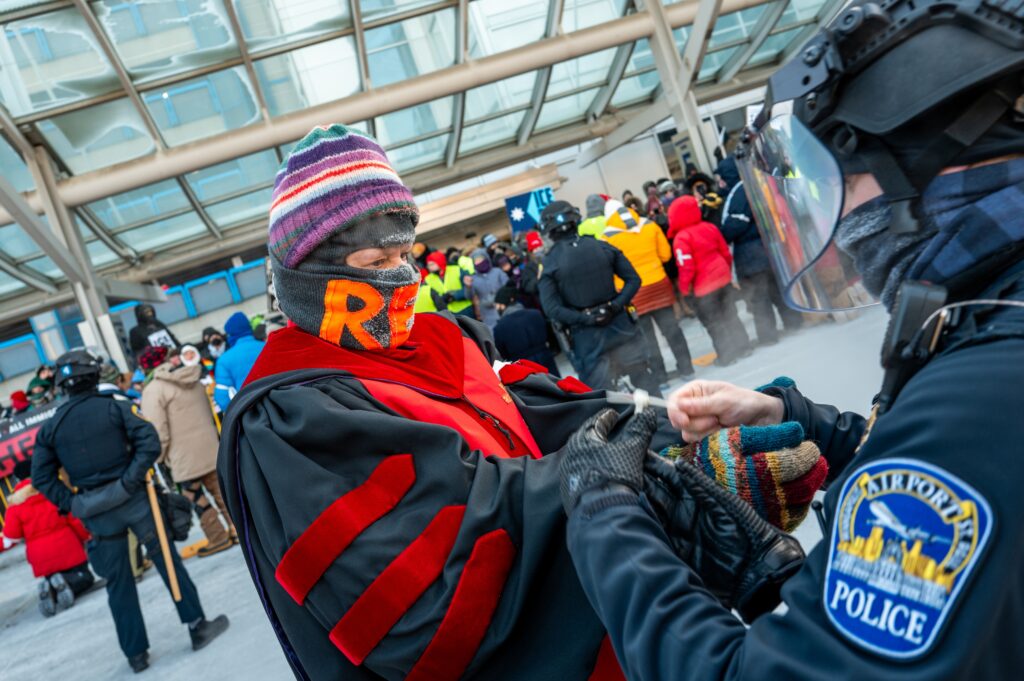
ST. PAUL, Minn. — Roughly 100 clergy were arrested without incident during a protest against deportation flights at Minneapolis-Saint Paul International Airport on Friday, as an economic protest of the Trump administration’s immigration operations in Minnesota shuttered hundreds of businesses in the Twin Cities.
Organizers of the action, dubbed ICE Out of Minnesota: Day of Truth and Freedom, have called for residents to boycott work, school and shopping. The goal, said Ruth Kashmark, who closed her bar Friday to participate, is to demonstrate that “this is what the world’s going to look like if you take our hardworking neighbors away.”
Friday is normally one of Kashmark’s busiest days at the 620 Club in St. Paul, but she wanted to show solidarity with nearby immigrant-run businesses that have shut down or reduced work. “We’ll take the loss,” she said.
Faith leaders, labor unions and business leaders have joined to promote the general strike, amid continuing tensions over U.S. Immigration and Customs Enforcement actions in the state, including the fatal shooting of Renée Good by an ICE officer.
A march is planned for 2 p.m. in Minneapolis, where the National Weather Service warned of minus-50 degree wind chill through Sunday morning. Labor leaders are expecting a large turnout. Of the 18,000 tickets being offered for the 2 p.m. event, 15,647 had been claimed as of 10:45 a.m. Central time, said Minnesota AFL-CIO spokesman Chris Shields.
The airport protest earlier in the day sought to call on airlines to halt cooperation with government deportation flights from the facility, a spokesperson for Faith in Minnesota said. The Bloomington Police Department confirmed it had assisted in making arrests, which occurred peacefully after about an hour of protest in front of airport entrances by singing and praying clergy members.
On Lake Street, a major commercial corridor in South Minneapolis that was devastated by riots following the murder of George Floyd in 2020, dozens of shops, salons, cafes and restaurants had the lights off Friday, with signage notifying customers of their participation in the economic blackout.
Some store displays included expletives about ICE. The west side of the thoroughfare was mostly deserted of pedestrian traffic.
Major fast food and convenience store chain remained open, as did the occasional small business. Goodfellas Barber Studio had its lights on, even though the barber said they supported the protests.
“It’s a ghost town today,” said David Burton, a customer who received a fresh shave and planned to protest later that day. “We have to get our cuts before protesting. In a situation where minorities are oppressed and fighting for our given rights, you want to start the day feeling good.”
Prayer vigils were planned across the state Friday. Some coffee shops planned to open without doing business to provide spaces for march attendees and ICE observers to warm up, offering free coffee and sign-making materials. One brewery planned to provide free hot dogs all day. Other businesses said on social media that they would stay open but donate revenue to community nonprofits.
At Red Balloon Bookshop, a children’s bookstore in St. Paul, staff voted unanimously to shut down for the day.
“We just felt that it was really important to show, despite any financial issues that will crop up, that we wanted to show our solidarity,” said Mallory Hayes, a store manager. The shop has been handing out free whistles to alert neighbors about ICE activity and “know your rights” cards in Somali, Hmong and Spanish.
Across the river in Minneapolis, Temple Israel synagogue was filled Friday morning with clergy, elected leaders and others for an interfaith service to launch the day of striking, marching and activism. Marcia Zimmerman, senior rabbi, declared that “history is on our side,” before lighting a candle in the synagogue’s sanctuary of remembrance for Good and people who have died in federal detention.
Washington’s Episcopal bishop, Mariann Budde, a former Minneapolis priest and prominent critic of President Donald Trump who traveled to Minnesota for Friday’s march, praised locals’ resistance.
“What I and others can do is connect the dots, between the scale and deliberate cruelty here with what has been taking place across the country,” she said, referring to the actions of the federal government. “Minneapolis has shown the country what it looks like to stand up.”
The strike and march come during the third week of tension in Minneapolis since Jan. 7, when Good was shot. In recent days, federal prosecutors subpoenaed the Minnesota governor and other officials, all Democrats; a 5-year-old was detained with his father in their driveway in a Minneapolis suburb; and the federal government arrested three activists in connection with a protest that disrupted a Sunday morning church service.
During a visit to the city Thursday, Vice President JD Vance — who had previously accused local leaders of stonewalling the federal deployment — said Trump had urged him to work with local leaders to “turn down the chaos a little bit, at least.” Last week, Minnesota Gov. Tim Walz (D) had called on Trump to “turn the temperature down,” an appeal the White House had initially seemed to rebuff.
Thousands of Minnesota residents, including many who do not normally consider themselves activists, have protested the federal government’s actions in the weeks since the Department of Homeland Security sent agents into the Twin Cities area with the stated mission of removing undocumented immigrants. They say federal agents have gone far beyond that brief, detaining U.S. citizens, pulling people from their cars, appearing to stop people on the basis of race, and using chemical irritants on people demonstrating against or monitoring their work.
Kimberly Case, 64, a Minneapolis native and retiree, braved the 4-degree snowstorm to protest outside the Vance event Thursday. Chase said she had been unable to stomach the fact that her niece and her classmates had been talking about digging a hole in their schoolyard to hide from ICE agents who might come to their school.
“We’re being invaded at all levels of society, from kids to old people,” said Chase, who wore a battery-heated vest to fight the chill. “But it’s not working. If anything it’s making our community tighter.”
Several court challenges to the Trump administration’s actions are now before federal judges. A federal judge in one suit last week barred DHS agents from arresting peaceful protesters, but this week an appeals court temporarily lifted that restriction while the litigation continues.
After the ICE officer killed Good this month, angry residents began protesting and the administration sent more federal agents to Minnesota, escalating tensions. A week later, on Jan. 14, an ICE officer shot 24-year-old Julio Cesar Sosa-Celis in the leg before arresting him and two other undocumented men at their home.
The Trump administration has defended its work as arresting criminals it calls dangerous and has characterized opposed residents as agitators getting in the way of the work of law enforcement.
“The fact that those groups want to shut down Minnesota’s economy, which provides law-abiding American citizens an honest living, to fight for illegal alien murderers, rapists, gang members, pedophiles, drug dealers, and terrorists says everything you need to know,” the Department of Homeland Security said in a statement to The Post on the general strike.
On X this week, Homeland Security Secretary Kristi L. Noem claimed without providing evidence that the agency had arrested more than 10,000 undocumented immigrants in Minneapolis. The Post was unable to verify Noem’s number.
At a news conference Friday morning, Greg Bovino, the senior U.S. Border Patrol official who has overseen the crackdowns in Minneapolis, said activists had tried to stymie his officers from making some of those arrests.
“We’re not going to be deterred,” Bovino said.
JaNaé Bates Imari, auxiliary minister at Camphor Memorial United Methodist Church in St. Paul, said that the way federal agents have operated has been dangerous and harmful to residents.
“We cannot allow this to continue,” she said at a Jan. 13 news conference announcing Friday’s action. “If you ever wondered for yourself, ‘When is the time that we do something different, when is the time that we stand up?’ … The time is now.”
At a planning party hosted by a mutual aid group at BlackStack Brewing in St. Paul on Thursday evening, volunteers handed out hundreds of donated granola bars, hand warmers, first aid kits, tampons and pins with expletives referencing ICE and Trump. Protesters readied signs.
Elise Klug, a St. Paul resident who grew up in a conservative Twin Cities suburb and describes herself as liberal, called out of work Friday with plans to attend the march.
“I believe in rights and equality for everyone, no matter where they came from,” she said. “I’m going to the protest to say: ‘This is not okay what they’re doing to other human beings.’”
This article will be updated. McDaniel, Allison, Brasch and Boorstein reported from Washington.
The post 100 clergy arrested at airport protest as Minnesotans strike against ICE appeared first on Washington Post.