Was it the “Wicked: For Good” limited edition Swiffer? Or the laundry detergent, dish soap, body spray, Dutch ovens, bath bombs, high tops, $49 popcorn buckets, insulated water bottles and the rest of the licensed (and unlicensed) merchandise/special menus/cocktails that relentlessly turned the world pink and green for months on end?
It could have been the endless memes, pop-ups, interviews and media blitz, all promising that the second film in the “Wicked” franchise would be even better than the first.
More likely it was the reviews, which, with a few notable exceptions (including the one from Times film critic Amy Nicholson), announced in tones that ranged from mildly disappointed to “Kill the Witch” scathing, that this was very much not the case.
An opinion seemingly backed up by the precipitous second-week dropoff at the box office.
Whatever the reason, academy voters made it very clear on Thursday that they are 100% over Jon M. Chu’s vision of Oz. Where “Wicked” received 10 Oscar nominations, “Wicked: For Good” got zero.
Goodbye, Yellow Brick Road indeed.
I actually liked the sequel more than the first, but being neither a film critic nor a member of the Academy of Motion Picture Arts and Sciences, my opinion matters not at all in this particular context. Still, “Wicked: For Good” was a highly successful movie, with a record-breaking opening weekend and a $524-million global box office haul. That’s less than its predecessor, which made $759 million, but a remarkably strong showing for a musical (much less a musical sequel) or most any film — including all of those nominated this year for best picture.
Despite the mixed critical reception, it most definitely brought many, many people into theaters and amid a steep decline in movie-going, it would have been nice for the academy to acknowledge the importance of this in some way.
Considering how steadily its Oscar buzz dwindled in the weeks leading up to the nominations, “Wicked: For Good’s” absence from the best picture list, or Chu’s from directing, wasn’t surprising.
It was, thankfully, a very good year for female characters, and the structure of “Wicked: For Good” worked against former nominee Cynthia Erivo emerging in the lead actress category (and there is little doubt she will be back in Oscar contention soon).
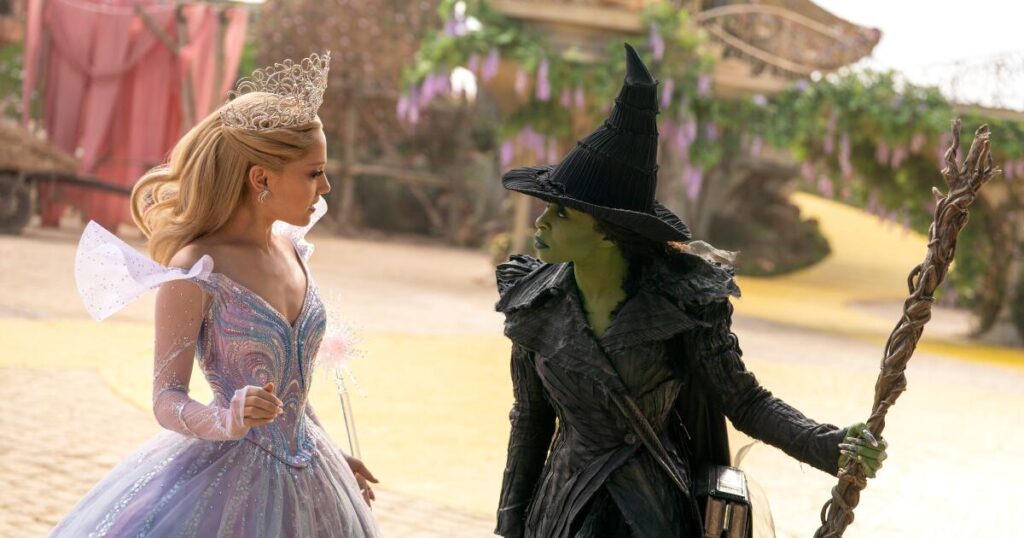
Ariana Grande, on the other hand, gave a noteworthy performance, miraculously selling both the flawed humanity of Glinda’s betrayal and her heroism in accepting that she had made a terrible choice for selfish and petty reasons.
Given how intertwined the two performers have been in marketing the film, perhaps voters felt they couldn’t nominate one without the other, but still Grande’s omission feels like a slight to the millions of audience members who found the story of this particular friendship relevant and revealing.
But the film’s utter absence from every other category makes the “Wicked: For Good” shutout feel vaguely … hostile? “Wicked’s” costume designer Paul Tazewell and production designers Nathan Crowley and Lee Sandales won their races last year; this time around they weren’t even nominated. Whatever flaws “Wicked: For Good” might have had, the costumes (with the possible exception of the “sex cardigan”) continued to be spectacular, as did the production design, not to mention the makeup and hairstyling.
Sequels often struggle to attain the glory of their predecessors, particularly those that set the bar high, and the trend of splitting adaptations of a single work into two films, whether the original appears to warrant it or not, left many people skeptical about the motivation for making two “Wicked” movies. The degree of difficulty was very high — the stage production is famous for its weak second half, both narratively and musically (it’s tough to follow a showstopper like “Defying Gravity”) — and Chu, with cinematographer Alice Brooks, intentionally leaned into a darker, more mature tone, in contrast to the candy-colored exuberance of the original.
Clearly, “Wicked: For Good” did not live up to academy voters’ notion of a best picture; instead they slid “F1,” which made $631 million, onto the list, perhaps as assurance that they do not actively hold box office success against any film (“Sinners,” which had a record-breaking 16 nominations, was the second-biggest earner with $368 million).
But if “Wicked: For Good” did not, for many, equal the sum of its parts, many of its parts were pretty spectacular and it wouldn’t have killed the academy to acknowledge that.
The post ‘Wicked: For Good’ wasn’t a masterpiece, but it didn’t deserve to be shunned by Oscars appeared first on Los Angeles Times.