The depth of the rift between President Trump and Europe was on full display on Wednesday as Mr. Trump delivered remarks in Davos, Switzerland, airing his disdain for Europe’s immigration policies, its regulations and its strident unwillingness to give him Greenland, which he insists America must own.
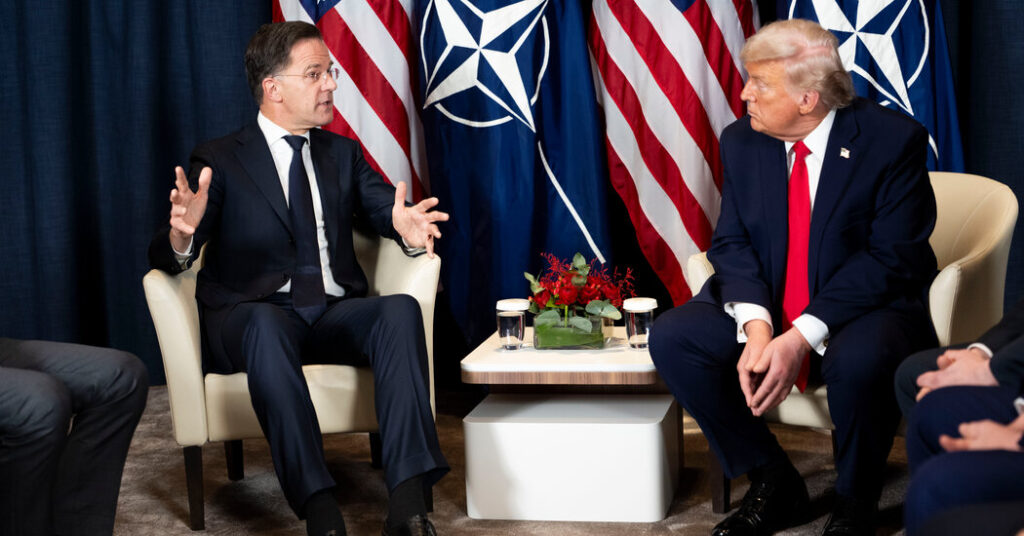
For months, Europe has been looking to find a diplomatic answer to de-escalate the crisis. Hope for such an off ramp came late Wednesday, when Mr. Trump posted on Truth Social to announce that he and Mark Rutte, the NATO secretary general, were working on a deal that could resolve the dispute over Greenland, an autonomous territory of Denmark. He suggested that tariffs he had previously threatened to impose on European nations starting Feb. 1 would no longer kick in.
But neither he nor NATO provided any details of what such that framework might look like, and there is no guarantee that such a deal will be finished. A member of the Danish parliament from Greenland called the deal into question in a social media post, saying it had created “total confusion.”
The dust had not yet settled Wednesday night. But one thing was clear. Mr. Trump’s comments throughout the day underscored just how little the United States and Europe — long the closest of allies — now have in common.
“While we may no longer be literally staring down the barrel of a gun on the trans-Atlantic relationship, we are still in a very rocky place,” said Jacob Funk Kirkegaard, a senior fellow at Bruegel, a research institute in Brussels.
“We are fundamentally at odds, in a way that can only reflect the very different values between most governments in Europe and the Trump administration,” he added.
European leaders, many of them shocked by Mr. Trump’s threats to take over the sovereign territory of an E.U. member and NATO ally, must still come together on what they might or should do if Mr. Trump changes his position again — and about the trans-Atlantic relationship more broadly.
On Thursday evening, leaders from across the 27-nation European Union will gather in Brussels to discuss the perilous state of Europe’s relationship with the United States. They may discuss the contours of the plan Mr. Trump alluded to in his social media post. They will debate how they should approach this new and more hostile era, especially when Russia is still waging war in Ukraine.
Mr. Trump had announced over the weekend that he intended to apply levies of 10 percent on several European nations that have recently sent troops to Greenland as part of a NATO exercise. Although he has suspended those tariffs, it is unclear if that will last.
The mere possibility set off a panicked flurry. European ambassadors met for an emergency gathering on Sunday to discuss the development, and many European leaders called Mr. Trump directly. Thursday’s summit was called in response to the threat.
The discussion is likely to touch on the state of play after the gathering in Davos, including Mr. Rutte’s discussion with Mr. Trump. Leaders will also vet what to do next.
Even if the tariff issue is resolved, and even if the Greenland matter is resolved, Mr. Trump’s aggressive push for the island — and his language about Europe in recent days and weeks — have exposed a serious rupture forming between the partners that is far from healed. Europe is grappling with a changed reality, after decades in which it relied on a stable relationship with the United States for both trade and security.
“The shift in the international order is not only seismic — but it is permanent,” Ursula von der Leyen, president of the European Commission, said on Wednesday morning.
A senior European official, speaking anonymously to discuss sensitive diplomatic matters, appealed for a bit of calm, noting that Mr. Trump recently threatened to sanction any country that did business with Iran, but has not done so until now.
The lesson, he suggested, was to keep Europe’s powder dry, not to overreact and escalate needlessly with a key ally, and push for diplomacy. To that end, he said the bloc should be ready to retaliate — to have leverage — but should not react unnecessarily.
The European Union already has a 93 billion euro, or $107 billion, list of U.S. goods prepared that it is poised to hit with retaliatory tariffs after Feb. 6. The list was finalized last year in response to Mr. Trump’s earlier trade war, and it will snap into place automatically unless E.U. officials take proactive moves to suspend it — making it a natural first step, should retaliation prove necessary.
Mr. Trump also had his usual harsh words for NATO during his speech on Wednesday, asserting that NATO allies would not come to the aid of the United States if attacked.
But the only time Article V of the NATO treaty, the commitment to collective defense, was ever invoked was to aid the United States after it was attacked on Sept. 11, 2001.
NATO troops fought alongside American soldiers in Afghanistan for a decade, and Denmark itself had more soldiers die per capita in Afghanistan than America did.
Still, at Davos, Mr. Rutte, the NATO secretary general, praised Mr. Trump for pushing member states to spend more on their own defense, which has strengthened the alliance.
Asked if he could imagine NATO without the United States, he said simply, “No.”
The United States “is by far the most powerful nation on earth, and the president of the United States is the leader of the free world,” he said, adding, “And you cannot envision NATO without the leader of the free world being an integral part of that organization.”
Mr. Rutte also touched on the most pressing security issue for Europeans, which is Russian aggression against Ukraine — right on the E.U.’s borders — and not an icy island in the Arctic.
“The risk here is that we focus, of course, on Greenland, because we have to make sure that issue gets solved in an amicable way,” Mr. Rutte said on a panel in Davos.
“Ukraine should be our No. 1 priority, and then we can discuss all the issues, including Greenland,” he said.
Steven Erlanger is the chief diplomatic correspondent in Europe and is based in Berlin. He has reported from over 120 countries, including Thailand, France, Israel, Germany and the former Soviet Union.
The post Trump’s Rift With Europe Is Clear. Europe Must Decide What to Do About It. appeared first on New York Times.