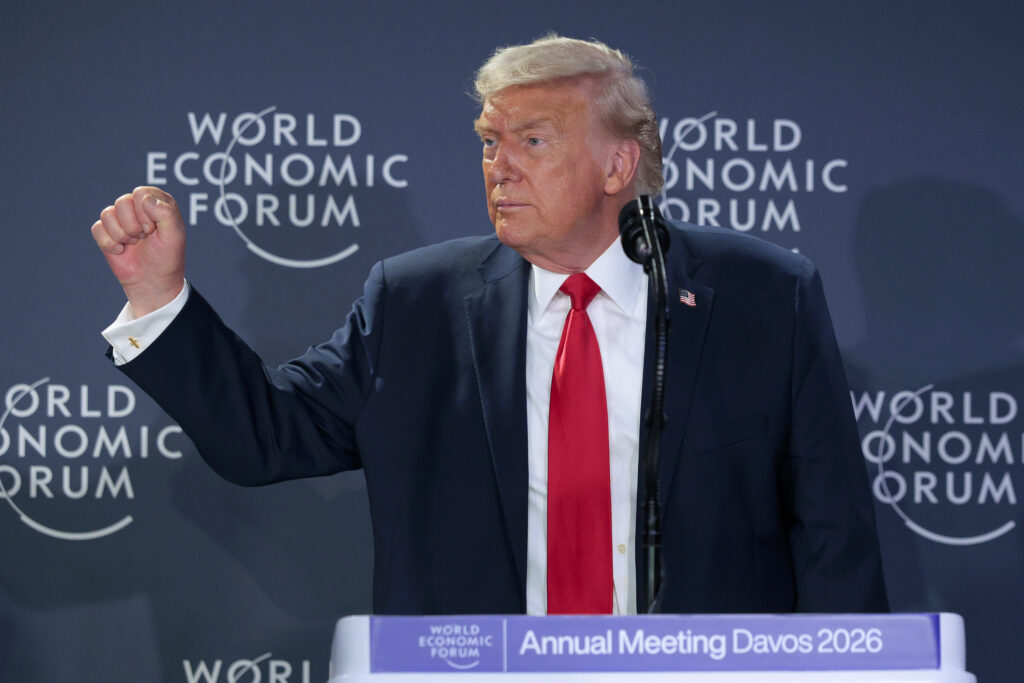
DAVOS, Switzerland — President Donald Trump said Thursday that he wants his new “Board of Peace” to work with the United Nations, but it was unclear if that pledge would ease concerns among some leaders that he is trying to sideline the international body.
Trump discussed the potential for collaboration at the board’s formal launch, which his administration has advertised as a tool to resolve global conflicts with a scope rivaling the U.N. He was joined by 19 world leaders but just two European representatives, from Hungary and Bulgaria, a contrast that underscored his ambition to reshape the world order and the limits of his approach.
“Once this board is completely formed, we can do pretty much whatever we want to do, and we’ll do it in conjunction with the United Nations,” Trump said at the signing ceremony. “You know, I’ve always said the United Nations has got tremendous potential, has not used it, but there’s tremendous potential in the United Nations.”
The Trump administration earlier this month withdrew from 66 international organizations, many of them U.N.-related agencies, commissions and advisory panels that focus on climate, labor, migration and other issues the administration has categorized as catering to diversity. Daniel Forti, head of U.N. affairs at the International Crisis Group, said at the time that the move was “a very clear vision of wanting international cooperation on Washington’s own terms.”
Some countries have rushed to accept Trump’s invitation to the board in recent days. Others as disparate as Canada, Russia and China were among those that equivocated, citing a need to study the proposal. France, Norway, Sweden, Denmark and Slovenia have declined to participate in the board as it is formulated — eliciting a furious reaction from Trump, who threatened to impose punitive 200 percent tariffs against French wine. Trump and his top aides, including Secretary of State Marco Rubio, said they expect many other countries to join.
Initially envisioned to shepherd the peace process in Gaza, the body was presented Thursday by senior Trump administration officials as a vehicle for broader ambitions. The administration has also emphasized that the board’s scope will extend beyond the conflict in the Middle East, spooking some of the countries that were invited to join.
“This is not just a board of peace,” Rubio said Thursday. “This is a board of action.”
Ali Shaath, a former Palestinian Authority official now overseeing Gaza’s administration, announced the reopening of the Rafah crossing — the land border between Egypt and the Gaza Strip that, in the past, has served as a vital lifeline for humanitarian aid and for Gazans to enter and exit the Palestinian enclave. Israel has said it will not reopen the crossing until Hamas returns the last body of an Israeli hostage in Gaza.
Israeli Prime Minister Benjamin Netanyahu said Wednesday that he would join, even as Israeli politicians levied harsh criticism of the composition of a subsidiary group, focused on Gaza, that includes representatives from Turkey and Qatar.
A permanent seat will cost countries $1 billion, though U.S. officials said the payment was voluntary and not an entry fee.
“Membership does not carry any mandatory funding obligation beyond whatever a state or partner chooses to contribute voluntarily,” said a U.S. official speaking on the condition of anonymity under requirements set by the administration.
The ceremony on the stage of the World Economic Forum crystalized how Trump has dominated the annual conference, even as he pursues policies that strain the global partnerships that the forum has promoted since its founding 55 years ago. His urgent effort to recruit countries also highlights the dilemmas faced by world leaders grappling with how to work with the American president.
European officials are wary of contributing large sums of money to a new organization shaped around Trump’s vision for the world; but the same leaders are also under pressure to work with the unpredictable American president, whose support is key to future of Ukraine and more broadly, of the NATO alliance.
The president’s team handling implementation of the peace board includes Rubio, special envoy Steve Witkoff, Trump’s son-in-law Jared Kushner, former British prime minister Tony Blair, Apollo Global Management co-founder Marc Rowan, and White House advisers Robert Gabriel and Josh Gruenbaum.
Trump has dispatched the same team to pursue resolutions for the most complex, intractable global conflicts — such as the war between Ukraine and Russia and the future of Greenland.
More than 50 countries are known to have been contacted by the White House, either through statements made by Trump or officials representing recipient countries. A full tally of countries solicited for a seat on the board was not made public.
The White House on Thursday released a list of countries that signed onto the board, which included Belgium. Maxime Prévot, the country’s deputy prime minister and minister of foreign affairs, swiftly refuted the announcement. Belgium has “reservations” about the proposal, like other European nations, he wrote on X.
“Our effort will bring together a distinguished group of nations ready to shoulder the noble responsibility of building LASTING PEACE,” read the invitation sent to Argentine President Javier Milei. “We will convene our wonderful and committed partners, most of whom are HIGHLY Respected World Leaders, in the near future.”
The proposed charter and the list of invitees — which includes Russian President Vladimir Putin — have raised concerns among some of the prospective members.
Canada’s finance minister said the country would not pay $1 billion for a permanent seat. Canada accepted the invitation on principle, Canadian Prime Minister Mark Carney said separately, though he added that Canada’s participation would be conditioned entirely on the resumption of a “full flow” of humanitarian aid to Gaza.
Both Putin and Ukrainian President Volodymyr Zelensky received invitations to join the board, raising questions about the prospect of the two countries, which are at war, collaborating in the context of an international peacemaking body.
“Russia is our enemy. Belarus is their ally,” Zelensky said on Tuesday. “It is very difficult for me to imagine how we and Russia can be together in this or that council.” Officials in Poland raised similar concerns.
Trump on Wednesday said that Putin had accepted his invitation to the board, though Putin clarified afterward that he had not and the Kremlin was still studying the proposal.
The board was initially conceived to oversee the implementation of the ceasefire and peace process in Gaza. The United Nations Security Council authorized the establishment of the board as a “transitional administration” in Gaza for the purpose of coordinating reconstruction efforts.
But the board’s charter, obtained over the weekend by the Times of Israel, makes no reference to the conflict in Gaza. “The Board of Peace is an international organization that seeks to promote stability, restore dependable and lawful governance, and secure enduring peace in areas affected or threatened by conflict,” it reads.
Trump ended Thursday’s event by signing the Board’s charter while seated at a table, with more than a dozen world leaders standing around him, watching.
Cat Zakrzewski in Davos, Lior Soroka in Tel Aviv, Adam Taylor in Washington and Amanda Coletta in Toronto contributed to this report.
The post Trump launches ‘Board of Peace’ at Davos, testing global order appeared first on Washington Post.