Howard Husock is a senior fellow at the American Enterprise Institute and author of “The Projects.”
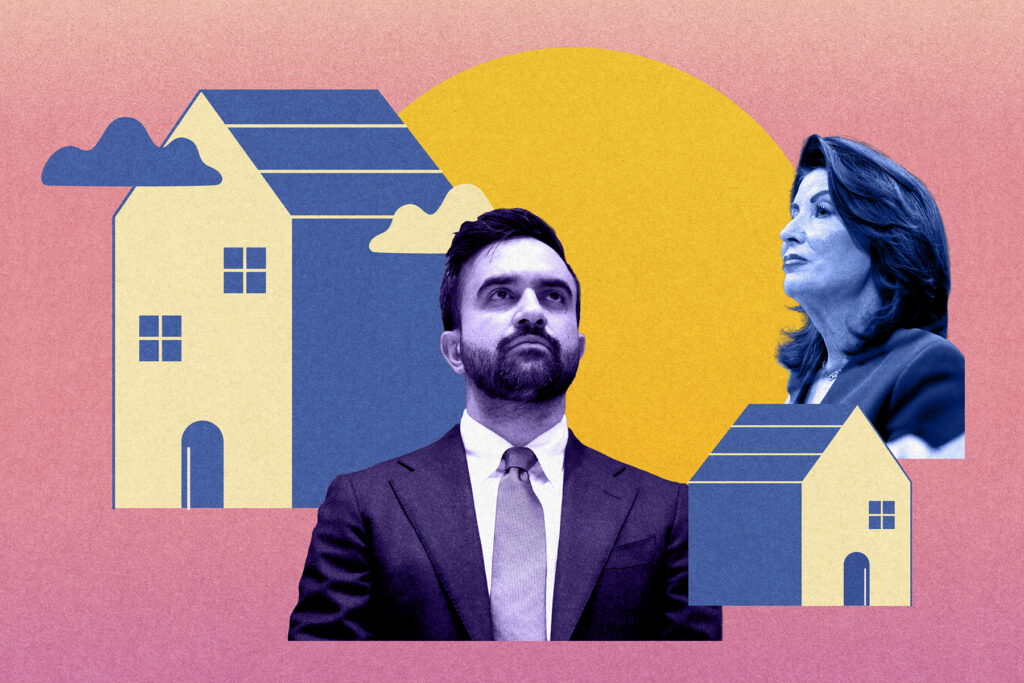
Affordability, especially lowering housing costs, enjoys bipartisan political support — at least in theory. But affordability is a goal, not a specific program, and even progressive Democrats can break with each other on how to achieve it. That’s the lesson learned from New York Gov. Kathy Hochul’s recent housing proposal, one that sets the relatively moderate Democrat apart from progressive New York Mayor Zohran Mamdani. Other Democrats should pay close attention and choose their approach carefully.
Their differing proposals contrast in broad ways that transcend housing — less regulation or more; increased private supply or additional government subsidies; courting a key interest group or risking the anger of political activists.
During her State of the State address last week, Hochul proposed what she calls the “Let Them Build” program. Its linchpin is a relaxation of New York’s State Environmental Quality Review Act, which the governor characterized as adding “unnecessary costs and years of needless delays” to housing development and slowing down projects “by an average of two years, costing hundreds of thousands of dollars per project.” Hochul’s push to cut red tape is remarkable to hear from a Democratic governor of a deep blue state, but rising housing costs have led some Democrats to embrace unwinding burdensome regulations.
Construction data tells the story. Per census data, New York authorized around 46,000 new housing units in 2024; North Carolina, with roughly half New York’s population, issued slightly more than 95,000. Florida, with slightly more residents than New York, issued more than triple the Empire State’s total. All but 12,366 of New York’s new housing units were in buildings of five or more apartments — which are more likely to be rented than owned.
The affordable single-family home, arguably the epitome of the American Dream, was not being built fast enough to keep up with demand. Nor were two- and three-family homes, like duplexes and triplexes, which can serve as starters for young families. A healthy housing market provides a ladder from starter home to mansion, with a multitude of small steps in between.
Relaxing environmental red tape may help the market achieve this. But the Hochul proposal carries symbolic consequences as well. By daring to question the necessity of environmental regulation, Hochul is crossing a core Democratic constituency in a state where environmentalists are politically potent.
It’s by no means a sure thing that Hochul will gain the legislative approval she needs. A related previous proposal, offering state aid to municipalities in return for their being required to relax local zoning, flopped in 2023. Even if the environmental reform passes, the key action will continue to be at the local level, where planning and zoning boards make critical decisions about how much and what types of new housing will be permitted. Brave Democrats will need to be willing to call out local officials who inhibit new supply and bear responsibility for affordability becoming a national problem.
Mamdani offers a different approach. Though he nominally expressed support for Hochul’s speech, his policy emphasis on the campaign trail and during the mayoral transition tells a different story. His appointed tenant advocate, Cea Weaver, has called homeownership a “weapon of White supremacy” and railed against property ownership as “an individualized good and not a collective good.” She admitted that her past statements were “regretful” and Mamdani has stood by her appointment.
Mamdani’s signature promise to “freeze the rent” for nearly 1 million Gotham apartments allowed him to successfully court a key interest group, rent-regulated tenants, at the expense of housing supply. The rent freeze will exacerbate the plight of marginally profitable landlords already in trouble because state law sharply limits rent increases even when major repairs have been performed. The collateral damage includes an estimated nearly 50,000 “ghost apartments” absent from the market, likely because they are unprofitable to operate.
But rather than trying to unleash the private sector as a combination affordability and prosperity program, Mamdani proposed 200,000 new government-subsidized, income-restricted rental units. In other words, an approach based on redistribution. New York would be better served if he ditched his campaign promises and fully focused on efforts to build more homes.
Keep in mind that New York already has more public housing — over 177,000 units — than any other American city. The Big Apple also has nearly 300,000 housing voucher-supported units, and 960,000 rent-regulated apartments. That’s more than a million subsidized or rent-controlled units. If subsidized and regulated housing were the secret to affordability, New York would be leading the way. Instead, it faces low vacancy rates and a perennial housing crisis.
Public housing, originally intended for the working class, has devolved into a modern day poorhouse. And, in New York’s case especially, public housing is akin to the slums it was meant to replace, as the city faces a more than $78 billion bill to stem leaks, mold, rodents and elevator breakdowns.
Notable Democrats are coming out against Mamdani-style rent freezes and are focusing on making it easier to build. Mamdani’s fellow progressive Massachusetts Gov. Maura Healey recently came out against a statewide referendum that would adopt rent controls in the Bay State. “Rent control is not going to be the solution to how we get through this crisis,” she said. “We need to build more homes.” Regulation, according Healey, deters development. Democratic Gov. Gavin Newsom made a similar move to relax California’s environmental review law, notorious for tying up housing development in litigation, which was signed into law last summer.
There is no doubt that there are political points to be scored by linking high housing costs to a variety of villains: greedy landlords, private investors buying homes, inadequate government subsidy. But the divide in New York between Hochul and Mamdani offers Democrats looking to seize the issue a useful choice — between the counter-productive and the practical.
The post There’s a practical way to lower housing prices. Democrats should seize it. appeared first on Washington Post.