“The object of the Museum is to acquire power,” announces a crusty old archaeologist in Penelope Fitzgerald’s 1977 satire, The Golden Child. It isn’t a goal he respects. He wants the museum where he’s settled into semiretirement to genuinely devote itself to educating its visitors. Instead, he correctly charges, its curators act like a pack of Gollums, hoarding “the art and treasures of the earth” for their own self-aggrandizement and pleasure.
Fitzgerald never names the museum The Golden Child is about, but it’s a massive state-run one in London: It’s not hard to guess that it’s the British Museum. If she had been writing in the United States, she’d surely have targeted one of the 21 museums that make up the Smithsonian, an institution that has its own struggle with hoarding—and with the public’s idea that it hoards. Its reputation as the “nation’s attic” is entrenched enough that the National Museum of American History winked at it with an exhibit by that name in 1980.
But the Smithsonian has long sought a higher mission than national storage. George Brown Goode, who ran the Smithsonian in the late 19th century and set its intellectual course, swore that it would be not a “cemetery of bric-a-brac” but a “nursery of living thoughts.” He wanted it to consist of “museums of record”—cultural institutions that tell canonical stories about the history of the nation—and today, it does. Its museums do far more than any privately funded ones to shape and crystallize our country’s narrative.
That’s not to say that the individual objects housed in the Smithsonian’s collections aren’t themselves consequential. I recently asked Laura Schiavo, an associate professor of museum studies at George Washington University, why the country needs the Smithsonian, and she told me it was because “we have an obligation to the objects” it owns.
But Americans argue about the Smithsonian far more than we would if only its possessions mattered. When our museums of record tell us a story, that story matters enormously. Maybe that’s why outside efforts to influence the Smithsonian’s viewpoint are part of the institution’s history. Take the Enola Gay. In the early ’90s, the National Air and Space Museum began designing an exhibition that would coincide with the 50th anniversary of the bombing of Hiroshima, focusing on the bomber itself. Initially, curators, working with academic historians, planned a show that would call attention to Japanese civilians’ suffering and question the use of nuclear force.
When the Air Force Association found out, it was furious. Its public response sparked a massive controversy. Newt Gingrich, newly House speaker, protested that the “Smithsonian is a treasure that belongs to the American people and it should not become a plaything for left-wing ideologies.” By the time the Enola Gay went on display in 1995, the show had been stripped not only of critique but also of context. The mess showed that the stories the Smithsonian chooses to tell are even stronger than the Smithsonian itself. Why else would one of the most influential members of Congress, which provides roughly two-thirds of the institution’s funding, treat the Air and Space Museum as a potential political threat?
The current White House seems to share Gingrich’s perspective. In August, the Trump administration announced that it would comprehensively review many of the Smithsonian museums to ensure that they promote American exceptionalism and use “unifying” and “constructive” language in their exhibits and materials. Evidently, this precludes the National Portrait Gallery mentioning Donald Trump’s impeachments in the wall text beside his photograph. (The museum has called it a routine change.)
[Read: Take a close look at Trump’s portrait]
In a perverse way, such encroachments make sense. If the Smithsonian’s framing of history didn’t matter, nobody in or out of government would care about the language it chose. But if storytelling is the most important of its roles, then it stands to reason that in a moment of profoundly contested national narratives, the Smithsonian is a newly contested institution. By arguing about it, we can argue about ourselves.
Little has been as contested as the debate over what to do with the nation’s Confederate monuments, the subject of an exhibit currently on view at Los Angeles’s Museum of Contemporary Art and the Brick, far from what S. Dillon Ripley, a former secretary of the Smithsonian, called the “vast monumental marble” palaces on the National Mall. In 2015, the white supremacist Dylann Roof murdered nine worshippers at Charleston’s historically Black Mother Emanuel African Methodist Episcopal Church. He had posed online with a Confederate flag, and public reaction to the killings included a push to eliminate Confederate iconography—flags and statues of leaders such as Confederate President Jefferson Davis and Generals Stonewall Jackson and Robert E. Lee—from civic space.
At the time, the U.S. had more than 1,500 of these monuments, which overwhelmingly presented their secessionist subjects as heroes. Most remain standing today, but roughly 200 have come down. After their decommissioning, these statues met fates varied enough to indicate an ongoing lack of consensus about whether these monuments should be seen or preserved. Some went into storage or got moved to Civil War cemeteries, and Charlottesville, Virginia, had its statue of Lee melted down. This monument was especially controversial: The campaign to remove it attracted the attention of the far right and led to the 2017 “Unite the Right” rally at which a counterprotester named Heather Heyer was killed. The tragedy made plain that although Lee, Jackson, and the soldiers they led are long gone, arguments about their memory still have mortal stakes.
The bronze ingots that were made from Charlottesville’s melted-down Lee statue form part of MOCA and the Brick’s “Monuments,” a show that uses the techniques of art, not history, to contextualize these relics of the Confederacy. At MOCA, each decommissioned statue is shown as it came: covered in gruesome red paint; touched only by corrosion; or, in the case of a Jefferson Davis sculpture, pink-streaked and laying on its side. Defaced plinths line the entryway to the exhibit.
The effect is that of an existential demotion: The monuments, which once dominated parks or plazas, seem inert, especially in comparison with the contemporary artworks that surround and react to them. I overheard a woman asking her companion if an enormous statue of Lee and Jackson on horseback was a “real sculpture,” meaning one that once stood in public—a question that demonstrates the museum’s ability to sap the monuments of their historical power.
And yet “Monuments” arguably contains more commentary on the present than claims of any kind of victory over the past. Its paint-bombed Davis shares a gallery with a series of huge Andres Serrano photographs of Klansmen. Serrano’s images are confrontational: His subjects’ eyes communicate their sense of authority, even impunity. Yes, they seem to say, the Confederacy was toppled, but so what? We’re here.
Five miles east, at the Brick, is a more complicated confrontation. When Charlottesville decommissioned its monuments, it gave a bronze statue of Jackson on his horse, Little Sorrel, to the artist Kara Walker, perhaps best known for her cut-paper silhouettes of the antebellum South and the enormous sugar-coated Sphinx that she installed in a defunct factory in 2014 as an homage to the enslaved workers who long powered the sugarcane trade. For “Monuments,” she transformed the Jackson statue into Unmanned Drone, a sculpture made from severed and rearranged hunks of horse and man. Little Sorrel’s head hangs between its legs, and its rear end rides in the saddle. Human limbs dangle. It’s an oddly forlorn vision, an eternal wanderer who seems to have been punished. It is also the most resonant object—art or monument—in “Monuments.” Unmanned Drone encapsulates the show’s message: These statues may no longer be powerful, but they remain with us, as metal or as headless ghosts.
[Clint Smith: Those who try to erase history will fail]
An exhibit as opinionated as “Monuments” would likely be impossible at the Smithsonian under any presidency. As the Enola Gay debacle demonstrated, politicians and other stakeholders—including the donors who provide a decent amount of exhibition funding—tend to want the institution to tell uplifting stories. Plenty of visitors would like the same thing. Not everyone is prepared to feel haunted by the nation’s past; it’s easier to imagine the nation’s attic as full of treasures than of ghosts.
Meanwhile, the Smithsonian’s status as an arbiter of national stories also makes some visitors wrongly assume that it celebrates whatever it shows. Robert C. Post, a Smithsonian curator emeritus, writes in his 2013 book, Who Owns America’s Past?, that in the 1980s, the National Museum of American History got critiqued for overlooking the country’s failures as it was striving to do the contrary. Even wall text that explicitly described the Seminole Wars as an “all-out campaign of extermination” could not stand up to “the assumption that anything on display was being affirmed simply by virtue of being there.”
Many of the Smithsonian’s recent troubles revolve around the misapprehension that its museums praise—and should praise—anything they show. The Trump administration seems animated by the conviction that Smithsonian museums use this power to advance a “divisive, race-centered ideology.” Perhaps for this reason, last year’s White House budget contained no funding for the not-yet-built Museum of the American Latino or for the Anacostia Community Museum, which is the Smithsonian’s only museum dedicated to the city it calls home. The latter is housed in a small, inviting building—there’s free coffee in the lobby—in a residential Black neighborhood a few Metro stations from the National Mall. It costs far less than most of its counterparts to run, making the threat to defund it read as hostility to the thought that ordinary Washingtonians deserve inclusion in the Smithsonian and, by extension, in the American story.
I visited the Anacostia Community Museum recently to see “A Bold and Beautiful Vision: A Century of Black Arts Education in Washington, D.C., 1900–2000.” D.C. is the home of the country’s oldest Black high school—Paul Laurence Dunbar High School, founded 84 years before Brown v. Board of Education began the process of school desegregation—and the exhibit traces its teachers’ and graduates’ influence on generations of nationally significant Black artists. One is Hank Willis Thomas, whose work I’d just seen at MOCA; another is Sam Gilliam, a Color School painter whose enormous, beautiful draped canvas Relative I’ve often visited in the National Gallery of Art, where it occupies 13.5 feet of wall. Its installment there is a statement of historical importance: It’s next to Helen Frankenthaler’s Mountains and Sea, generally considered one of the most influential Abstract Expressionist works to come after Jackson Pollock’s drip paintings. By pairing them, the National Gallery’s curators seem to be arguing that Gilliam’s art, which has never received the same attention as Frankenthaler’s, matters just as much.
At the Anacostia Community Museum, Gilliam’s work tells another story entirely. “A Bold and Beautiful Vision” contains three of his paintings, presented not as grand works but as approachable examples of a former D.C. public-school art teacher’s achievement. Museumgoers’ drawings hang near them, suggesting continuity between Gilliam, who died in 2022, and the young artists of today’s D.C. Whereas the National Gallery includes Gilliam in a narrative formerly dominated by white painters, the Anacostia Community Museum uses him to include its visitors in the sweep of American art.
Only the Smithsonian could tell Gilliam’s story in both these ways. Such is its unique power. No wonder the country argues about it. If anything, we should argue about it more. The White House’s push to suppress the Smithsonian’s programming is part of an attempt to strong-arm influential cultural institutions and, in turn, culture itself. More broadly, though, it seems fruitful for Americans to discuss and debate the stories that our national museums tell. It might even be a sign of trouble not to have some public wrangling about the Smithsonian, especially in the lead-up to the country’s 250th anniversary.
But the gravity of these conversations slows them down, even as it raises the stakes of their outcomes. If the Smithsonian’s potency comes not from its objects but from its ability to shape and record the nation’s history, then, in some ways, it has succeeded too fully. At least right now, what the Smithsonian says has become too meaningful for its own good—which is why, as important as the Smithsonian’s autonomy is, it’s just as vital that the country has other museums, too.
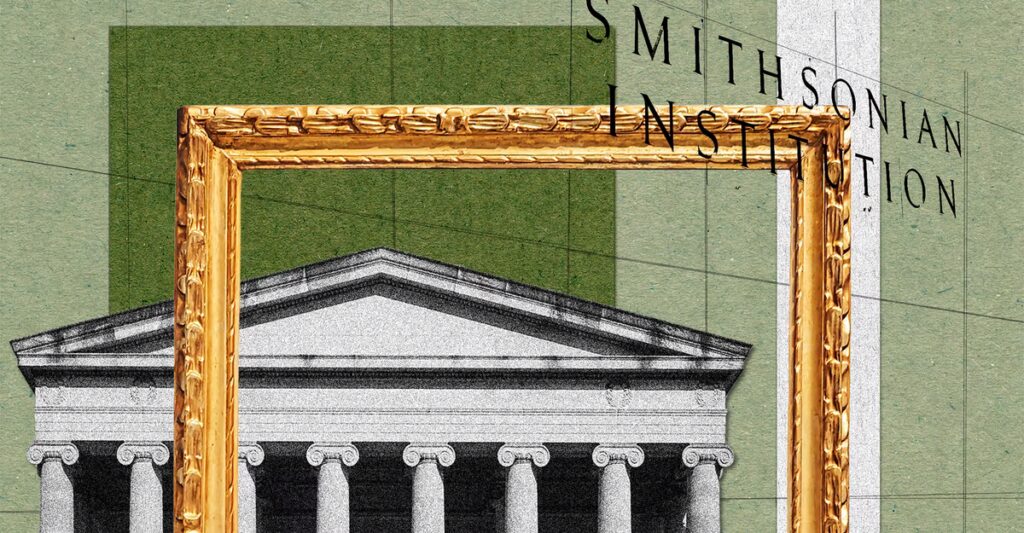
*Illustration by Akshita Chandra / The Atlantic. Sources: Kara Walker’s sculpture “Unmanned Drone” by Patrick T. Fallon / AFP / Getty; P_Wei / Getty; Doug Armand / Getty; Getty.
The post The Real Fight for the Smithsonian appeared first on The Atlantic.