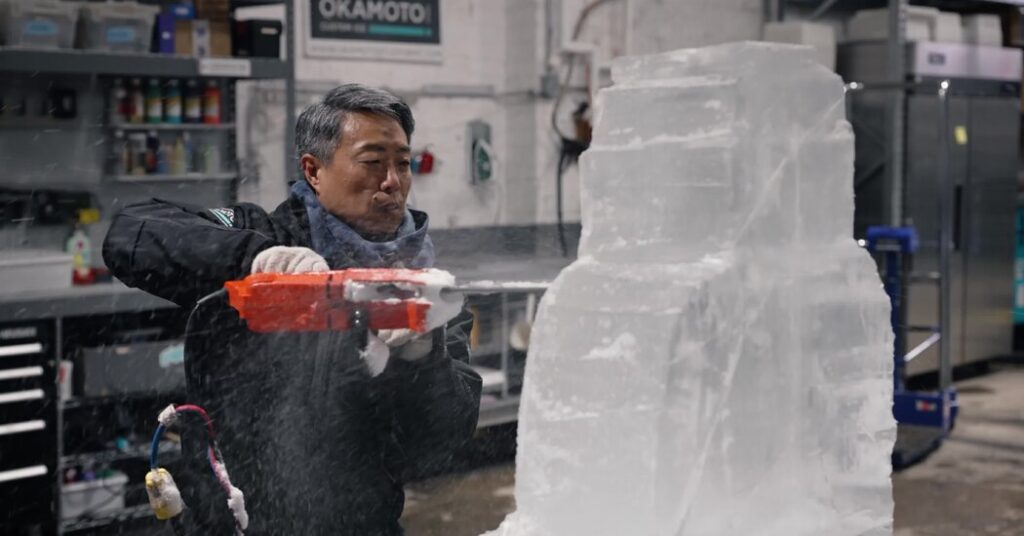
In order for the Buddha to take shape, Shintaro Okamoto needed to see eye to eye with him.
In a slight squat, chisel in hand, Okamoto chipped away at a fine layer of ice. Forms began to emerge — the curve of a nostril, the angle of a jaw.
The Buddha is a figure Mr. Okamoto, 51, knows well. When he first started his New York-based ice sculpture business with his father in 2003, one of their first customers was a sprawling Japanese restaurant in TriBeCa that wanted a fresh ice Buddha for their dining room every day. Mr. Okamoto estimates they made 2,500 of them over the next several years.
“Ice Buddha definitely has a special place in my heart, because it was what took our company, Okamoto Studio, to the next level,” he said.
Today, Mr. Okamoto, who works out of a warehouse in Long Island City, has an expansive catalog that includes animals, luges, logos, table centerpieces, bars and custom cocktail ice. Last year, he carved a display for the New York Rangers, a slipper for Disney’s 75th anniversary of Cinderella and an Air Force 1 sneaker for a shoe distributor.
Mr. Okamoto was born in Fukuoka, Japan, and grew up in Anchorage, where his father, Taeko, ran a Japanese restaurant. His father first learned about ice sculptures in culinary school in Japan, where he was taught that intricate ice displays could elevate a restaurant’s interior. From there, it became a creative hobby and side business.
As a child, Mr. Okamoto remembers his father driving him to a lake near their home with a shovel and a saw. Here, he cleared the ice and cut a block, carving a swan from it.
Today, Mr. Okamoto loves the work. But it wasn’t always that way. His first memories of ice sculpting conjure memories of cold feet, wet shoes and shoveling slush. It was his father who was the artist, devoting hours to carving his latest display. “For him it was father-son time, but for me it was just shuffling scrap ice in a really cold space,” he said.
Over time, Mr. Okamoto’s father taught him the craft. When he was a teenager, he carved his first swan, and the father-son duo began entering global ice carving competitions, meeting artists from Australia, Japan and France, where few had formal training.
“They were wood carvers, they were chefs, they were the most random people who fell in love with this crazy art form, craft, and figured it out as they’re going because there’s really no school for it, there’s no art for it,” he said.
After high school, Mr. Okamoto left Alaska to go to art school. After he graduated with his master’s degree in fine arts, his parents packed up their home and drove across the country to help him launch Okamoto Studio in New York. The duo led the business together until his father died in 2012.
Inside Okamoto Studio, the walls are lined with power tools and rolling dollies are at the ready. The concrete floors are outfitted with ample drains, and electrical outlets are strung overhead. A large walk-in freezer is the storage site for both the initial ice blocks and finished products. Most of the carving takes place outside the freezer, on the warehouse floor.
Eight machines freeze 40 gallon ice blocks that weigh 275 pounds and measure 40 inches by 20 inches by 10 inches. These are Mr. Okamoto’s blank canvases.
With his structure set, Mr. Okamoto transfers his grid drawing onto the ice, lightly carving his sketch with a hand chisel.
The ice that Mr. Okamoto carves is not the ice you have in your freezer at home. His machines circulate water so as to freeze blocks from the bottom up, creating ice that is denser and crystal clear — so clear that as he cuts it with a chain saw, the teeth are visible through the translucent mass.
While the tools have progressed and some carving can be aided by automated equipment, the technical craft of ice carving is still an art form that’s largely passed down between generations.
With training from his father, Mr. Okamoto is now teaching a new school of carvers in his studio. Some of his students have gone on to start their own ventures.
Ice is ephemeral. Mr. Okamoto carves with an urgency, knowing that the ice is melting. And no matter how polished and precise, his final products only glisten for so long before a puddle becomes the only proof they ever existed.
“Ice certainly emboldens you,” he said.
Michaela Towfighi is a Times arts and culture reporter and a member of the 2025-26 Times Fellowship class, a program for early career journalists.
The post The Exacting, Ephemeral Art of Ice Carving appeared first on New York Times.