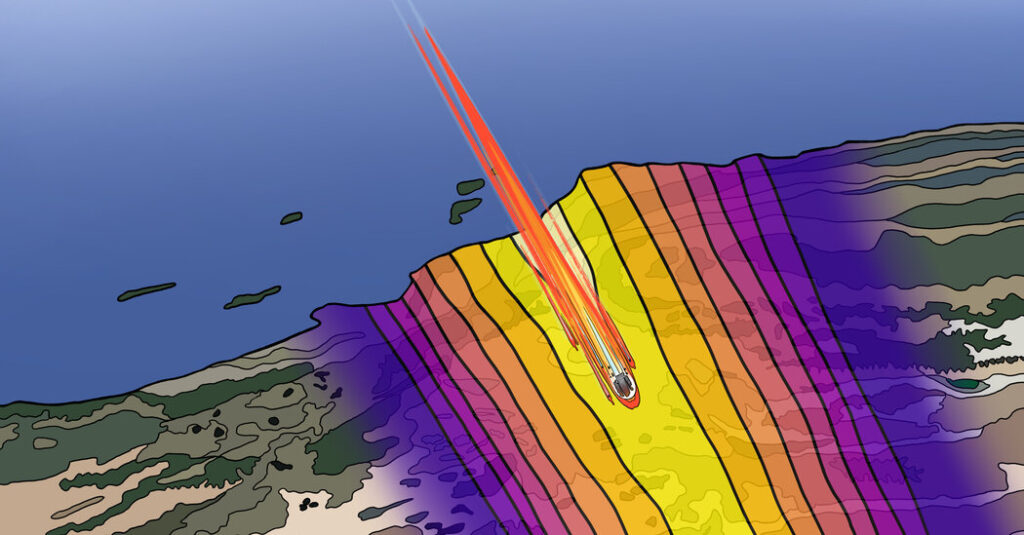
Large chunks of space junk that return to Earth at supersonic speeds are like artificial meteors, emitting sonic booms that shake the atmosphere before slamming into the ground.
That phenomenon gave Benjamin Fernando, a planetary seismologist at Johns Hopkins University, an idea after he saw footage of an unexpected and ominous fireworks display over Southern California on the night of April 2, 2024. Part of a spacecraft plunged uncontrollably through the atmosphere at hypersonic speeds before splitting into incandescent streams.
This pandemonium was made by a mission that ferried three astronauts to China’s Tiangong space station back in 2022. During the spaceflight, the Shenzhou-15 spacecraft released its 3,300-pound orbital module. It was not designed to re-enter the atmosphere, but a decaying orbit inadvertently brought the module back to Earth.
Tragedy was averted through sheer luck alone. Re-entering space debris is often “moving so fast that there’s not a huge amount you can do about it,” Dr. Fernando said. The haphazard atmospheric re-entry of the module would have caused fatalities had it struck a plane in the air or people on the ground.
Warning people to evade falling space debris is a tall order. But Dr. Fernando’s team showed it was possible to precisely map out the trajectory of an object as it re-enters the atmosphere, and to narrow down where surviving pieces may have fallen, thanks to seismometers, which are chiefly designed to detect earthquakes.
In a study published this Thursday in the journal Science, the researchers showed that sensors throughout California registered the sonic booms of the Shenzhou-15 module’s disintegration. This data let the researchers ascertain how and when the spacecraft component broke apart, and in what direction the fragments were traveling.
Space debris can be toxic, flammable or radioactive, so finding it quickly before people come across it could save lives. “This study is incredibly useful,” said Samantha Lawler, an astronomer at the University of Regina in Saskatchewan who was not involved with the new work. “If somebody can go out and find pieces” from the Shenzhou-15 incident or a future re-entry event, she added, “that would be the real test.”
And re-entry events are becoming more commonplace, as rocket launches and satellite deployments become more frequent. “In the first few months of last year, we were up to four or five spacecraft re-entering the atmosphere every day,” Dr. Fernando said — with the majority being SpaceX’s Starlink satellites. A piece of one recently crashed into a Canadian farm.
Finding out where space detritus ends up is troublesome. The U.S. Space Command tries to forecast re-entry paths, but an object’s turbulent journey through the atmosphere can throw these calculations off — meaning that finding the hazardous matter can take weeks, if it ever is located.
Dr. Fernando thinks seismometers could solve this conundrum. Although primed to pick up the seismic waves of tectonic events, the tools can detect the rumblings of hurricanes, avalanches and megatsunamis. They also register the midair destruction of meteors, whose sonic waves strike the ground and create seismicity. The acoustic effects of re-entering spacecraft parts aren’t too dissimilar.
The Shenzhou-15 module’s own sonic booms were detected by 124 instruments in the Southern California Seismic Network and by one station in Nevada. And by untangling the seismic spaghetti on each, the new study’s authors reconstructed the module’s terminal voyage.
The module entered the atmosphere moving up to 30 times the speed of sound, generating a powerful sonic boom — one that indicated that the module did not fragment immediately or catastrophically. Soon after, multiple sonic booms were detected, signifying a rapid series of fragmentation events.
“This kind of cascading failure we have is in some ways the worst-case scenario,” Dr. Fernando said. That’s because a somewhat staggered fragmentation pattern raises the odds of hardier spacecraft segments, like fuel tanks, making it to the ground intact.
To date, no such fragments have been found. But if anyone were to look, the team’s analysis suggests that a patch on the California-Nevada border region near Las Vegas would be a good bet.
The authors hope to deploy their method the next time a sizable piece of junk falls from the firmament. But even if this technique can help recover any dangerous pieces on the ground, it’s not yet clear what can be done to warn people ahead of impact.
“Thankfully, no one’s died yet,” Dr. Fernando said. “But it’s only a matter of time.”
The post Sonic Booms and Seismic Waves Can Reveal Where Space Junk Crash-Lands appeared first on New York Times.