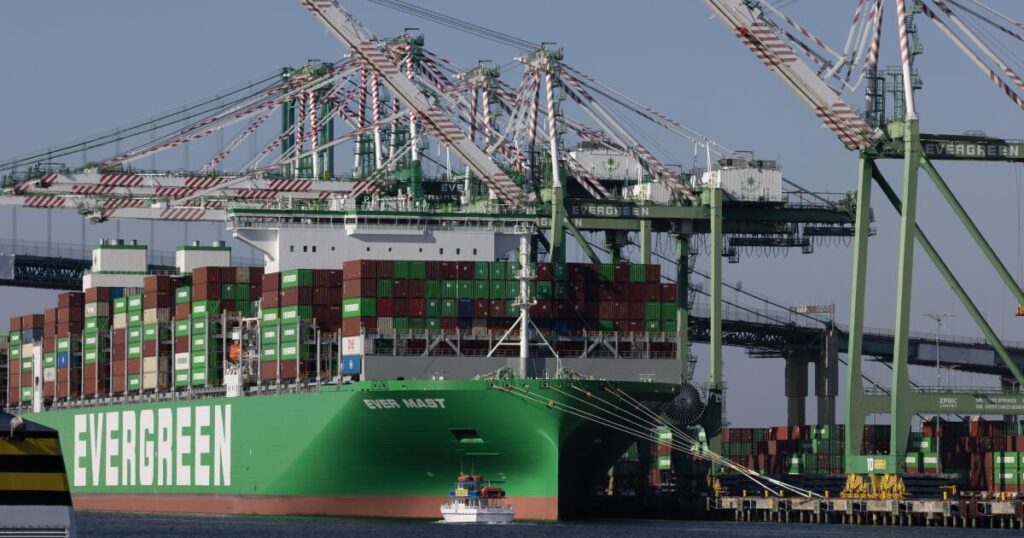
As economic uncertainty and steep tariffs shook global trade in 2025, the Port of Los Angeles remained the busiest marine gateway in the country and recorded its third busiest year ever.
Executive director Gene Seroka outlined investments in infrastructure, technology and climate initiatives at the 11th annual State of the Port on Thursday. Near the waterfront in San Pedro, Seroka addressed a 930-person crowd that included Los Angeles Mayor Karen Bass and Long Beach Mayor Rex Richardson.
The port is getting ready to meet ambitious climate goals and accommodate increasing cargo volume in the decades ahead, Seroka said. In 2028, the port will host six boating and sailing events during the Summer Olympic Games.
“From accelerated dips in volume to record highs, [2025] truly was a roller coaster,” Seroka said Thursday. “Cargo remains the lifeblood of the U.S. economy. American farmers, manufacturers, retailers and consumers all depend on how well we move that cargo.”
The Port of Los Angeles moved 10.2 million cargo containers last year, representing a less than 1% decrease from 2024. The port’s busiest year on record was 2021, when it processed 10.6 million containers in the midst of the pandemic.
2025 was characterized by volatility, Seroka said, as manufacturers and merchants scrambled to keep up with President Trump’s changing tariffs on key trade partners. As shippers frontloaded their goods to get ahead of import taxes, cargo volumes swung high and low.
In April, the port moved 842,806 containers, 9% more compared with the same time period in 2024. In May, cargo volume fell to 5% lower than the year prior. July was the busiest month in the port’s 118-year history with more than 1 million containers moved.
“Despite uncertainty and global instability regarding changing tariffs policies, the port stood strong, rising to the occasion and meeting this moment,” said Bass on Thursday.
The Port of Los Angeles has been the busiest in the U.S. for 26 consecutive years and generated $333 billion in trade in 2024. Combined, the ports of Los Angeles and Long Beach account for one out of every nine jobs in Los Angeles, Orange, Riverside, San Bernardino and Ventura counties.
As Seroka shared his vision for the future in the cavernous AltaSea facility, he emphasized the need to build bigger and smarter. Groups of stakeholders including terminal operators, cruise lines and union representatives sat at large round tables with green table cloths and floral centerpieces.
Applause followed the announcement that the latest air emissions report showed the Port of Los Angeles had achieved the lowest emissions on a per-container basis of any port in the world.
“We are moving more cargo than ever before with the lowest pollution footprint on record for every container shipped,” Seroka said.
Seroka also announced that the port saw a record 1.6 million passengers on 241 cruise calls last year. Pacific Cruise Terminals will build a new world-class cruise ship center in the port’s outer harbor, he said.
To maximize capacity for newer and bigger container ships, Seroka wanted to raise the 185-feet-high Vincent Thomas Bridge, which connects San Pedro to Terminal Island and Long Beach. Last November, the California State Transportation Agency rejected plans to raise the bridge during a planned re-decking project.
In October, the port released a Request for Proposals to evaluate the feasibility of a new Pier 500 marine container terminal that would increase the port’s capacity while staying on track with climate goals, Seroka said.
Several other infrastructure projects are on the horizon, such as the Maritime Support Facility being developed on 80 acres of land on Terminal Island as well as the Avalon Pedestrian Bridge, which will offer access to the new Wilmington Waterfront Promenade.
“This port must be ready for whatever is coming,” Seroka said. “Shifting trade policies are creating uncertainty and volatility, and the maritime supply chain is at the center of it all.”
Laurence Darmiento contributed to this report.
The post Port of Los Angeles plans for growth after ‘roller coaster’ year appeared first on Los Angeles Times.