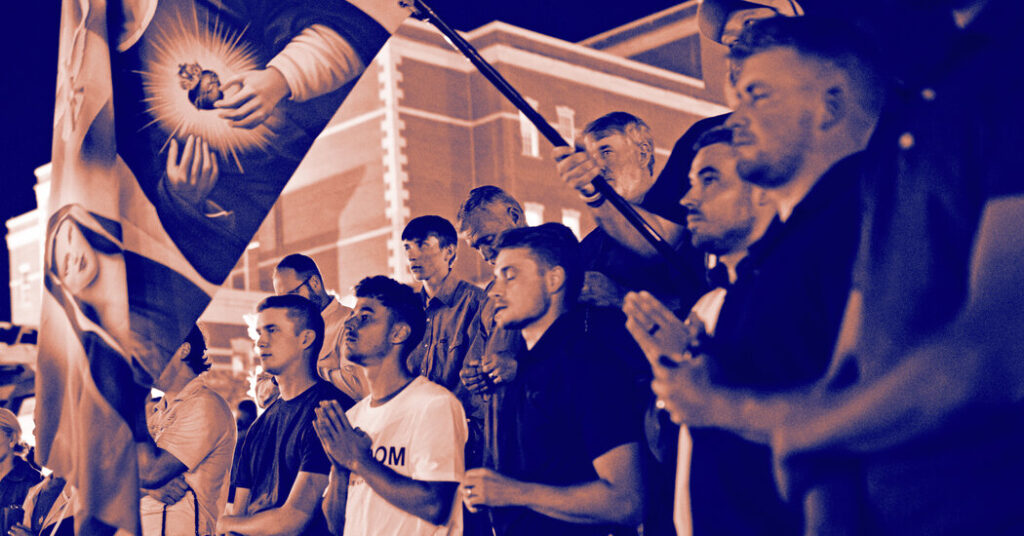
In the early 2020s, something unexpected happened: America stopped becoming less religious.
The share of Americans with no religious affiliation had been rising for decades. Suddenly, that increase stopped. And all over the media, there was talk about religious revival. About trad wives and orthobros. About Gen Z potentially being more religious than their parents.
My guest today is the perfect person to talk about what’s really happening in American religion. Ryan Burge is an ordained minister who witnessed American Christianity’s decline close up. In 2024, he had to close the doors of the church that he’d been pastoring. He’s also, in my own opinion, the best data analyst tracking trends in American religion right now, with a new book, “The Vanishing Church: How The Hollowing Out of Moderate Congregations Is Hurting Democracy, Faith, and Us.”
Below is an edited transcript of an episode of “Interesting Times.” We recommend listening to it in its original form for the full effect. You can do so using the player above or on the NYTimes app, Apple, Spotify, Amazon Music, YouTube, iHeartRadio or wherever you get your podcasts.
Ross Douthat: Ryan Burge, welcome to “Interesting Times.”
Ryan Burge: My absolute pleasure to be here.
Douthat: So I want to start just by talking about the big recent religious trends in American life, and especially the claim that secularization might be going into reverse, or even that revival is in the air.
Before we talk revival, I want to start by defining a very important term for understanding what’s been happening in the U.S. for the last 20 years. That term is “none.” And I do not mean Catholic nuns, but something else. What is a “none”?
Burge: So, “nones” are people who identify with no religious tradition. What that means is we ask a question about affiliation, and they describe their religion as “atheist,” “agnostic,” or “nothing in particular.”
That third piece is the one that we forget about a lot. These are people who look at all the options — Protestant, Catholic, Muslim, Mormon — and they just shrug their shoulders and say: “I’m not a Christian, but I’m not an atheist either.” And they just click “none of the above.” So the “nones” are those three groups together: atheist, agnostic, nothing in particular.
That group has grown from 5 percent of America in 1972 to about 30 percent of America today. It’s the biggest social movement happening in America — or happened in America over the last 30 years — that we just don’t talk about that much.
Douthat: I don’t know if I agree that we don’t talk about it that much. I feel like commentary on religion, as long as I’ve been a pundit, has been dominated by the sense that America is getting less religious. That people are disaffiliating.
But then something changed around 2020 to 2021.
Burge: Yeah. I think we’re moving into a new era of what’s happening with American religion. It was rapid secularization from 1991 to 2020. Now we’re in a period of stasis. The share of Americans who are nonreligious has really stuck at that same level, around 30 percent. The share of Americans who are Christians is in the low 60s, maybe 63 or 65 percent, and it’s been that way for the last five years now.
This is a plateau, not a reversal. This is not a revival. The directions are not reversing themselves. They’re just staying where they are right now.
Douthat: Give me some speculation, though, about why we’ve seen the plateau. Why do you think it seems like there is basically just a chronological pattern where for a while, you could just count on each generation being substantially less religious than the previous generation. And with Gen Z and the millennials, they are less religious, but it’s just not as strong a pattern as you’ve seen before.
And I know this is outside the realm of data — I’m going to do this to you repeatedly in the interview — but did something change in 2017 to 2025 that would put a floor under religion that would make it seem a little more resilient?
Burge: The way I think about it is, there’s a bedrock of American religion that I don’t think exists in any other Western country. What’s happened over the last 30 years is that a lot of people were loosely affiliated. They’d say they were Protestant or Catholic, they’d go to Mass once every two or three years, and they would say they’re Catholic or Protestant because that’s culturally acceptable. But as times have changed and the nones have continued to rise, it used to be you didn’t want to say you were an atheist — there’s a lot of stigma against it — and now there’s —
Douthat: God didn’t like it too, right?
Burge: No! Exactly.
Douthat: People were nervous.
Burge: And America didn’t like it. Think about it: In the ’50s, ’60s, and ’70s, we had the Cold War. We were fighting against Communism, which was atheistic, so there was sort of a stigma that we could not get over. And now, over the last 30 years, that stigma went away, and more and more people, I think, were actually being honest when they took surveys in saying they were nonreligious. But once you scoop off all that loose topsoil — those marginally attached people — you get closer and closer to bedrock.
I think what we’ve realized is: There’s a core of religiosity in America. I mean, I just don’t see a future in America where the share of Americans who are nonreligious rises above 50 percent. There’s just nothing in the data that says that. Whereas, if you had asked me 10 or 15 years ago, I would have said: Numbers keep going up. And that’s not happening now.
Douthat: How do the identification numbers interact with actual data on church attendance, which I know is itself really hard to measure? People also will say they go to Mass or church or synagogue more than they really do. But is it something where religious identification has fallen faster than church attendance, or has attendance declined meaningfully in the last 20 years?
Burge: So we think about religion with three components: Behavior, belief, and belonging.
So, behaviors, like church attendance — that’s actually fallen the fastest of all of them.
The way we think about it is behavior is the first one that goes. Then usually it’s followed with belonging, and then belief is behind all those things.
If you look at “never attending” people, they actually are more likely to say, “God exists, without any doubts,” than they are to say, “God doesn’t exist at all.” So there’s still this core of belief in America that you don’t see in the rest of the world.
Douthat: Or you don’t see it in Western Europe.
Burge: Exactly. Western Europe’s our comparison for a lot of things
Douthat: I mean, while we’re making these comparisons, in India and Sub-Saharan Africa, you see plenty of religious belief.
Burge: Absolutely.
Douthat: But for a long time, there’s been a sense that there’s a kind of norm in the developed world that is Swedish or French or German, and that America is the outlier. Then, for a while, I think a lot of people said: Oh, it looks like America is secularizing, and we’re going to turn into France or Sweden or Germany, just on a different timeline.
But your view is that no, we have gone a little further in that direction, but we’re not going to go that much further under current conditions.
Burge: This is why American religion doesn’t work anywhere else. We’re incredibly economically prosperous, which means we should be very irreligious. But we’re actually both at the same time. That’s the opposite of what Western Europe’s up to right now.
Douthat: OK. Tell me why that is.
Burge: Oh gosh!
Douthat: Sorry, it’s just going to be all beyond the numbers. Give me a quick theory on the resilience of American religion.
Burge: I think the easiest answer is that we never adopted a state church.
Douthat: For historical context on this point, I think there’s a lot of people, maybe especially secular people, who imagine that the story of religion in America is one where the country starts out super religious — maybe it’s the Puritans and whoever else — and has just gradually become more secular over time.
In fact, America has gotten more religious at various moments across its history. And so you have much more of a cycle of revival, decline, revival, decline, rather than just a long narrative of secularization.
Burge: I think in American religion, it is not a straight line. The idea that we’re going to just slide towards secularization — the pendulum definitely swung towards secularization. The new atheist movement 15, 20 years ago was all the rage, and now those guys are minor players in this conversation.
We can’t measure vibes — this is where we get in trouble as social scientists — but the vibes around religion have shifted from “The new atheists are the coolest thing ever” to “Those guys have tired ideas and we should at least reconsider the role of religion,” whether it be cultural Christianity, which seems to be on the march right now, and maybe not devout attending Christianity, but the value of religion in a functioning society.
Douthat: Right. So in some of these vibes-based debates, you have been the guy with the data critiquing the vibes. People will say: “Oh the country’s turning back to Christianity,” and you’re there to say, “Sorry, it’s a plateau — no big evidence of people going back to church.”
I want to talk about a few subcategories, though, within that larger narrative, where it seems to me like something genuinely novel is happening. Let’s start by talking about men versus women. What is the historical pattern of gendered behavior around religion, and how is that maybe changing?
Burge: In most countries where we can get data, women are more religious than men. Not dramatically so. But this is something we know in social science, that women are more religious than men.
Douthat: Is this true across religions? Is this true in Islamic countries versus Christian countries, or is it mostly a Christian phenomenon?
Burge: It’s mostly a Christian thing, that women are more religious than men. What’s funny is we don’t know why. There’s all these interesting theories, like biological theories. There’s anthropological theories, like women needed someone to help them take care of the kids, and church provided this kind of social safety net for them. We don’t really know why — we just know that women are more religious than men.
What we’re seeing, interestingly enough, among Gen Z is that women are still leaving the church at an incredibly rapid rate. And men are still leaving, but at a slower rate. And what that ends up being is that the religiosity of Gen Z men and women is probably about the same now. It’s not that men are returning to church — this is a really important point. The data does not say —
Douthat: Well, some men are.
Burge: Some men are.
Douthat: But in the aggregate —
Burge: In the aggregate, we’re not seeing Gen Z men become more religious. It’s just that they’re secularizing slower than young women are, and that’s allowing those lines to cross when it comes to religiosity.
Douthat: Can you tell in the data what this means for specific churches? For instance, one of my colleagues just wrote a big story that I think you commented on about Eastern Orthodoxy in America, which is a very small part of American religion, but there are a lot of stories — and I’ve heard them myself — about male converts to Eastern Orthodoxy being a big thing. That would be a small example where you might say: OK, you have men sticking with Christianity or returning to it in particular places, but it’s going to create a dynamic where some churches are much more male, and some churches are much more female.
Burge: I think the Orthodox story’s interesting — don’t get me wrong. But we have to put them in context. There’s less than a million people going to Orthodox Church in America, out of a country of 330 million people. Southern Baptists — there’s about seven million Southern Baptists who go to church every Sunday. So let’s put things in their proper orbit.
My job is to not look at the outliers — it’s to look at the middle of the distribution. And I think the reality is, what’s going to happen in the future is this: My church at the end was 75 percent women. That’s what a lot of these churches are dealing with right now, because they’re older and women tend to live longer than men do. I think that balance might get closer to evening out over time, but I still think the reality is that American religion — mainstream American religion — is still going to be majority female, because boomer women are more religious than boomer men and Gen X and millennials. So this is a small trend that we would need to see continue for decades to actually see a difference you would feel on the ground if you went to an average church.
Douthat: Do you think that balancing out is good for churches? It seems like you can tell a lot of different stories, but one story would be: OK, it’s obviously good for churches to have more men in the pews, but if organized religion generally, Christianity in particular, has a specific problem losing young women, then you get a kind of bro-tastic, would-be patriarchal culture in these churches. and maybe it accelerates a female exodus.
Or alternatively you say: Look, no, actually, if you have a lot of churches that are suddenly 50–50 male–female, these are maybe the only institutions in American life that might have that kind of balance. You get more marriages, more successful communities.
Which of those two stories sounds more realistic to you?
Burge: I mean, 50–50 is a good outcome, but you’ve got to understand that the types of Christianity that are still dominant in American life — evangelicalism and the Catholic Church — are both male dominated across the board.
Douthat: Male dominated in their hierarchies and pastoral leadership, but not in who goes to Mass and church, right?
Burge: Exactly right. The pews, it’s a lot more women. In the pulpits, it’s almost all men. That is not changing demonstrably, I think, over the next 20 or 30 years.
But I will say it’s probably not a bad thing if you’re a young man or a young woman trying to find someone to marry and have kids and build a life with, when there’s 50–50 young men and young women in the pews. In that way, I think it’s actually a very good thing. If you walked into a church and it was 90 percent Gen Z men and 10 percent Gen Z women, that’s a real problem.
Douthat: Well, for the men.
Burge: Well, yeah. And for the future of the church too, though, because then you become unattractive to young women. They walk in and go: Whoa, dude, there’s no place for me here.
Churches need to be receptive to all kinds of people. And so that 50–50 future is actually probably a good thing — if it holds. That’s the most important thing. If these Gen Z men maintain this habit throughout the rest of their life, which, I mean, that’s obviously an open question right now.
Douthat: Yeah. All right, let’s talk about class, after gender. Again, like the story that women are more likely to go to church or be religious than men, there’s a longstanding story that’s very popular among political pundits, that says: OK, America is a nation with a secular elite and a very religious lower middle class or working class.
The reality is more complicated. Talk about class and education in American religion.
Burge: In America, the data’s really clear on this: Educated people are actually more likely to go to church than less educated people are. Educated people are more likely to identify with any religious tradition compared to uneducated people. Actually, the ideal combination of education and income for church attendance is people with a bachelor’s degree making between $60,000 and $100,000 per year, so white-collar, upper-middle-class-ish people.
Those evangelical megachurches you drive by in the suburbs called “The Journey” and “The Bridge” — guess who’s the modal member?
Douthat: “Elevate.”
Burge: “Elevate” — yeah. I tell a funny story. We drove by this factory-looking building on the interstate. My wife goes, “Hey, what is that? That’s new.” And it was called “Ascend.” And I go, “I wonder if that’s a church. Go look it up.”
So she Googles it. It’s a marijuana dispensary.
Douthat: [Chuckles.] That’s the tough question: Nondenominational church or marijuana dispensary?
Burge: You can never figure it out. But guess what? The kind of people who would go to the nondenominational church are suburban, white, upper-middle-class, educated folks. That’s what religion has become in America. It’s the top end of the spectrum, not the bottom end of the spectrum.
I think the problem here is that we get a lot of our theories from Europe, and in Europe it’s the opposite: The educated people are the least likely to go, and the less educated people are the more likely to go. So religion in America does not work at all like religion in Europe does.
Douthat: That doesn’t quite hold, though. When you go into graduate and postgraduate degrees, it still is the case that the kind of would-be intelligentsia is slightly more secular and that religious practice is more common middle- to upper-middle class. I’m going to give you anecdotes in response.
Burge: Love them.
Douthat: One of the aspects of this kind of vibes-based conversation about revival in America is about people with Ph.D.s — the professional class, the intelligentsia, because in that zone, you just have a lot of stories right now. I go to college campuses and people running the local Catholic parish or student group will say: We had X number of converts among the undergrads and grad students this year — and I did not hear those stories 10 or 15 years ago. Do you think that there’s any scenario where the American elite is actually getting more religious in a concrete way?
Burge: I do think that there’s a future in which religiosity does increase, but I’m not sure that we can pin it on just their belief in the Bible or God as what’s driving.
Religion is obviously a theological pursuit, absolutely. It’s also a social pursuit, though. People realize that going to church does all kinds of good things for them outside of just saving their soul from eternal damnation. It allows them to make friends. It allows them to find a partner. It also allows them to say, “I need a veterinarian.” “I need a dentist.” “Oh, hey, Dr. So-and-so sits in the pew behind you, just go talk to him.” It creates this social connection. And they don’t realize this. They don’t vocalize this, and it never clicks in their head of why they’re doing these things.
What we see over and over again is that dropping out begets dropping out. Dropping out of religion — the “nothing in particular” group we’re talking about — they’re the very lowest level of educational attainment. Only 25 percent of them have four-year college degrees. So they’re dropping out of education, they’re dropping out of religion, and they’re dropping out of politics. They’re basically isolating themselves from American society.
I think education, social trust, and institutional trust are all locked together in this matrix of things that make you either more willing to engage in polite society, or less willing to engage in polite society. Educated people have a level of trust that less educated people do not.
Douthat: This connects to what you were saying — for a lot of people, it seems like disaffiliating from religion is just a way of being disconnected from institutions. And then, as religion either remains resilient or becomes more potent in the upper middle class, it becomes in a way — pardon my language — a sign of having your [expletive] together. Right?
Burge: Absolutely. That’s what I always tell people. If you want to know who goes to church, it’s educated people who have middle-class incomes and are married with children. That is the golden path we talk about: What leads you to success in life, leads you to church.
Douthat: This is a very economic, secular-ish frame for understanding religion. My last question about possible sources of revivalism, let’s make it a little weirder. Let’s talk about non-Christian and post-Christian spiritualities, because it definitely seems like whatever is going on with the vibes, some of it has people newly interested in astrology, the paranormal, witchcraft, U.F.O.s.
I tell this story a lot: I go into my local Barnes & Noble, and it used to be that there was one shelf that you would call “Paganism” or “Witchcraft” or something. And now it’s four or five shelves of tarot cards and magic and all of these things. I live in New England, haunted by witchcraft for hundreds of years, but still, something there has shifted.
What do you make of non-Christian or post-Christian religion or spirituality as a source of cultural significance for religious belief?
Burge: This is something that I get asked about a lot. People are replacing religion with these new spiritual practices. We did a survey of 12,000 nonreligious people, and we asked them, “How important is spirituality to you?” from “not at all important” to “very important.” We gave them a list of practices, like tarot, yoga, astrology, meditation — all these things.
Twenty-five percent of the nonreligious people said spirituality is very important. It was about 60 percent of religious people. So the more religious you are, the more spiritual you are. And this idea that there’s this huge number of Americans who are spiritual but not religious — we call them , — is really not there in the data.
So this idea they’re replacing it is actually false. They’re not replacing religion with spirituality — they’re replacing religion with nothing is what it looks like.
Douthat: So does that mean that those shelves in my Barnes & Noble reflect mostly syncretism? That it’s just more people who are defining themselves officially as Protestant or Catholic, maybe going to church, but they’re also suddenly interested in tarot cards and astrology?
Burge: Two things I would say to that. One, yes. I think there’s a lot of people who are like buffet Catholics, who are like: All right, I’ll take this piece from here, and then go to mysticism for this — I think that’s part of it.
The other part of it is that the people who are really committed are really committed and buy a lot of literature about it. You don’t have to have too many people in that core to make that market actually work. I think that’s actually probably what’s happening here, that a small group of very committed people are. And listen, a lot of that leans toward the female side. A lot of the Wiccans are females. And guess who the No. 1 buyer of books is? It’s women.
Douthat: So there is potentially a potent version of American paganism. It’s just numerically pretty small.
Burge: It’s very small, and it’s very loud. So they’re overrepresented on places like social media. In our minds, we make it a lot bigger.
The share of Americans who are not Christian and are not none is probably 7 percent of the country right now. The share of Americans who are Latter-Day Saints in this country is 1 percent. We take these small religious groups, blow them up in our minds, and act like they’re much bigger, because Christianity is the norm — we’re just used to what that is. Even today, about 60 percent of Americans are Christians. For every one Muslim in America, there’s about 60 Christians. We’ve got to be clear about how the size of these groups — not saying that Muslims don’t matter, or Latter-Day Saints don’t matter. It’s just important to know, in the relative context of macro religion in America, they’re a rounding error compared to Christianity.
Douthat: Let’s talk about that big number, because the big story of the last two generations is one of decline. Some big parts of American religion have declined to a point where it’s hard to imagine them coming back in a big way.
And the biggest of them all is the Protestant mainline, which is the set of denominations — Methodist, Baptist, Lutheran, Presbyterian, Episcopalian — basically the dominant religious force in American life for a very long time. And my own theory, and it’s obviously not mine alone, is that the decline of the mainline is itself an underrated part of our present polarization and derangement, that we used to have this set of centering religious institutions that don’t exist to the same degree and on the same scale anymore.
This is something that you’ve experienced directly. You were a mainline Protestant pastor at the First Baptist Church of Mount Vernon, Ill.
Burge: Yep. Correct.
Douthat: Just talk for a minute about that experience and what happened to that church.
Burge: Yeah. So I took over that church when I was 24 years old.
Douthat: So you had gone to seminary?
Burge: No! God bless the Baptists. We need no training.
Douthat: No training. Good.
Burge: I started as a youth pastor for three years as a part-time job, and then I became a pastor, because, listen, in rural America, there’s a supply and demand problem when it comes to pastors. And I was willing to raise my hand and say, “I’ll go do it.”
So I joined First Baptist in 2006. They had about 50 people on an average Sunday. And this was a congregation, a 14,000-square-foot building on seven and a half acres of ground. When they built the building in the 1960s, there were 300 people on an average Sunday. It was one of the pillars of the community. All the teachers and the lawyers and the doctors were part of this church. And it was a shell of itself when I got there — 50 people.
Douthat: This is Northern Baptists, right?
Burge: American Baptist.
Douthat: American Baptist. But it’s not the Southern Baptist Convention.
Burge: That’s right. We are the mainline flavor of Baptist faith. And so some churches were L.G.B.T.Q. affirming, some churches had female pastors, but it was up to the local church to decide that. So every church was a little bit different on their theology.
In Southern Baptist, you can’t have female pastors, you can’t do gay weddings. So my church slid into obscurity over time. When you walk in and you see a whole bunch of gray hair and no kids, that’s bad.
.op-aside { display: none; border-top: 1px solid var(–color-stroke-tertiary,#C7C7C7); border-bottom: 1px solid var(–color-stroke-tertiary,#C7C7C7); font-family: nyt-franklin, helvetica, sans-serif; flex-direction: row; justify-content: space-between; padding-top: 1.25rem; padding-bottom: 1.25rem; position: relative; max-width: 600px; margin: 2rem 20px; }
.op-aside p { margin: 0; font-family: nyt-franklin, helvetica, sans-serif; font-size: 1rem; line-height: 1.3rem; margin-top: 0.4rem; margin-right: 2rem; font-weight: 600; flex-grow: 1; }
.SHA_opinionPrompt_0325_1_Prompt .op-aside { display: flex; }
@media (min-width: 640px) { .op-aside { margin: 2rem auto; } }
.op-buttonWrap { visibility: hidden; display: flex; right: 42px; position: absolute; background: var(–color-background-inverseSecondary, hsla(0,0%,21.18%,1)); border-radius: 3px; height: 25px; padding: 0 10px; align-items: center; justify-content: center; top: calc((100% – 25px) / 2); }
.op-copiedText { font-size: 0.75rem; line-height: 0.75rem; color: var(–color-content-inversePrimary, #fff); white-space: pre; margin-top: 1px; }
.op-button { display: flex; border: 1px solid var(–color-stroke-tertiary, #C7C7C7); height: 2rem; width: 2rem; background: transparent; border-radius: 50%; cursor: pointer; margin: auto; padding-inline: 6px; flex-direction: column; justify-content: center; flex-shrink: 0; }
.op-button:hover { background-color: var(–color-background-tertiary, #EBEBEB); }
.op-button path { fill: var(–color-content-primary,#121212); }
Know someone who would want to read this? Share the column.
I was there for 17 years. In the last year, we would have 10 or 12 on a good Sunday. We actually had to give our building away to a private Christian school because we couldn’t afford to pay the insurance and the upkeep and the maintenance and all those things. Eventually we decided this was not a good use of our time and resources.
So right after Easter, we voted to close. And we were going to close as close to our anniversary as possible. The church was founded in 1868, and it closed in 2024. At the end, we had about 28 people on the membership roll and maybe 10 or 12 actual attenders on a regular Sunday.
Douthat: Why?
Burge: Because I’m a bad pastor, Ross.
Douthat: Well, I mean, I didn’t want to say that.
Burge: You didn’t want to say the obvious, right? I’m the worst pastor in the history of the world, as I tell people. I’ve been a part of three churches, and two of them don’t exist anymore. So if you want your church to close down, hire me and give it like five years and it’ll be done.
But listen, because if you look at macro-level religion, guess what? Christianity in America has been in decline — well, it was in decline — for about 30 years. The mainline, which is what my church was, has been in absolute free fall for the last 70 years.
There’s some data from the 1950s that say over half of Americans were in the membership rolls of a mainline church in 1958. Today it’s 8–8.5 percent of Americans who are mainline Protestant. And in a lot of these traditions, the average age is about 60 years old, which is certainly not good for the future of a church.
I was also in a community that’s the same size today as it was in 1950, so we’re not growing. Christianity’s not growing. We had all these things working against us, and there are tens of thousands of churches in those exact same positions right now. They’re just holding on for dear life as they slide toward closure like my church did.
Douthat: So why did this hit the mainline in particular so hard? Why such a decline so fast for this big and pretty diverse group of churches. There are big differences — or were — between Episcopalians, Congregationalists, Presbyterians, and American Baptists, and yet all of them have experienced this kind of decline.
Burge: There’s an article written by JP Demerath in 1995 in a scientific journal where he basically makes the argument that the mainline declined because it succeeded so well. It got the average American to accept their worldview of religious pluralism and individual freedom and free speech.
It used to be that the mainline stood apart from the average American as being different. Then when the average American adopted all these mainline principles, there was no differentiating factor between the mainline and the average American.
That’s why evangelicalism’s done so well, by the way. It’s clearly stood apart from the rest of the culture and said: There’s us, and there’s them. We are not them, and they are not us. Let’s have these distinctive beliefs on gay marriage, on female pastors.
And some people are drawn to that difference. A guy told me once: Listen, I went to a mainline church for a long time, but it felt like a country club with Jesus. I’d rather just go to the country club.
The mainline’s always been squishy on these things. The Southern Baptists — white Southern Baptists — are 80 percent Republicans at this point. I think in some ways, by them not choosing a side in the political fight that we’re in right now, people want to go to a place that’s coded left or right.
The mainline resisted all that. And I think that’s actually part of their demise, because people couldn’t figure out what they are.
Douthat: So often you’ll hear a narrative that says: Churches have declined because they’ve become too politicized. And I’ve made versions of that argument myself. I’ve argued that you could see it applying to both left and right.
It seems to me, though, like you are saying that in certain ways, political tribalization can be a source of strength. So which is it? Is polarization bad for Christianity, or are churches succeeding by leaning into it?
Burge: I think it could be good for the church, but bad for the country.
Let me make this point clear: Most pastors — even evangelical pastors — are not standing up at the pulpit on Sunday and saying, “The Trump administration’s great. We support their immigration policy.” This is a misconception that people who did not grow up in religion have about religion.
I always say: Evangelicals don’t go to that many political meetings — and the first comment is like: “Yeah, they do, every Sunday.” And I’m like: No, no, you haven’t been to an evangelical church. They’re not being overtly political. Now, they might talk about their view on marriage or their view on gender or something like that, but it’s not inherently political.
Where the politics comes from in a lot of these churches is the bottom up. It’s coming from the pews, it’s coming from the Bible study, it’s coming from the parking lots and the hallways. That’s what happened in my church. I never talked about politics from the pulpit. But people before and after church, I’d hear them talk all the time about politics. And it was Republican politics, to be quite honest with you, because I’m in a Republican area. That’s what’s happening in a lot of these churches.
What’s happened in America, especially white Christianity is coded as Republican — and that’s not always been the case, by the way. I think this is a point that people forget: Even in the 1980s, among the white evangelical church, the share who are Republicans and the share of Democrats was the same.
Douthat: Yeah.
Burge: Same in the mainline church.
So what we’re seeing here is really a unique moment. The No. 1 predictor of whether you’re going to be religious or not in America — besides, obviously, the religion questions — is: What is your political ideology? If you’re a liberal, 50–50 chance you’re a nonreligious person. If you’re a conservative, it’s about a 12 percent chance that you’re a nonreligious person.
I think people are being attracted to church because they see it in America, especially white people, as being a conservative institution. And we’re even seeing the rise of people who say they’re evangelical who don’t go to church, because they like what the word “evangelical” means.
And so, what religion has become is another tribal marker of who you vote for on Election Day, as opposed to what it used to be.
Douthat: Why does politicization and polarization seem to help conservative churches more than liberal churches?
Burge: I think young people think, “I’m a liberal, so I’m going to be irreligious.” They don’t even accept the possibility that you can be a liberal Christian anymore.
I think this is the problem with the mainline. They thought the solution to the right-wing movement of the evangelical movement is to become super left wing. I think a lot of Americans are actually searching for a church that’s relatively apolitical in the pulpit and the pews.
So here’s what I tell people: If you are fine with your church having a rainbow flag out front, but you’re not happy with another pastor having a MAGA hat in the pulpit, there’s a problem here.
Douthat: The Catholic Church, for various reasons, has, I think, worked harder to try to present itself as above politics. You have clearly strong white Catholic support for Republicans, but the church is going to issue criticisms of Trump’s immigration policy, and so on. But is there a strategy apart from leaning into tribalism that you would actually recommend to pastors and leaders?
Burge: I think this is the hard thing: How do you be aggressively apolitical? I think there’s ways to do it. I think actually the Catholic Church is a great example of how they could lean more into the consistent ethic of life. I tell my students about this, by the way. For those listening, it’s the idea that life should be protected at beginning, middle and end. So from natural conception to natural death. The Catholic Church is opposed to abortion, opposed to birth control, but also opposed to the death penalty. It’s also opposed to unjust wars and physician-assisted suicide.
I explain that to my students and they go: Yeah, I don’t really know if I agree with it, but I respect that position. It helps me think about these issues of life and death in a way that I’ve not thought about them before.
Helping people think holistically about these things, but not being super directed — like, “Well, this is where the Trump administration violates the consistent ethic of life” — is a better way to go about it. Let them make the connections, not you make the connection.
Douthat: Yeah, but I mean, that’s a hard balance to strike.
Burge: One hundred percent.
Douthat: It’s just as easy to get a dynamic where your consistent ethic ends up alienating people all over the spectrum. The Catholic bishops take a lot of flak from political conservatives for policies that are seen as liberal or left wing, especially around immigration, but also around the environment. At the same time, they win no friends on the progressive left by being against euthanasia and abortion and whatever exciting bio-technological evils await in the future.
It just seems like, again, in terms of practical pastoral strategy in a polarized environment, you can end up in a sour spot, even when you’re trying to be as holistic as possible in your message.
Burge: Yeah. But I mean, God calls us to be faithful, not successful, right? I mean, I understand, I’m a demographer — I talk about the growth and decline in these religious groups. But at the end of the day, isn’t part of what we’re supposed to do to help people think about the major problems that the world’s facing, that society’s facing, that they’re personally facing?
So if you’re at that little church that’s declining in the Midwest, what’s your option at this point? You’re not going to start a praise band and bring new people in. Might as well preach the Gospel as best you understand it and let the chips fall.
That’s a fatalist position, by the way — I totally understand that. But what’s your alternative?
Douthat: No, it’s certainly not a fatalist position if you believe in God. But to that “preaching the Gospel” question, what about issues of belief? One of the narratives around mainline decline has been, yes, it’s somewhat about politics, and yes, it’s somewhat about class, and so on, but the mainline also seemed, relative to more conservative and evangelical churches, at least in its leadership, to just not be as sure about core doctrines of Christianity. The resurrection, the miracles, the literal stuff. And even if you look at the evangelical churches and say: Oh, they’re too partisan, or they’re too ideological — you go to those churches and they are talking about Christ crucified and raised from the dead and the forgiveness of sins and these kinds of things. Do you think that that is also a part of the story of which churches grow and which decline?
Burge: The data says that mainline clergy are definitely much more squishy on these theological issues than evangelical clergy are.
But I think this is one of those haunting questions that I have. A lot of people are doubters; they can never certainly believe any doctrine of their church. Like, the pastor stands up and says something very stridently and confidently, and the people in the pews go: “Yeah, I hope so.” Or “I guess so.” Or “Maybe that’s true.” I just think it’s more prevalent in the mainline than it is in the evangelical church.
And let’s be honest, Ross, in the Catholic Church, it’s widespread. The people in the pews are not there because they agree with the church’s teaching on a whole bunch of stuff. A majority of Catholics are in favor of abortion. Almost all Catholics have used birth control. A majority of Catholics are in favor of female priests, and yet they show up because it’s more than the belief thing — it’s something else going on there.
Douthat: Yeah. This isn’t my personal belief structure, but I feel like someone could stay in the pews for a long time disagreeing with the Catholic Church about whether abortion should be fully banned if they still believed that the Mass was what it claimed to be and that Jesus rose from the dead.
Do you think that’s right, or do you think it’s all just a continuum of political beliefs, supernatural beliefs, and so on?
Burge: I do think that the people who show up generally do have a supernatural belief in God. They do believe in the core. But I think we can all admit that throughout our lives, our core beliefs have been malleable and we believe more and we believe less.
What keeps us in the pew, then, if our belief begins to wane in the literal resurrection of Jesus Christ? What keeps us going? I think it’s that social aspect of: We expect you to be there. We would like you to be there. You’re a valuable member of our community. If you’re there —
Douthat: You’re raising kids, and you’ve got to take them to church.
Burge: Yeah. You need both-and, right? I don’t think there’s a huge number of people who go to church every Sunday who literally believe in none of it. I think a lot of people show up and go, “I hope I believe.” Or, “Some days I believe.”
Douthat: “Lord, help my unbelief.”
Burge: Exactly right. “On my best day, I do believe these things.”
Douthat: I guess I’m just interested in finding what is the unexpected lever that changes religion in some way in America? If you had a bunch of liberal Protestant pastors who were still political liberals but who suddenly were less squishy on the core religious questions, I’m just interested in what does that change? And maybe the answer is not that much, that it’s always just a numbers game.
Burge: I just think there’s a certain number of people who are drawn to certainty, and there are certain people who are repelled from certainty. And what does church look like for that second group, those doubtful people versus those certain people?
The mainline’s always been the refuge of the doubters, who try their best to believe these things but just can’t get over the hump sometimes. And if that goes away, if you’re Protestant, your only option is the evangelical pastor who pounds the pulpit and says: “If you don’t believe what we believe, you’re going to hell.” And the person sitting there goes: “Yeah, but how do you know that?”
That’s what we’re missing: This huge chunk of people who were open to the idea of belief are not going to have an outlet to go to a place where they really do feel like people like them are welcome and the conversation’s worthwhile, because it’s going to be: “Unless you believe what we believe, you are less than us.” And why would you want to go to a place where you feel like you’re less than, voluntarily? I certainly wouldn’t.
Douthat: Just to go big picture for America, for the nonreligious person who’s like, “Why do I care about the Protestant mainline?,” what is the takeaway of mainline decline?
Burge: There’s something called social contact theory — Gordon Allport talked about it. It’s just the idea that being around people who are different than you makes you more tolerant of those differences. And when we’re so cloistered, where it’s just all these people who believe all these core beliefs about Jesus and gay people and women pastors, you don’t know the other side. You never hear the other side of the argument actually articulated in a thoughtful, loving, careful way. You just see the memes on Facebook about the other side.
Atheists are in the same boat. They don’t understand evangelicals at all. And they basically create the worst version of them in their minds, where they all hate gay people and they all hate women and they hate immigrants. And it’s like: No, the average evangelical is not really there either.
I think what we do is we create caricatures in our mind because we never interface with someone from the other side of the aisle. It’s hard to hate people when you know them, when you see them every day. And unfortunately, because we’re becoming so cloistered, the mainline used to be the great meeting place — left, right, and center all hung out together. Now, all we’ve got is a really conservative religion and no religion at all, and there’s really no meeting place between the two.
Douthat: All right, let’s use that as a segue into larger questions about the future. Let’s talk about the religious America of 2050. What parts of American Christianity are growing right now?
Burge: Yeah, so the rise of the nones is the No. 1 story.
Douthat: Right, that’s No. 1. But among people who are religiously affiliated, it’s nondenominational Christianity.
Burge: Yeah. To me, the second-biggest story is the rise of the nondenominationals. In the General Social Survey (G.S.S.), about 3 percent of Americans said they were nondenominational in 1972, and today it’s 15 percent who are nondenominational.
Denominationalism is in decline, really across the board. The only large Protestant denomination that’s growing consistently is the Assemblies of God, which is a Pentecostal evangelical denomination. They’re doing really well, actually. But every other denomination, whether it be Episcopalians, Presbyterians, Baptist, Lutherans — they’re all significantly smaller today than they were 20 or 30 years ago.
The future of American Protestant Christianity is going to look like very little denominationalism, and a whole bunch of nondenominationalism, which from an analytical standpoint is incredibly hard to wrap your head around.
Douthat: Right. But I’m going to ask you to generalize. We were joking earlier about the clichéd names of nondenominational churches. For people who aren’t familiar with that world, what is nondenominational Protestantism right now?
Burge: They’re evangelical. Not all of them, but the vast, vast majority are evangelical in their orientation and theology and practice and all the things that we would call evangelical.
One thing is, they’re anti-institutional. They’re anti-authority in a lot of ways. Where does your money go when you put it on the plate? Well, it goes right here. It stays right here in these four walls. So what we’re going to have is a very fragmented Protestant Christianity, where you’ve got a little fiefdom here of 15,000 people in this church, and 20,000 people in this church.
I think the problem is, it’s going to be harder to conceptualize, to measure, to really understand what these groups look like, because now you’ve got these little pockets. You’ve got Joel Osteen in Houston, Texas. He’s an evangelical, but he doesn’t interface with most other evangelicals. You got Paula White down in Florida, whom Trump loves, but she’s Pentecostal and believes in the gifts of the spirit. And other evangelicals, like Franklin Graham, would never talk to Paula White.
You’ve got all these little pockets, and they don’t add up to a cohesive “What is evangelicalism?” In 30 years, that question is going to be almost impossible to answer. Not that it’s easy now, but it’s going to be 10 times harder because of this amorphous nature of nondenominationalism.
Douthat: Does that depoliticize things? We were talking about evangelical identity as a kind of tribal political identity, but if you’re totally fragmented and everyone is loyal to a particular pastor in a particular setting, do you think that nondenominational Christianity is less Republican than the evangelicalism of today or 10 years ago?
Burge: I think evangelicalism has been so branded, though, as Republican, it’s going to be hard to shake that larger mentality.
But the cracks are forming. For instance, a lot of those churches are male led and their official doctrine is that only men can be pastors. But on Mother’s Day, they’ll have the pastor’s wife get on stage with the pastor and talk about what it’s like to be a mother. So they’re trying to half-step away from conservative evangelical orthodoxy.
They won’t make plain their views on same-sex marriage, but if you ask them in private, they’ll tell you: “Oh, we don’t do gay weddings.” So they’re not going to be as strident because they want to grow. And so a lot of them, with the sermons they give, are like: Here are three ways to be a better father, two ways to be a better Christian or church member or whatever. It’s sort of Christianity-lite.
But listen, at the end of the day, the proof’s in the pudding. They’re the only ones that have shown growth in this era of secularization, so what they’re doing has to work at some level.
Douthat: Does this just make American Christianity more supernaturalist in some way? You mentioned that a lot of these churches are Pentecostalist. Pentecostalism, for those who don’t know — you mentioned the gifts of the spirit — it’s very focused on speaking in tongues, prophecy, healing. Very different from the mood of old-school mainline Christianity.
Burge: Yes.
Douthat: So that’s already changed. Does it change more? Would you expect religion as practiced in 2050 generally to be more supernaturalist?
Burge: The common thread that runs through religious growth, not just in America, but across the world, is Pentecostalism, what we call charismatic worship, which is what a lot of people see when they think of nondenominationals — the drums, the guitars, the raised hands, the long worship sets. This emotionalism, I think, is actually a predominant factor.
And this is where the mainline loses, by the way, because I don’t know if you’ve been to a mainline church. There’s no emotional —
Douthat: I was raised Episcopalian in Southern Connecticut, so I have some familiarity with mainline customs.
Burge: Yeah. No raising of hands in those churches, huh?
Douthat: No raising of hands. But also, just the idea that Christianity is a supernaturalist religion, which is woven into Catholicism in its own way — saints and healings and so on — was altogether absent.
Burge: Yes.
Douthat: And I think you can tell a story where 1950s American Christianity, in some ways a peak of Christian practice, is also the least supernaturalist style of Christianity.
Burge: It was! The most intellectualized.
Douthat: Very intellectualized. Very suburban American way. Modern 20th-century progress and so on.
And the equivalent, even if it is also suburban today, is much more like: We baptized someone and he was blind and he got his sight back — this is a video I was literally watching this morning because someone linked to it, I think from a megachurch. That’s just a bigger part of Christianity now, and going forward.
Burge: In the 1960s, if you went to a church where people raised their hands and rolled in the aisles or had these big emotional responses, people would look at you like you’re an odd person. And now, millions of people are engaging in that worship. It’s been very normalized in modern America.
The downside of this is it leads to a Christianity that’s really all heart and no head. The problem with the mainline has always been that it’s too much head and too little heart. You’ve got to have both in equal measure.
There’s no tradition, by the way, who I think does a good job of targeting — maybe the Catholic Church, Ross, to play a little —
Douthat: Well, that’s our goal. That’s the Catholic goal. But I think the pattern with Catholicism has been weirdly — or not weirdly — that it’s now getting lots of, not just intellectual converts, but would-be elites, who in the old days would’ve become Episcopalian or Presbyterian. If they want to be religious, they’re more likely to become Catholic, even as Catholicism, which was once the big, mass immigrant, working-class religion, is losing ground in that territory. So there’s an odd religious dynamic of Catholic elites and evangelical nondenominational churches that are underrepresented in elite society.
Burge: But I mean, look at the Trump administration. JD Vance obviously converted to Catholicism, famously. But Marco Rubio has always walked halfway between —
Douthat: He’s been in both worlds.
Burge: Exactly right. But I think that’s a very strategically smart thing to do. Not just nationally, but especially in Florida, because guess what? If you go to a nondenominational church and a Catholic Church, you’ve checked off religion in Florida for almost everyone. So I do think that these elites are strategic in this.
Douthat: You’re so cynical about our political leaders! What about race, ethnicity and immigration? You get a lot of movement from Hispanic Catholicism into Pentecostalism. How much of these changes are demographic changes?
Burge: So, one way that non-denoms have actually done well is by creating diverse congregations, because they’re in diverse areas. If you’re in suburban Houston, for goodness sakes, it’s diverse. But the Catholic Church in America would not be what it would be without immigration, especially from Central and South America.
The question, though, that we have is: How do they assimilate to American culture? For instance, if you come here from the southern border and you land in a county that’s overwhelmingly Catholic, you’ll stay Catholic. But let’s say you move to a place like suburban Dallas, where the elite class are all going to “Elevation” and “The Journey.” Are you going to start moving in that direction because you want to assimilate and be seen as part of polite society and not segregating in your own Hispanic community?
That’s an open question that we don’t really know the answer to, because it’s happening right now all across America, especially the second generation, too. If you weren’t raised in the Catholic Church in Mexico, you don’t have the strongest connection as your parents do. Your parents want you to go to Mass, but man, all your friends are going to that cool church down the road. What do you decide to do? That’s a huge part of it.
The other part of the immigration story that’s really interesting is if you look at Hinduism, Islam, Buddhism — those are immigrant religions. That’s how they got a foothold in America. If they can’t rely on immigrants because of the current situation that we’re in right now, how do they maintain or grow their size in the United States when their fertility is starting to look like American fertility, which is very low? That’s a different story than bringing new people in from overseas.
Douthat: Is there any non-Christian religion that you would expect to be more influential in 2050 than it is today? Or to at least something like the role that Judaism eventually took on in 20th-century America?
Burge: I think Islam is going to have some influence in some pockets of America, but most certainly not in a macro-level, nationwide way. We talk about Michigan, obviously. Dearborn is a majority Muslim community now, the first large one in America. But even there, you’ve got to get to a critical mass, and it doesn’t look like a lot of these religious groups are ever going to get there. I think the reality is that where they’re geographically located really puts a ceiling on their ability to influence the national political conversation.
Douthat: The Amish — I have to ask.
Burge: [Laughs.]
Douthat: Because you’re talking about numbers and fertility, and I have read fun demographic projections that say, guess what? By 2075, 15 percent of Indiana and Pennsylvania will be Amish. Is the 21st century the Amish century?
Burge: [Laughs.] You know what? In some odd way, I actually think they might have.
But here’s the thing: Amish people typically stay out of politics. That’s been their posture for a long, long time.
Douthat: Sure. For now.
Burge: For now.
Douthat: But if you have a situation where a substantial portion of Southern Pennsylvania is actually Amish — I think it’s more likely to happen in Midwestern states — but do you put any stock in those kinds of demographic predictions?
Burge: I think at the local and county level, there’s a real possibility that the Amish could start winning elections and changing policy, and maybe even win a state rep — something like that.
Douthat: But, just forget politics. Would you bet on exponential Amish growth?
//////////////////Burge: I would bet on continued Amish growth, but not exponential Amish growth. Because as a religious tradition gets bigger, it’s harder to maintain its cohesion like it had before. When you’re 100,000 people, everyone stays in the tribe because you know everyone. But once you get to several million — I think this is what the Church of Jesus Christ of Latter-Day Saints is facing right now — it’s almost a victim of its own success. It got so large in America that it’s easier to leave now because you don’t feel that sense of internal cohesion. There’s not been a single religious group in American history that’s got incredibly large, that’s maintained its growth rate all the way through.
So yeah, they will continue to grow probably faster than other forms of religion, but I just don’t see a future where, in 2100, if the average Amish family has six kids, that they all stick in that tradition. I would be shocked by that, because it would buck everything that we know about how religion works in America.
Douthat: All right, I want to end by pushing you towards wilder speculations.
Burge: Oh my gosh.
Douthat: And you can resist. We’re trying to stay with the data here, and you are a partial debunker of overly enthusiastic projections of revival or anything else. But religious change in U.S. history, to say nothing of the world, is often pretty weird.
Burge: It is.
Douthat: And in the early 1800s, Thomas Jefferson had this famous quote where he said that there’s not a young man alive today who won’t die a Unitarian.
Burge: [Chuckles.] Yes.
Douthat: And Unitarianism was the rational faith of the future in 1800.
Burge: It was.
Douthat: And then, instead, we got tent revivals, Great Awakenings, and everything else. Give me some thoughts about the weirder things that you see as a student of American religion and some kind of speculation about the weirdest thing you’re keeping an eye on as a future trend.
Burge: I wouldn’t say it’s the weirdest thing, but I think the rise of the Trad Cath is really interesting. For those of you listening at home, Trad Caths are people who reject Vatican II. The idea that: Mass in English is ridiculous. We should do the Mass in Latin. Women should cover their heads. The priest should face the elements when he blesses the elements. We should go back to the way it was 100 years ago because that’s when the Catholic Church was strong in America.
There’s actually an argument to be made that that might actually be the future of Catholicism in America, because those families don’t practice birth control and they have lots and lots of kids.
Douthat: But for Traditionalist Catholicism in whatever form to really take over U.S. Catholicism, like everything else, you would need conversions. You can’t do it with—
Burge: Fertility.
Douthat: Large seven-kid families alone, at least over a 25-year time horizon.
Burge: Yeah. Mm-hmm.
Douthat: You’re speculating about a lot of people who are right now not in that world, joining that world.
//////////////////Burge: I think you could see a lot of right-wing, regular Catholics would go and shift over because they like the politics of what that church means and how the church is going.
Now listen, I don’t think in 50 years a majority of American Catholics are going to be enjoying the Latin Mass, but I do think it might be a significant minority — and a vocal minority too, which in some ways is actually more important than actual butts in seats.
The other thing I’ll say — and I think this is really, really interesting — is the mainline is starting to take some cues from evangelicalism and really focusing on church planting, which is starting new churches. So the Episcopalians, for instance, if they find an interesting young priest who seems really engaged, they’ll give him a whole bunch of money and say: Go start a church somewhere. Here’s a million dollars, or $500,000, and if you need more money, come back. Because guess what we’ve got a lot of? Money. We don’t have a lot of exciting young priests.
Church planting has basically been exclusively the purview of evangelicalism for the last 30 years, and we’re seeing some of this on a small scale. Episcopalians might be coming back because they’re starting fresh. They’re not moving into an old building with all this tradition. They’re saying: No, no, let’s lean into “The Journey” and “The Ramp” and “The Village,” but in an Episcopal way.
Listen, what’s the alternative for the mainline right now? It’s perpetual decline. So you might as well go out swinging. I think some of them have picked up on that message and actually might be aggressive in church planting in the future. And there might be a future for the mainline.
Douthat: Out of the mainline denominations, who’s going to make it? Would you bet on the Episcopalians, because they’ve hit bottom? This is an interesting thing: Places hitting bottom and actually benefiting from hitting bottom sooner. Who do you bet on?
Burge: I think the Episcopalians, because of their institutional heft and their financial support, to be honest with you, are going to last for a very long time. I think the United Methodists are going to continue to persist because there’s just still a ton of them.
Douthat: There’s a lot of Methodists.
Burge: Yeah, there’s like 4.5 million, even today, after the schism. And I think getting over the schism is like: OK, we’ve gotten over the worst of it now. We can survive with what we have.
I do wonder if there’s going to be some mergers or at least friendly cooperation between the Lutherans and the Presbyterians. We call them the Seven Sisters in the mainline right now. In 50 years, there’s certainly not going to be Seven Sisters.
Douthat: Who else would you bet on? Out of the small groups in America, from Eastern Orthodoxy to non-Christian religions, who do you think is big — surprisingly big — in 2050?
Burge: There’s these little bitty denominations that are actually doing really well. The Anglican Church in North America, which is the more conservative wing of the Episcopal Church — they’re only 125,000 people. They’ve had sustained growth now for the last 15 years. They’re a very new denomination, by the way, which I think actually works in their favor because they’re combining the best versions of evangelicalism with the best versions of the mainline, which I think is really successful.
There’s a group called the P.C.A. — Presbyterian Church in America — which is Tim Keller, who was a very famous preacher and a prominent member of the P.C.A. They’ve grown consistently now for 30 years, and I think they’re going to continue to go up.
I think the Orthodox Church is probably going to do relatively well. But by relatively well, I mean they might add 25 percent membership in the next 30 years.
We’re never going to see a mega denomination like the Southern Baptist Convention or the United Methodist Church ever again.
Douthat: Ever again?
Burge: Ever again.
Douthat: All right. Well, you’ll have to come back to this show in 2050 —
Burge: When I’m on my last legs
Douthat: And talk to my A.I. avatar.
And that can be the last question: New religions. We haven’t really talked about the role of the internet. I think it’s the ground underlying a lot of the trends you’re talking about. But when you look at everything, from online life in general to how people relate to A.I. and so on, do you see something genuinely new emerging in that space, or is it all too soon to tell?
Burge: I see the role of the internet actually being somewhat destructive to American religion in that it shows you all the bad things in a very compelling way: “Why do they not believe this?” Or “Why are they inconsistent on this thing?” Or “Did you know the church’s history on this is bad?”
What’s really interesting is, during Covid, we were like: “We’re going to move church online.” And over 90 percent of churches were streaming online right after Covid. What we realized is that online church does not do any of the positive things that we thought in-person church did. And we thought: “Oh, we’re going to work from home.” And guess what? Now everyone’s back to working in the office three or four days a week.
Nothing that we’ve seen created online seems like it has any legs to it. Even among young people who attend online and in person, two-thirds of them prefer attending in person and 15 percent prefer online. The other 15 percent don’t care either way. So even young people are not drawn to digital anything.
Listen, religion’s endured for all of Western civilization because it works for lots and lots of people. And no matter how much we try to remake it with technology and A.I. and the internet, showing up on an average Sunday with a bunch of people and singing some songs and saying some creeds and hearing a sermon is transformative and will be for all of human history, as far as I can tell.
Douthat: All right, that’s a bold prediction and a good place to end. Ryan Burge, thank you so much for joining me.
Burge: It’s been a pleasure.
Thoughts? Email us at [email protected].
This episode of “Interesting Times” was produced by Andrea Betanzos, Sophia Alvarez Boyd, Victoria Chamberlin and Emily Holzknecht. It was edited by Jordana Hochman. Mixing and engineering by Pat McCusker and Sophia Lanman. Cinematography by Bets Wilkins and Marina King. Video editing by Arpita Aneja and Steph Khoury. The supervising editor is Jan Kobal. The postproduction manager is Mike Puretz. Original music by Isaac Jones, Sonia Herrero, Pat McCusker and Aman Sahota. Fact-checking by Kate Sinclair and Mary Marge Locker. Audience strategy by Shannon Busta, Emma Kehlbeck and Andrea Betanzos. The executive producer is Jordana Hochman. The director of Opinion Video is Jonah M. Kessel. The deputy director of Opinion Shows is Alison Bruzek. The director of Opinion Shows is Annie-Rose Strasser. The head of Opinion is Kathleen Kingsbury.
The Times is committed to publishing a diversity of letters to the editor. We’d like to hear what you think about this or any of our articles. Here are some tips. And here’s our email: [email protected].
Follow the New York Times Opinion section on Facebook, Instagram, TikTok, Bluesky, WhatsApp and Threads.
The post No, Young Men Are Not Returning to Church appeared first on New York Times.