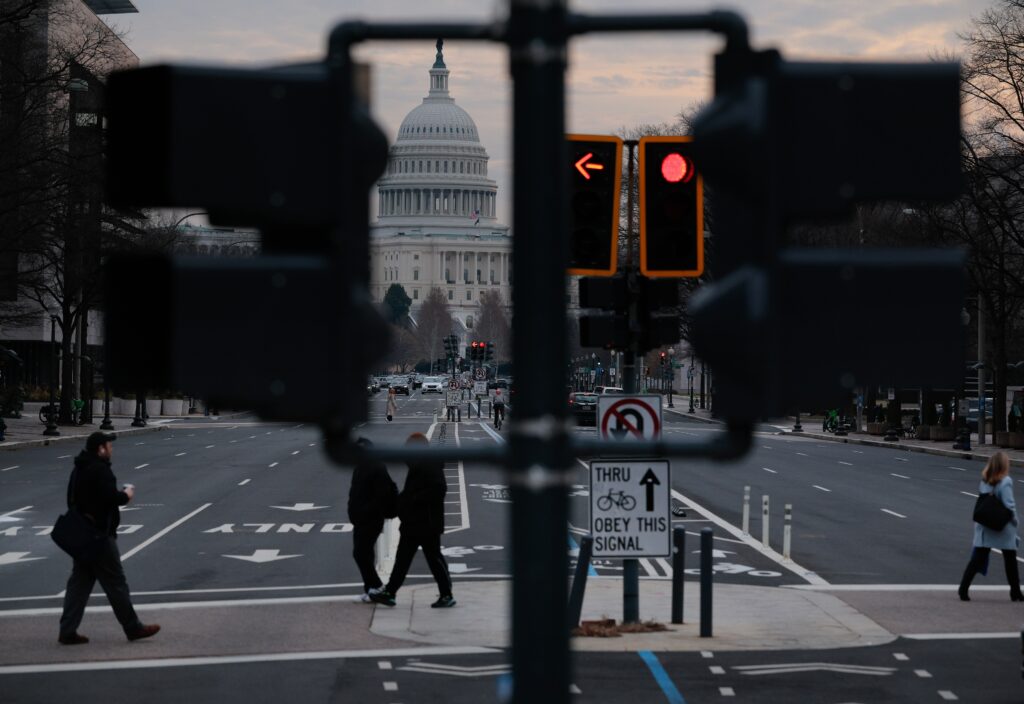
Despite the upheaval of the past six years, one thing has not changed — D.C. traffic is bad. A new survey taken by the Metropolitan Council of Governments (MCOG) between March and June of last year finds that at 41 minutes, the average commute in the area is about as far and long as it was in 2019.
Commuting patterns have changed, however. More people are teleworking at least two days a week and taking transit; on the other hand, the region has grown, and a larger proportion of suburbanites in Maryland and Virginia are driving to work alone.
“More and more people are coming into the office just for a few hours,” Kanti Srikanth, head of planning at the regional group. “All of that shift is going to change when there is demand on our roadways and on our transit system.” The peak rush hour is not 6:30 to 7:30 in the morning; it’s now about an hour later. All of that will have to be considered as plans are made for new transit and road infrastructure.
The group interviewed 7,524 commuters in D.C. and 11 surrounding jurisdictions. Here’s what else we learned.
1. People are back in offices, but not all the time
While working from home part of the time remains far more common than it was before the pandemic, more people are returning to the office. In 2022, the last time this survey was taken, 75 percent of commuters teleworked at least three times a week. In 2025, that percentage was 35 percent.
Remote work “does not appear to be the ultimate solution we expected and hoped for” to deal with traffic congestion, Neil Harris, head of MCOG’s Transportation Planning Board said Wednesday at a discussion of the survey results among local leaders.
The decrease has largely been driven by federal workers. Before the pandemic, they were the group most likely to telework. Now, because of return to office policies under the Trump Administration, they are the only one with fewer teleworkers than in 2019, down from 48 to 23 percent.
Nearly half of workers who can telework are doing “split shifts” at least once a week, where they do some work from home and some from an office.
2. Driving still dominates, but solo drivers are unhappy
The least happy group of commuters is also the largest: people who drive to work alone. Fifty-five percent of commutes in the region are made by someone alone behind the wheel. In 2016, 57 percent of these workers were satisfied with their commutes. Now, it’s only 44 percent. That’s despite the fact that the average car commute length — around 43 minutes — hasn’t changed much since 2019.
The least happy, with the longest commutes, are people who live in the “outer ring” of exurbs. In that group 81 percent drive alone, the average commute is 50 minutes, and only 38 percent say they are happy with their long commutes.
3. Satisfaction among train commuters is up
While the average transit commute is about the same distance as the average driving commute — 17 to 18 miles — transit commutes take longer, with an average of 52 minutes on a train or bus. But commuters who get to work by Metro are happier than they were three years ago, with 62 percent saying they were satisfied or very satisfied with their commute compared to 46 percent in 2022. That echoes a Washington Post-Schar School polltaken in the spring of 2025, which found that 80 percent of riders rate Metro positively.
Overall, Metro commuter satisfaction rose between 2016 and 2019, after the agency started tackling a plethora of safety and reliability issues. That upward trend was halted by the pandemic, when few people were riding and manufacturing defects forced the agency to sideline much of its fleet. Since then Metro has won riders over again with increased frequency and fewer disruptions. Commuter rail riders are also relatively content, with 58 percent saying they are satisfied with their commute.
3. Satisfaction among bus commuters is down
Metrobus ridership has rebounded the fastest from the pandemic, climbing to over 10 million rides a month, according to agency statistics. But only half of commuters are satisfied with the bus, according to the survey. While satisfaction rose from 44 percent in 2022, it is lower than it was in 2019 (66 percent) and 2016 (62 percent). That’s a challenge as local leaders look to the bus network as the way to expand public transit access in the area, saying adding new rail lines is too expensive and difficult. One serious problem is reliability. Buses get stuck in traffic and absenteeism messes with schedules.
Train stations are also much more of a draw than bus stops. Forty-three percent of people polled who either moved or took a new job in 2025 said they considered proximity to a Metro rail station when they did. Only 22 percent considered bus stops.
However, the survey was done just before Metro redid the entire bus network, implementing changes that benefited some commuters while leaving others frustrated.
4. Toll lanes have changed some behavior
Since the 2019 survey, Virginia has added toll lanes to I-66 — on express lanes outside the Beltway and for all single-car drivers during rush hour inside the Beltway. Even though carpoolers and buses are exempt from tolls, only 17 percent of commuters using those roads take advantage of those options. But 15 percent of high-occupancy vehicle and express lane users said they did change their schedules to avoid paying high tolls. And nine percent said they shifted to taking a shared car, van, or bus to use the toll lanes at least some of the time.
Kimberly McCool, an official at the Virginia Department of Transportation told reporters the state is “proud of our 97 mile network of HOV and express lanes,” which have generated over $150 million in funding for transit and other alternatives to driving. Virginia has put toll roads on its half of the Beltway, and Gov. Wes Moore (D) recently said he was considering a public-private partnership on the Maryland side to rebuild the American Legion Bridge.
5. Bike and bus lanes have not slowed D.C. down
Inside the “core” of D.C., Arlington and Alexandria, commutes are the shortest — about 33 minutes one way. That number hasn’t changed despite the fact that D.C. has 50 more miles of bike lanes and 11 miles more of bus lanes than it did in 2019.
District Department of Transportation Director Sharon Kershbaum said that was an achievement.
“I know there is a misperception that when you use travel lanes for bike lanes or for bus lanes, it’s going to create congestion and slow things down,” she said. “But this data is showing in fact … commuter times haven’t changed.”
The happiest commuters are the ones who bike, walk, or take a scooter to work; they are also far more likely to live close to work with an average commute of 4 miles and 22 minutes. They are also one of the smallest groups, as fewer than 2 percent of commutes are made on foot or by bicycle.
The post Five ways D.C.-area commutes have changed since the pandemic appeared first on Washington Post.