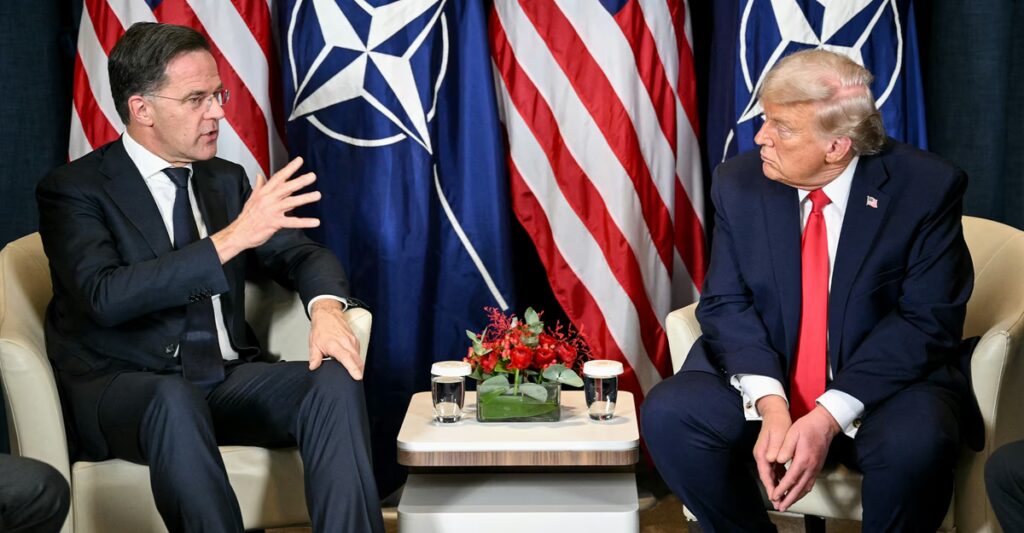
Yesterday afternoon, Donald Trump announced that he had “formed the framework of a future deal” with NATO Secretary General Mark Rutte, raising hopes in Europe that the Greenland crisis may have reached an end. The framework reportedly respects Denmark’s sovereignty over Greenland and focuses instead on beefing up America’s military presence in the territory, reaching a deal on crucial minerals, and increasing cooperation on both Arctic security and Trump’s Golden Dome missile-defense system.
The worst of the crisis may have passed, at least for now. But the past few days underscore the extraordinary stakes of a debate among Europe’s leaders that remains unresolved. Should they take a conciliatory approach toward Trump, in the hope of coaxing him to their side? Or should they stand firm when he threatens them, imposing costs on him even if it means risking their relationship with his administration?
The lesson that Europe is likely to draw from the past year—and particularly from the Greenland fiasco—is that it must do both. It needs Trump whisperers who will flatter him, but it also needs to pack its velvet gloves with steel. If Europe’s leaders only praise him, Trump is likely to ignore them when convenient, rip up any deals they have made, and take whatever he can when the opportunity arises. If they show only toughness, they risk prompting him to withdraw from NATO or rupture the transatlantic alliance in other ways.
[Vivian Salama: Trump wants to be the new Polk]
The past week helps demonstrate these dynamics. Just a few days ago, Trump refused to rule out the use of force in taking Greenland, and he promised to impose tariffs on eight countries that recently sent troops to the territory for a security mission, even though the deployment had been fully coordinated with the U.S. military. Then, in a speech at the World Economic Forum in Davos yesterday morning, Trump lambasted Europe: “If it wasn’t for us, you’d all be speaking German and a little bit of Japanese perhaps.” He reiterated his argument that “no nation or group of nations is in any position to be able to secure Greenland other than the United States.” “That’s our territory,” he claimed. But he disavowed the use of force, saying instead that he wanted to acquire Greenland through “immediate negotiations.”
This was seen as a major concession, but it prompted further questions. What happens when Denmark refuses to transfer ownership? Will force be back on the table? Senator Lindsey Graham, who had been meeting with European officials in Davos, stoked further anxiety with a social-media post soon after Trump’s speech, in which he demanded that Denmark give the United States the legal title to Greenland.
Just an hour after his speech, however, Trump rescinded his tariff threat and announced that the aforementioned framework had been reached. The New York Times reported that European officials had discussed granting America sovereignty over Greenland’s U.S. military bases. But a European official with direct knowledge of the negotiations—and who was not authorized to speak publicly—told me this was not part of the deal.
If the framework sticks, it will be a triumph of Danish diplomacy. For the past year, Copenhagen has offered to work with the Trump administration on all of its policy demands. But it imposed two red lines and never wavered: The Danes wouldn’t compromise on Greenland’s territorial integrity or its people’s right to self-determination. Otherwise, though, the president had wide latitude to get what he wanted.
Many other European leaders, by contrast, have responded to Trump’s repeated bullying over the past year with nearly unconditional accommodation and praise, while working behind the scenes to moderate his policies. They agreed to his demands to increase their defense spending to 5 percent of their GDP. Their response to his tariffs last year was minimal. Rutte, the NATO leader, even called Trump Europe’s “daddy.”
This soft approach is easy to ridicule, but the Europeans have been able to point to some successes since deploying it. Trump stopped talking about leaving NATO. He agreed to sell weapons to Ukraine and provide intelligence support. And the approach prepared the way for yesterday’s announcement that Rutte himself had been the one to broker the deal with Trump that defused the crisis.
The framework appears to respect Copenhagen’s red lines, which raises the question: Why did Trump suggest he would finally agree to it? After all, it was on offer for most of the past year.
The main answer is that Denmark made clear that it was not going to back down in negotiations, leaving Trump with few options. If he had used force in Greenland, he could find himself in a war with one of America’s closest allies. Such a war would be clearly illegal under U.S. law, and it could trigger a civil-military crisis, presenting military officers with plainly unlawful orders.
Other European countries also played a key role in increasing the potential costs of Trump’s aggression. The European Union agreed to impose $93 billion tariffs on the U.S. if the ones Trump had threatened actually took effect. And some leaders, including French President Emmanuel Macron, suggested using the Anti-Coercion Instrument, also known as the European “bazooka,” which allows for a unified trade-policy response to coercive behavior like Trump’s. The Europeans were divided on invoking the instrument; some worried that Trump might escalate and pull out of NATO altogether. But their serious discussion of it suggested to the president that he might run a genuine risk.
[Read: The fuck-around-and-find-out presidency]
And then there were the financial markets. According to Treasury Department data, EU members and NATO allies hold more than $3.31 trillion in U.S. debt—more than triple what China holds. On Tuesday, the yield on the benchmark U.S. 10-year bond reached its highest level since August, sparking concern that investors would sell off U.S. Treasuries if Trump escalated the conflict.
Moreover, the prospect of controlling Greenland is deeply unpopular among Americans. One poll conducted earlier this month found that 75 percent of them oppose any attempt to take over the territory. And more than a dozen Republican senators made public statements warning against it.
The Greenland crisis was in many ways the sum of Europeans’ fears about Trump, raising the specter of an attack on a NATO ally and the dissolution of the alliance. For the moment, the crisis seems to have been averted. But Trump is too fickle of a negotiator for Europe to take comfort in yesterday’s announcement. To keep him from re-escalating or threatening them on other issues in the future, they may well follow some advice from an unlikely source: Vice President J. D. Vance.
“I think a lot of European nations were right about our invasion of Iraq,” Vance said last year. “Frankly, if the Europeans had been a little more independent, and a little more willing to stand up, then maybe we could have saved the entire world from the strategic disaster that was the American-led invasion of Iraq.” Vance continued, “I don’t want the Europeans to just do whatever the Americans tell them to do. I don’t think it’s in their interest, and I don’t think it’s in our interests, either.”
The post Europe’s Red Lines Worked appeared first on The Atlantic.