The Energy Department said on Thursday that it was in the process of revising or canceling more than $83 billion in loans for clean energy technologies that had been approved under the Biden administration.
The announcement came from the agency’s loan programs office, which played a central role in the Biden administration’s efforts to develop new technologies to fight climate change. Under President Joseph R. Biden Jr., that office finalized or issued conditional commitments for roughly $104 billion in lending for battery factories, transmission lines, hydrogen plants and many other projects.
The Trump administration has sought to reshape the agency and renamed it the Office of Energy Dominance Financing. Last year, the energy secretary, Chris Wright, announced a sweeping review of the office’s loan obligations.
Since then, the agency said, more than $29.9 billion of those Biden-era loans have either been canceled or are in the process of being scrapped. Loans and loan guarantees worth another $53.6 billion appear to be moving forward, albeit with revisions, though the agency did not provide further details.
The Energy Department declined to provide a full list of the affected projects, but many of the loan cancellations included in the $29.9 billion figure had been previously announced, either by the agency or the borrowers themselves.
Some projects had already withered over the past year because the outlook for renewable energy and electric vehicles had dimmed considerably under President Trump, who has disparaged those technologies as a “green scam.” In other cases, the Energy Department has canceled the financing directly.
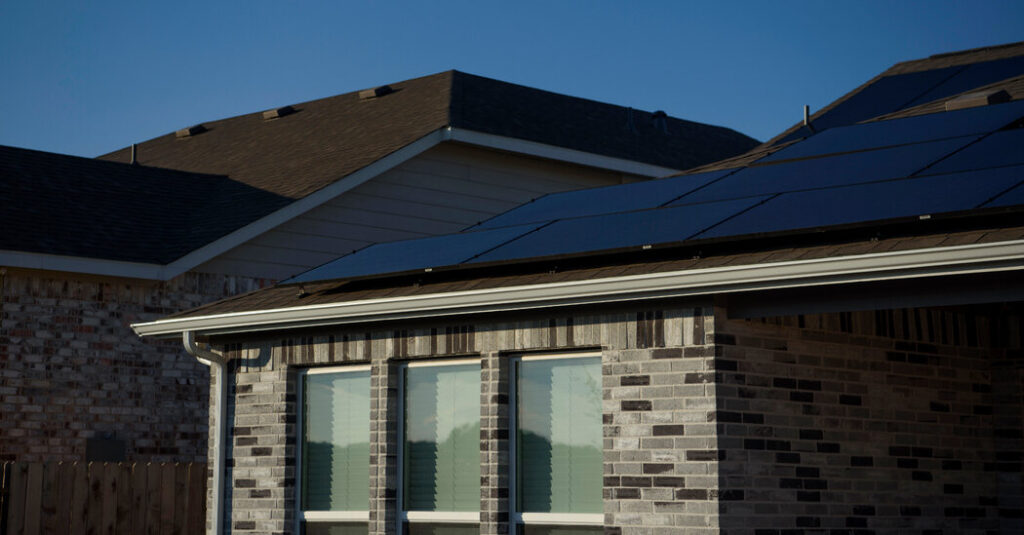
Last May, for instance, the agency backed away from a partial loan guarantee worth $2.92 billion to Sunnova Energy, a residential solar panel installer that was experimenting with a novel way to link home solar and battery systems. Sunnova, which filed for bankruptcy the next month, had been running into trouble even before Mr. Trump’s return to office because of high interest rates and reduced state incentives for solar.
In July, the Energy Department canceled a $4.9 billion loan guarantee for the Grain Belt Express, a planned transmission line in the Midwest that would have connected wind farms in Kansas with cities in Illinois and Indiana. The project faced opposition from Senator Josh Hawley, Republican of Missouri, who urged Mr. Wright to scrap the Biden-era loan guarantee.
In November, Plug Power, a company that aims to convert renewable electricity into hydrogen fuels, said it would suspend all work on activities related to a $1.66 billion federal loan guarantee that had been finalized during the Biden administration. The prospects for so-called green hydrogen have faded lately, particularly after Mr. Trump’s domestic policy bill cut tax incentives for the technology.
Other previously announced cancellations include loans or loan guarantees for KORE Power, a battery manufacturer; Redwood Materials, a battery recycling firm; and Aspen Aerogels, a company making novel insulation materials for electric vehicle batteries.
Trump Administration: Live Updates
Updated
- Trump to Expand ‘Mexico City’ Abortion Rule to Include D.E.I and Gender
- House Passes Spending Package Over Democratic Revolt on ICE
- 4 takeaways from Jack Smith’s testimony to Congress.
It is unclear whether any of the companies that had their financing withdrawn might try to appeal the termination of their loans. This month, a federal judge ruled that the Energy Department had illegally canceled seven energy grants that had been issued through other programs during the Biden administration.
At the same time, the Trump administration has sought to provide loans and financing for technologies it favors, like natural gas and nuclear power.
Mr. Wright has said he wants to use much of the agency’s remaining loan authority — estimated at more than $289 billion — to bankroll new nuclear plants as well as to support technologies like geothermal energy and mining for critical minerals.
The Energy Department under Mr. Wright preserved a $1.5 billion loan guarantee that the Biden administration had finalized to help Holtec International restart a shuttered nuclear plant in Michigan. The agency also finalized a separate $1 billion loan guarantee to help Constellation restart a closed reactor at Three Mile Island in Pennsylvania.
Other Biden-era loans have been modified or cast in a new light to reflect the Trump administration’s priorities.
The Biden administration had issued a conditional commitment for a $1.5 billion loan guarantee to Wabash Valley Resources, which was planning to produce low-carbon fertilizer in Indiana by burying the emissions from its factory 7,000 feet underground. The Trump administration ended up finalizing the loan but sought to emphasize the project’s use of coal rather than its emissions benefits.
The Trump administration also restructured a loan to Lithium Americas, which is trying to produce lithium carbonate for batteries in Thacker Pass, Nev., so that the federal government was able to take an equity stake in the project.
In some cases, Republican lawmakers have lobbied for projects in their districts.
In Great Falls, Mont., a company called Montana Renewables had secured a $1.67 billion loan guarantee from the Biden administration to expand a plant that converted vegetable oils and fats into diesel and jet fuel. Initially, the Trump administration paused the first scheduled payment. But last February, Senator Steve Daines, Republican of Montana, said that he had prevailed on the White House to unblock the funds.
The Energy Department’s loan office was created in 2005 to help emerging energy technologies, which often have trouble getting conventional financing, become commercially viable. It gained notoriety after it lent $535 million in 2009 to Solyndra, a solar firm that went bankrupt two years later. But it also gave a crucial $465 million loan in 2010 to Tesla, which grew into an electric vehicle powerhouse.
Mr. Wright has claimed that many of the Biden administration’s loan approvals were rushed, pointing out that the majority of deals were either finalized or received conditional commitments after Mr. Trump won the 2024 election.
Former agency officials, however, have said that projects go through exhaustive vetting. And some said that attempts to go after loan agreements could deter companies from doing business with the federal government in the future.
“If we get to conditional commitment with a loan program recipient, that’s the government’s credibility,” David Turk, the deputy secretary of energy during the Biden administration, said last year. “That’s the American people’s credibility on the line to follow through and make sure that we are providing that certainty for investment.”
Brad Plumer is a Times reporter who covers technology and policy efforts to address global warming.
The post Energy Dept. Says It Is Canceling $30 Billion in Clean Energy Loans appeared first on New York Times.